Disclaimer:
In spite of the following text being a critical review of the Involuntary Human Extinction Movement, and one that some might find a bit harsh, that is noncontradictory to my acknowledgment of the historical and priceless contribution of this movement for the originality, the pioneering spirit, the courage, the patience, and persistence, which serves as an inspiration for me as an activist.
The Voluntary Human Extinction Movement describes itself as a movement advanced by people who care about life on planet Earth, and don’t “carry on about how the human race has shown itself to be a greedy, amoral parasite on the once-healthy face of this planet”. They suggest that the “hopeful alternative to the extinction of millions of species of plants and animals is the voluntary extinction of one species: Homo sapiens…us.”
But despite this description, and of course their promising title, reading their materials, even only the basic ones, not to mention all of them, reveals a much less ambitious call. It appears more of a very radical ‘population reduction movement’ who is in favor of human extinction, rather than truly a human extinction movement, as I’ll exemplify and explain in the following text.
One example from their About The Movement section: “Each time another one of us decides to not add another one of us to the burgeoning billions already squatting on this ravaged planet, another ray of hope shines through the gloom.”
Each time another one of us decides to not add another one of us to the burgeoning billions already squatting on this ravaged planet, is clearly better than adding another one of us, but it’s definitely not another ray of hope that shines through the gloom, it is just another person doing what is morally demandable. The fact that they see it as another ray of hope that shines through the gloom, indicates how low the ethical bar they are setting for humanity is.
Notice that they don’t even say each time another one of us decides not to breed at all but only not add another one of us. While that’s fine for an ecological movement or population reduction movement, this bar is utterly insufficient for a voluntary human extinction movement. To seriously suggest that humanity would ever voluntarily choose its own extinction, they must at least set the bar much much higher than that.
Don’t get this wrong, I think they rightly expect so little of humanity, as the human race has proven all along history how morally unreliable it is so it is only reasonable not to ask much of humans. But that is exactly why it is so unreasonable to expect a voluntary human extinction, and why they should definitely omit the voluntary part in their name.
Another example for an extremely low bar can be found under Do Volunteers expect to be successful?: “The Movement may be considered a success each time one more of us volunteers to breed no more. We are being the change we want to see in the world.”
This ethically extremely low bar should barely be relevant for an ecological movement. The fact that unfortunately this low bar is currently too high even for the ecological movement, only further strengthen that it is absolutely hopeless to wait for a voluntary human extinction.
While lowering the bar makes sense regarding some issues, for example when it comes to environmentalism it makes sense to demand less of people so that more would adopt environmentally friendly lifestyle (such as asking people to give up a flight and prefer a local destination for their holiday rather than giving up their holyday entirely), in the case of extinction it doesn’t work that way. Obviously the less humans the better, but extinction is categorically different. Extinction is binary. Even if every person would choose to create “just one” person, it means (in population terms) that each person would be replaced, and unless for some reason people would start to die much younger (as opposed to the current course in which people die older than they used to) not only that the human population won’t go extinct, it would remain the same in the better case or more probably would keep growing.
With the current reproduction rate, a few more people who decide not to add another one of us is extremely far from the official goal of this movement. What is the point of establishing such a movement with such an aspiring name if it considers a success each time one more of us volunteers to breed no more?
If you think that the low bar isn’t necessarily indicative of VHEMT, which definitely aspires to human extinction, but of humanity and what it would never find acceptable, then it nevertheless is indicative of VHEMT. That is since if humanity would never accept such a high bar as voluntary extinction, it says something about the movement who nevertheless insists on asking humanity to voluntarily go extinct. It doesn’t make a lot of sense calling for something you think would never be accomplished.
Under Are some people opposed to VHEMT? they write that: “At first glance, some people assume that VHEMT Volunteers and Supporters must hate people and that we want everyone to commit suicide or become victims of mass murder. It’s easy to forget that another way to bring about a reduction in our numbers is to simply stop making more of us. Making babies seems to be a blind spot in our outlooks on life.”
Obviously I agree that human extinction can be brought about by other ways except everyone committing suicide or mass murder, as this blog’s goal is human extinction by forced sterilization. However, I highly disagree that making babies seems to be a blind spot in people’s outlooks on life. The fact that people usually choose how many people to create, and when, means that they know they can control it. People don’t choose to create people because making babies is a blind spot but because they want to. The problem is not that people don’t know that they don’t have to create people, the problem is that people want to make babies. It is not a blind spot it is a desire. And that is one of the reasons why voluntarily human extinction is impossible. The real blind spot is in VHEMT’s outlooks on humans.
Under What’s wrong with babies? Don’t you like babies? in the section Biology and Breeding, they write: “Considering the future world we are creating for future generations, procreation today is like renting rooms in a burning building—renting them to our children no less.”
While interesting and very powerful, this analogy is also very partial. It is not accurate to say that we are renting rooms in a burning building to our children, but that we are renting rooms in a burning building in which every living being lives, and to pyromaniacs. These children will not only suffer from the burns themselves but will intensify the fire and by that intensify the suffering of others as well. The madness in procreation is not only that people are renting rooms in a burning building to their own children, but that by that they are causing them to burn more and more rooms of more and more other sentient beings. The aim of this comment is not to niggle but to point out a very important aspect of the issue, since the more complete version of this analogy makes human extinction much more urgent. In fact so urgent that it can’t allow itself to wait for humans to do it voluntarily.
Further along this part they write: “Youth is a wonderful phase of life, whether it’s people, panda, or panther. It’s sad to imagine there being no more of any of them. A baby condor may not be as cute as a baby human, but we must choose to forgo one if the others are to survive.
Choosing to refrain from producing another person demonstrates a profound love for all life.”
This is not a case of love but of ethics and of justice. And it is wrong to present it as an issue of love. Not because love doesn’t exist or for being cheap sentimentalism or anything like that but because it turns the issue into affection contest between humans and other species. Not only that it is a tactical suicide, it is simply not the issue. It is not about who we prefer but who is the victim and who is the victimizer, who is more oppressive, who can choose otherwise and who can’t, who is more crucial to the ecological system, who is cruel despite that it is not necessary, and who almost never hurts others unless is it necessary. These factors, which all point at the obvious conclusion that the problem is always humans, are the ones who should be in focus.
Further in the section Biology and Breeding, as part of the answer to the question What about the human instinct to breed? They write: “Humans, like all creatures, have urges which lead to reproduction. Our biological urge is to have sex, not to make babies. Our “instinct to breed” is the same as a squirrel’s instinct to plant trees: the urge is to store food, trees are a natural result. If sex is an urge to procreate, then hunger’s an urge to defecate.”
I wish it was true, but it is so naïve that it is actually strange. According to this logic only people who are unaware of contraception, or people who had problems with their contraception and live in places where abortion is not an option, would breed. Clearly and unfortunately, this is not at all the case. Obviously people who are fully aware of the option of having sex without breeding, by using contraception, and of having an abortion in case of contraception failure, are breeding as well. They are not breeding because of an urge to have sex, but because of an urge to have kids. It is not an uncontrollable urge, evidently many choose when and how many times to breed, and some choose not to breed at all. However, for every person who chooses not to create another person, there are many who choose to force people into existence of extremely hard living conditions. People can separate between sex and breeding and they can have urges for each. The thing is that the urge to breed is not the only one. There are other urges, and other pressures, some social, some psychological, some biological, and some are cultural, who are urging people to control their urge to breed. Anyway my main claim for forced sterilization is not that people have an urge to breed which is uncontrollable, but if anything, it is exactly the opposite. Although it is true that if people were unable to overcome their biological urge to breed, it would make a very strong case for forced sterilization, I think that the fact that people can control their urge to breed but willingly choose to inflict so much suffering on others , including their own children, makes an even stronger one.
Still in the section Biology and Breeding, they offer an ingenious chart called Why Breed? which in addition to being creative and funny, it is also quite comprehensive, powerful and important, so I highly recommend everyone to read it.
And lastly regarding the Biology and Breeding section, they write that: “Cultural conditioning to procreate begins early and continues insidiously into adulthood. It’s so strong that most of us have never considered not breeding. It’s so pervasive that we don’t realize we’ve been indoctrinated by society to act against our own best interests. An instilled desire to create children feels natural, almost biological. A choice isn’t much good if we don’t know we have it.”
This is too easy and it can’t explain millions of people who are totally aware of the option not to breed and choose to do so anyway. Nowadays, many people are not only aware that they don’t have to breed, but also that some people think that they must not breed. Most choose to do it anyway. The problem is not that people don’t know that they have a choice, the problem is that they have a choice and most are always making the wrong one. So the problem won’t be solved if everyone knew that they have a choice, but if everyone won’t have a choice but making the right one.
In the section called Death they write that “the Grim Reaper is not Gaia’s knight in shining armor – he can’t just kill the stork. We are the potential heroes of this rescue. If enough members of the human family become vehement about preserving life on Earth, fair Gaia has a prayer.”
Opposing human extinction by killing is one thing, seriously claiming that if enough people would become vehement about preserving life on Earth, it can save it, is very peculiar, since even if most people become vehement about preserving life on Earth, all it takes for humanity not to go extinct is few who won’t. Again, the less people there are the better and so the number of people matters a lot, but in terms of extinction, as long as enough people would choose to procreate, there won’t be a human extinction.
Under the section Ecology they write: “Our voluntary extinction for the eternal good of all other life on Earth will be the ultimate demonstration of the best qualities of humanity: compassion and reason.”
I am curious which history books they have read because I fail to see when exactly the human race has ever shown compassion and reason. No other species goes to organized wars, not to mention so often and in humane scale, no other species enslaved his own kind since the beginning of its time (and in many places in the world still does), no other species constantly and systematically loots, rapes, conquers, bully, destroys and pollutes everything around it.
There was no point in history in which the human race has shown compassion and reason. And it had its chances. For example, humanity could long ago be a vegan species (definitely since the Neolithic Revolution). However, currently less than 5% of the human population is vegan, meaning 95% of the human race refuse to stop creating new sentient beings only to make them miserable for their entire lives so they can enjoy eating them. So to voluntarily extinct themselves so other animals could live?! Forget which history books, which hallucinogenic drugs one must be on to seriously suggest that?! People are not even willing to stop making more victims all the time and to stop making the lives of these victims more horrible, they are not willing to stop torturing others for the sake of their pleasure of consuming their meat, so suggesting that they would voluntarily remove themselves is absolutely delusional.
In this very section they themselves show that since 1600 CE humans have been responsible for most of animal extinctions, 23% of which caused by hunting, meaning that about a quarter of animal extinctions wasn’t caused by habitat destruction due to the human race’s destructive expansion, but by deliberate and intentional murders. The human race destructiveness and havoc is to such an extent that it is ridiculous to even dream of a voluntary human extinction. Instead we must wake up and think of involuntary ways to accomplish that.
But it is not exactly that this movement is unaware of who they are dealing with, as they write in the end of this section: “We have an opportunity to prove we can behave benignly despite our biological heritage. We may never be able to stop fighting with each other, exploiting the natural world, or giving in to other primal urges, but we can stop breeding and eventually our nature will be history.” Only that it’s exactly because people would never stop fighting with each other, exploiting the natural world, or give in to other primal urges, that they would never voluntarily stop breeding. And that is exactly why the human extinction movement mustn’t be voluntary and exactly why we must make them stop breeding and make their nature history.
In the section Success, under What will the world be like when our population starts getting smaller? They describe a very unrealistic reality:
“Shortages of resources are caused by longages of consumers, so the fewer we number, the greater our material wealth could be. Social justice demands a more equal opportunity to exploit Earth’s resources. A dubious goal, more easily achieved when there are fewer people to redistribute resources to.
Conflicts arise primarily out of resource shortages, so peace becomes more likely with fewer people occupying the same lands and drawing from the same wells.
Children will be more respected and better cared for as there are fewer of them. The appalling numbers of children dying today could be reduced to an ugly page in the history books.
Housing will become plentiful without building more houses. A sustainable civilization will be possible when we stop taking more than is being regenerated by Nature.”
Although, obviously the greater the human population, the greater the harms it causes, it is not that a smaller number of people, even significantly smaller, would abolish their harms. Had the human race population been smaller, the same kinds of harms would exist only on a smaller scale. The human race is a problem no matter what its scale is. If it would be smaller the harmfulness would be smaller and vice versa, but its harmfulness won’t disappear had its scale been smaller.
Evidently, there were wars, tortures, famines, rapes, plunders and any other horrible thing people are doing, when the human population was much smaller than it is now.
In fact, VHEMT contradict their own prediction in a different article called The myth of the “Noble Savage” in which they specify various examples of the human race amazing destructiveness, taken from its ancient past, when the population was much much smaller, and yet…
For example:
“According to Jared Diamond the Easter Islanders, Anasazi, Creeks, Middle Easterners, Hawai’ians, and sundry Polynesian societies wreaked large-scale and irreversible damage on their environments by destruction of forest, fauna, and flora.
He recounts how when Polynesians arrived around 400 CE, Easter Island was covered with palms, trees and shrubs. By 1500 CE the entire forest was extinct and the population, grown past the carrying capacity, resorted to warfare, tyranny, slavery and cannibalism.
Similarly, the Hawaiians drove to extinction at least 50 species of birds including sea eagles and several kinds of large flightless ibises, and completely wrecked the ecologies of the drier lowlands of the islands. In similar fashion, between 1000 CE and 1200 CE, the Anasazi at Chaco Canyon irreversibly deforested their surroundings to a distance of more than 75 km.”
And another one:
“In his book The Ecological Indian, Shepard Krech shows that the relationship between indigenous North Americans and the environment was ambiguous at best. For example, the Hohokam of southern Arizona powerfully modified the ecology of the Gila and Salt River valleys by way of huge irrigation works leading to the salinization and exhaustion of the soils, and the eventual collapse of their urban society.”
And one last example:
“Indigenous populations used fire to clear large areas of tropical forest well before the arrival of Europeans reports a new study published in Annals of the Missouri Botanical Garden. The research has important implications for understanding the impact of present forest development on biodiversity and forest regeneration in the tropics.
Using pollen, phytolith, and charcoal records to identify the distribution and composition of tropical vegetation and fire patterns over the past 11,000 years, Dolores R. Piperno of the Smithsonian Tropical Research Institute in Panama and National Museum of Natural History in Washington, DC, found evidence of widespread fire use for land-clearing by pre-Colombian populations in Latin America. Her work confirms earlier research suggesting the substantial impact native populations had on tropical forests long before European arrival in the New World.”
The human race destructiveness is obviously greater when their numbers are great, but it doesn’t stem from its quantity but from its quality. The quality of human destructiveness and cruelty affects the quantity of the destruction and cruelty in the world. A world where the human race population is much smaller would be much better than ours, but that is only because ours is so horrible. Only compared with a world as horrible as ours, a world with fewer people could be presented as the better option. But that doesn’t make it a good option, but a smaller hell.

Another interesting answer in the Success section is to the question: Is voluntary human extinction possible?:
“Our extinction is not just possible, it’s inevitable: billions of species have come and gone already.
But, will enough of us reach the level of awareness needed to voluntarily reverse our present course toward involuntary extinction? This isn’t likely, which is all the more reason not to create another of ourselves.”
The fact that it isn’t likely that enough people would reach the level of awareness needed to voluntarily reverse our present course toward involuntary extinction, isn’t merely all the more reason not to create another of ourselves, but mainly all the more reason to ditch the voluntary part. Otherwise all the horrors would keep occurring.
A lot of good movements with good ideas, good motivations, good premises, high internalization of the problems and etc., at the end of the day are summed up with ‘the change starts with us’ and ‘at least let’s not be part of the problem’. But not creating another of ourselves is not not being part of the problem since as long as we know what’s going on in this horrible world and are not doing something to stop it, besides the ethically obvious and very undemanding decision not to make the problem bigger, we are part of the problem, or at least definitely not part of the solution. Not creating another of ourselves is choosing not to increase the immense problem, it is not choosing to decrease it, not to mention trying to solve it. Trying to solve it means first of all realizing that it is not likely that enough people would reach the level of awareness needed to voluntarily reverse our present course toward involuntary extinction. VHEMT state that they do, but act as if they don’t. As the name not only implies but spells it out, this movement is for voluntary human extinction, meaning they want to see the human race go extinct. This is not going to be achieved by some people who decide they are not going create another of themselves, but by some people who decide that none is going to create another of themselves. Human extinction would be achieved by some caring and devoted people who would make everybody sterile. Not because the human race deserve a punishment for all the horrors it caused all along history, but since there is no other option but an Involuntary Human Extinction Movement.
Finally, in the section called Failure they write: “We could slow down, stop, and reverse our direction, avoiding the tragic destination persisting despite our best denials. Just because we never have doesn’t mean we never will.”
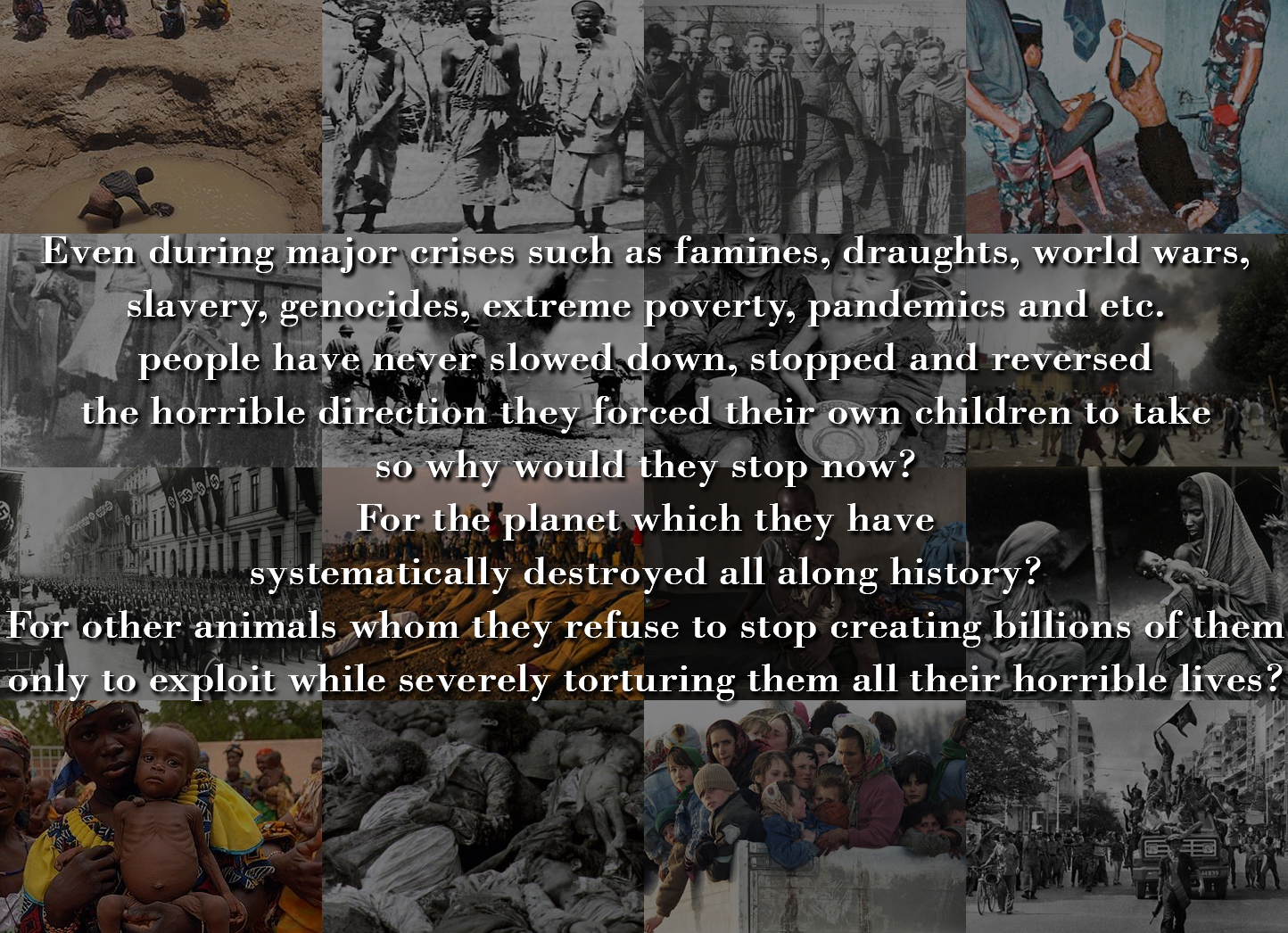
It is not that humanity never have, it is that it always did the opposite, and that does mean it never will. Even during major crises such as famines, draughts, world wars, slavery, genocides, extreme poverty, pandemics, and etc. people have never slowed down, stopped and reversed the horrible direction they forced their own children to take, so why would they stop now? For the planet which they have systematically destroyed all along history? For other animals whom they refuse to stop creating billions of them only to exploit while severely torturing them all their horrible lives?
Humans won’t voluntary slow down, stop, and reverse their direction. The only chance to reverse their direction is if they would be involuntarily stopped.
We can’t ensure that humanity won’t develop technologies which can overcome the forced sterilization method whatever it would be, but clearly the longer we wait, the more realistic it is that relevant technologies would be available. The longer we wait, the better human technology gets, therefore we must sterilize humanity as soon as possible because then it would give them only a few more decades to try to overcome it from our current level of technology. Waiting would give them a better starting point. The longer we wait, giving chance for the unethical voluntary based options which condemn trillions of sentient beings to life of suffering, the harder it would be to do it later. Eventually the most caring people would conclude that we must implement involuntarily options since other options are simply irrelevant. Waiting is dangerous. It is dangerous not only because it allows the human race to meanwhile keep growing and growing, but also because it tackles the real option of human extinction, an involuntarily one.
References
Leave a Reply