Author: anadmin (Page 5 of 8)

A Tragic Argument

The following text is the third critical review of a book by the philosopher Julio Cabrera.
The first one addressed his outstanding book A Critique of Affirmative Morality.
The second one addressed his book Because I Love You, You Will Not Be Born!
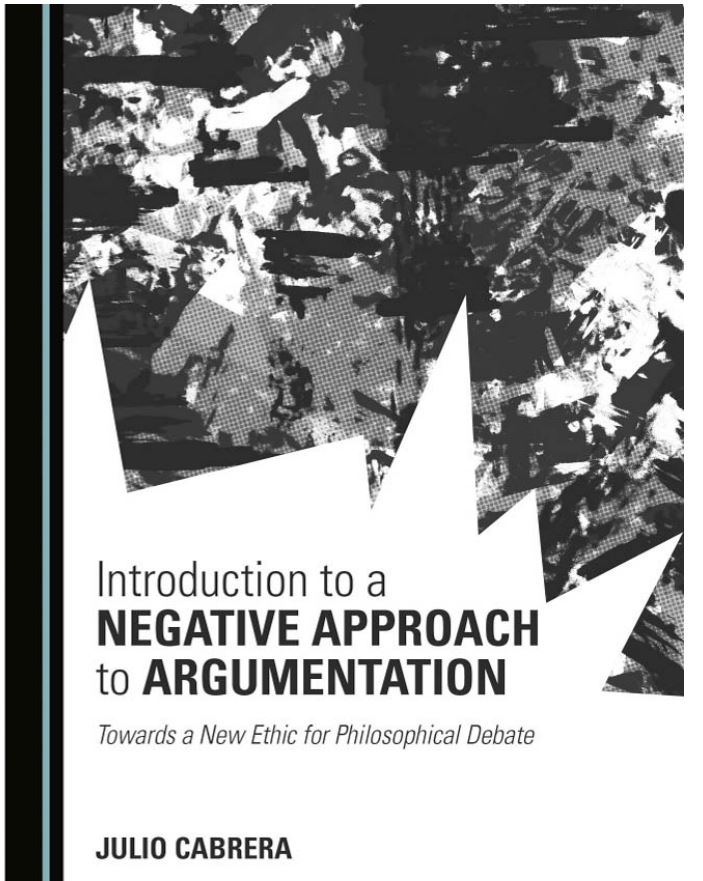
And this one addresses the book Introduction to a Negative Approach to Argumentation – Towards a New Ethic for Philosophical Debate.

After criticizing what he refers to as ‘affirmative ethics’ and the very possibility of being ethical in his monumental book A Critique of Affirmative Morality, Cabrera criticizes what he calls ‘the affirmative approach to argumentation’ and the very possibility of making a universally true argument that everyone must logically accept. In a way, his book about affirmative morality is kind of lamentation for ethics, and the book which is the subject of this text does a similar thing to argumentation. In his book about ethics he writes that morality necessarily leads to an impasse, and in this book that argumentation necessarily leads to an impasse.

The Affirmative Approach to Argumentation

Cabrera is critical of philosophy’s ‘Affirmative Approach to Argumentation’ which according to him seeks a unique universal “truth” in argumentation while aiming at proving wrong any opposing view or the option of several “truths”.

Cabrera wonders how is it that the greatest minds of all history haven’t yet reached the right answer about so many philosophical questions, and suggests that it is because so far philosophy aimed at one true answer and rejected the possibility of multiple answers.

“The “affirmative approach” consisting basically of thinking that philosophical queries have a right solution, or, at least, an adequate approach among many others that are inadequate or wrong. What we notice, even with “great philosophers” in classic and present times, is a remarkable concentration on their own positions, as they maintain a strong belief that they are providing an adequate approach to the debated questions and they reject, sometimes summarily, the alternatives. The affirmative approach sustains a meta-philosophical view of the plurality of philosophies as a scandal and a mistake which must be resolved in some way.” (Page 4)

And the way philosophy suggests to resolve that mistake, is according to Cabrera, by an affirmative argumentation process. Any argument theory has to go through six steps, one way or the other, which are:
(1) Determining the existence of an argument – first there is a need to check whether there is, in fact, an argument at all, as it could be that the case is of an unstructured mixture of statements, or a declaration of intentions, or an emotional expression.
(2) Determining the existence of an arguer – there must be someone who advances the argument and defends it, taking the burden of proof and assuming the responsibility for the argument.
(3) Reconstructing the argument – the arguer has to try to reconstruct the argument in question through argumentation schemes showing whether there is only one argument or many, which argument is central, whether an argument is a sub-argument of another, which are the relevant premises and which are the expected conclusions and so on.
(4) Making terms and premises clear – the arguer has to question whether there are terms to be clarified or defined in the reconstruction carried out in step 3; it is also necessary to expose the assumptions and the premises whose truth will be accepted without argument.
(5) Testing the argument’s correction – do conclusions effectively arise from premises and assumptions? How about the quality and reliability of the inferential passage? Is the argument convincing, cogent, overwhelming? Does it set forth its conclusion?
(6) Testing the aims of the argument – the argument might not have any impact on the audience being targeted and in that case, if purposes are not accomplished, the argument fails. The agreement or assent of the target audience can be crucial to many types of argumentation and, perhaps, to all of them.

The main reason Cabrera criticizes the affirmative approach and suggests an alternative approach to argumentation, is not because of fundamental flaws he inspects in the above formulation. He agrees that this is basically how argumentation should be performed, however he is crucially concerned with what actually happens in real philosophical arguments.
Cabrera inspects a major flaw in the affirmative approach to argumentation not necessarily as a result of major flaws in formal or informal logic, but in the insistence that inspecting arguments with ideal norms of logic would provide one right answer that no one can counter argue, a scenario that according to him never happens, and can never be guaranteed.

The affirmative approach to argumentation is affirmative in the sense that according to it, the answer to the question – can philosophical questions be resolved by argumentation, is affirmative, while according to Cabrera the answer is negative.
Naturally, each side of the argument aspires to assume the best arguments, but according to Cabrera an argument can be considered right or wrong only from a certain perspective, and there is no neutral or objective authority (such as God or a super-computer) that can decide between different perspectives as to which of them is the unique one for solving the philosophical issue.

Therefore, according to Cabrera, endless confrontation and conflict between arguments and counter-arguments is intrinsic to the very process of argumentation, which usually ends in an impasse.
Cabrera emphasizes that the problem is not necessarily that argumentation does not follow rules, but that in each one of the six steps of argumentation specified above, each side can use each step to open new lines of counter-argumentation, following the rules. Cabrera exemplify:
“Let’s take, for instance, step number 1, the very existence of an argument. From certain perspectives and assumptions there exists an argument which is perfectly inexistent from other perspectives and assumptions;”. (page 21) According to Cabrera whether there is a real issue to be subjected to argumentation is not something that can be decided in absolute terms, and he exemplifies: “in a debate on abortion, for example, the very “abortion problem” might not even exist for a religious arguer who considers the criminal nature of preventing the development of a foetus totally evident. For him, there is nothing to be argued at all.” (page 21)
And indeed we see that quite often in antinatalist debates, many pro-natalists are not convinced that there is a problem to begin with. As far as they’re concerned, life is good and it is good to make more of it.

And that’s only the first step. The second step – who has the burden of proof, is another example for something we often encounter in antinatalist debates as many antinatalists argue that the burden of proof is on the people who choose to procreate since the burden of proof applies to anyone who makes a positive claim, and pro-natalists simply presuppose that procreation is good despite that it was never questioned, let alone proven to be good.
Pro-natalists on the other hand argue that the burden of proof is actually on antinatalists as they are the ones who are challenging a perceived status quo, they are asking people to stop doing something so natural and that was done since forever.

Cabrera argues that the “Affirmative approaches to argumentation assume a highly rational conception of a human being, as a cooperative agent disposed, in principle, to engage in a critical discussion aiming for a reasonable solution to differences via argumentation and, when necessary, leaving their subjective and personal interests aside.” (Page 54), while actually and frustratingly, everything can be, and practically is, counter-argued according to the motives and the perspective of any opponent to any position.
In Cebrera’s words:

“Whatever our attitude may be concerning these stances, however unusual or even extravagant, one cannot deny that the defenders of these positions are able to advance arguments in their favour that can be regarded, under certain assumptions, as strong and deserving of reply. It is always possible to oppose an argument. Therefore, the very notion of a “counter-argument” must change in the negative approach, because counter-arguments are always available for any given argument; if counter-arguments are not advanced, this is not due to strictly argumentative reasons. There seems to be no argument without potential counter-arguments. Terms, premises or sequiturs can always be challenged or rejected, however well-defined or “sound” they may appear to their defenders.” (Page 24)

And to make things even more frustrating he argues that:

“The same way that it is possible to look at something without really seeing it, or hearing without listening, so it is possible to understand one concept without thinking with it; in a sort of conceptual blindness. Similarly, as some visual organizations of pieces make some particular perceptual associations easier and others more difficult, some organizations of concepts promote some specific kind of thinking and make others difficult or even block them completely.” (Page 33)

So according to Cabrera: “An informal logic theory that applies only to cases where there are expressive agreements at the point of departure, and therefore high expectations that one side will simply accept its defeat at the end, seems a rather narrow scope theory.” (Page 71)
In reality crucial problems do not arise only because and when arguers “do not follow the rules” or because they “commit fallacies”, but disagreements, misunderstandings and impasses are or can be preset at every moment during the process of argumentation, even when all the rules are strictly followed.

For these reasons and more, he argues that the affirmative approach to argumentation is false and a negative approach to argumentation is needed.

The Negative Approach to Argumentation

The fundamental ideas of the negative approach are as follows:
Arguments cannot be solved in a unique, correct way. Arguments can be solved correctly in many different ways. Contradictory conclusions don’t eliminate each other but both may be true at the same time, according to their own conceptual organizations (Gestalten), as long as they follow the steps required to present a possible line of argument. There are many ways of being right and not only one. There are always other lines that can act as a counter-argument to the line initially presented, therefore philosophical discussions are endless.
In the negative approach, the other arguers are not enemies who, with their lines of argument come to destroy mine, but only arguers who reason following other possible lines of argument, and that, from other assumptions, reasonably arrive at other outcomes different from mine.
The domain of argumentation therefore has no self-support. (Page 37)

And the general features of the negative approach to argumentation are:

“(1) We do not know what reality is, or even whether it is unique or multiple; but we know that reality presents itself as shattered and organized in many ways, all of them subjective, none of them unique. (The ontological thesis.)
(2) The different philosophical theories unveil and point to different aspects of reality, but only from their respective organizations. Thus, none of them fails, all of them succeed. They only fail in their attempt to depict the sole truth, transforming their perspective in “what the world really is”. (The epistemological thesis.)
(3) All philosophical theories are tenable in their own terms and they are systematically wrong or inadequate in other theories’ terms, but there is no neutral domain where this tenability could be conclusively and absolutely settled or decided. (The logical thesis.)
(4) Our theories are only perspectives among others, positions among others, without any kind of privilege. They are not the best theories just for being our theories, and they are not correct just because we were able to formulate them properly. In the negative approach, the impression that one’s own theory must be the best and others’ wrong, is nothing except a psychological delusion with no logical support. (The psychological thesis.)” (Page 39)

As opposed to the affirmative approach which assumes that at some point one arguer must prevail over the other by providing the better arguments, the negative approach sustains that all arguments have flaws that can always be stressed by counter-arguments. And counter-arguments according to Cabrera, can’t eliminate or rebut the arguments they challenge since they too are only additional arguments in the web of arguments. They can only reshape, reformulate or relocate an argument in relation to other arguments.
In that sense, and given that there is no external objective unbiased authority that can decide, philosophical discussions according to the negative approach are virtually endless. They end as a result of fatigue, frustration, lack of motivation or interest and etc., but not because one of the standpoints rebutted and eliminated the other.

Therefore Cabrera’s negative approach aims to:

“present and develop the logical position that we assume when we learn to “look around” beyond our own stances, seeing the alternative and decentralizing our own viewpoint, abandoning the intention to occupy the privileged space of unique truth. The negative approach prefers to place ones’ own perspective within a very wide and complex holistic web of approaches and perspectives that speak and criticize mutually without discarding one another, even when each position may fiercely maintain its own perspective supported on defensible grounds.” (Page 5)

One of the problems with that aim is that it is technically impossible to really get out of one’s subjective view. In the best case, one can only realize that its view is subjective and there are other views which might be right just as much from their point of view. But there is no real option for “decentralizing our own viewpoint” as each person’s view is necessarily a centralized one, even the very view of decentralizing one’s own viewpoint. Even when a person is trying to view others’ views it is done from that persons’ viewpoint. No one can really launch itself to other people’s conceptual organizations (Gestalten) and assumptions. This approach can be a good practice for understanding others and even to convince others of one’s own viewpoints, but these are public relations and activism claims, not philosophical ones. The problem of the centrality of our own viewpoint and its effects on the way that everyone absorb information and other viewpoints, can’t be solved by stating there is a need to “decentralizing our own viewpoint”, as this is by definition a mission impossible. It can be effective against dogmatism but it can’t be a recipe for how to do philosophy since if the idea is that every philosophical position is necessarily a result of the standing point of the person holding that philosophical position, then the look on other philosophical positions would still be from the standing point of the person looking at other positions. The decentralization would necessarily remain centralized. We need a decentralization of the decentralization to really decentralize our own views. This aspiration is an endless regression of decentralization.

But of course, the main problem with the negative approach to argumentation is not that it is technically problematic, but that it is utterly ethically problematic, being too tolerant towards alternative viewpoints no matter how cruel and harmful they may be. That flaw is clear to Cabrera who argues that the opposite approach is worse:

“In affirmative approaches, the crucial problem is to be too intolerant concerning the alternative. The crucial risk of negative approaches is just the opposite, being too lenient about them. Both approaches are problematic, and must decide not by a totally risk-free approach, but by a risk we are well equipped to deal with. The option taken by this author is that it is better–logically and ethically–to have an excessive tolerance than an excessive intolerance. But this is not absolute either, just an option in a world where there are no absolute and risk-free solutions totally satisfactory to all parties involved.”

However, I am not sure that the case is of the negative approach to argumentation merely being excessively tolerant. I think that for many it may seem as a theory that goes way further than that. Cabrera understands that his approach may be interpreted as a form of, or at least as supportive or an intensification of Moral Skepticism, Ethical Subjectivism, Moral Relativism and even Moral Nihilism, so he tries to explain why it is none of the above.
To not make this text too long and too complicated, as well as not to deviate from the main and more interesting issue of the book, I decided to add an appendix to this text with some relations to the issue of the negative approach to argumentation being too tolerant to the point of Ethical Subjectivism, Moral Relativism, Moral Perspectivism and etc. You can find it here.

So assuming, at least for the sake of the argument, that the negative approach is truly none of the above, its derived practical conclusion is still very disappointing. Similar to the book A Critique of Affirmative Morality, in this book as well, the criticism is super radical and the descriptions of reality are very sharp and raw, however the conclusion is feeble and deficient. After shredding affirmative ethics and any option to live ethically in A Critique of Affirmative Morality, his conclusion and suggestion derived from negative ethics was merely ontological minimalism. And in Introduction to a Negative Approach to Argumentation, his conclusion and suggestion derived from the negative approach to argumentation is merely a pluralistic stance towards other philosophical ideas and adopting what he calls the Tragic Negativism.

Tragic Negativism

According to Cabrera, argumentation is not a scene of debate between right and wrong but actually a tragedy:

“The attitude that I prefer to assume in this book concerning the negative approach to argumentation is in-between nihilism and indifference. I call it argumentative negativism. It could also be called tragic negativism, in the sense that the difference between tragedy and drama is that in drama one of the parties is good and the others are bad (heroes and villains), whereas in tragedy we find good people on both sides. This means that, in tragedies, someone good and fair will inevitably suffer or die. In the domain of arguments, tragedy appears when we know that we are rejecting a perfectly plausible and tenable posture; we reject it not for being bad, but because we prefer to sustain another perspective maybe incompatible with the other. Like in tragedies good people die, in tragic argumentation good lines of arguments are rejected.” (Page 182)

The tragic arguer is aware that:

“there are dozens of circumstances and contextual elements of character, prevailing values, education, influences, simplicity, fertility, life assistance, social or cultural pressures, pure aesthetic taste, laziness, error, etc., which lead us to prefer one philosophical position over others. We are not driven to it only by the pure force of reasoning; and if somebody demands that we justify our presuppositions, new lines of argument will have to be opened.” (Page 185)

Having said that, according to Cabrera, the negative approach doesn’t mean one cannot adherently hold moral positions:

“The negativist view does not prevent us from arguing vehemently and convincingly in favor of some position to which we strongly adhere. We, for instance, may take a position in ethics favorable to pointing out the moral problems of procreation, abortion, the value of human life and correlated objects we can take a very determined stance on these issues and others, putting all kind of objections to optimistic postures concerning human life. But we do this because we decided–for a series of reasons–to take this line of argument and not another, not in order to defend an objective, unique and irrefutable truth, eliminating alternatives. We simply feel ourselves affectively and intellectually very close to this type of position and adopt it. (although this offends our intellectual narcissism: we would have preferred to have chosen our positions based on deep and necessary reasons.)” (Page 186)

But I don’t understand how one is supposed to adherently advocate for moral positions realizing that others may be right from their own standpoints? If they are right then I am wrong trying to convince them. The negative approach says that it is ok to vehemently hold moral positions while it’s supposed to neutralize or at least dramatically weaken any attempt to convince others, because from their own standpoints they might be right.

People can’t adherently advocate for moral positions under the realization that their position is just another one among many other ideas and it might be wrong just as much. It indeed might lead to indifference, as Cabrera suggests, or to a mental state in which argumentation is actually an intellectual mind game, a rhetoric contest, instead of a crucial ethical discussion.
And evidently Cabrera writes that “Discussions do not have to become a matter of life and death.” Only that all ethical discussions are matters of life and death. It is not the only peculiar claim in the book but it is probably one of the strangest as it is coming from the person to whom mortality is of the most central arguments against procreation. How can a discussion about procreation be anything other than a matter of life and death? And obviously you don’t have to include mortality as one of your central reasons for being an antinatalist for it to be a matter of life and death, as it is in the name. Regardless of the mortality issue, creating a new life is by definition a matter of life and death. And the same goes for abortion, ending life, capital punishment, animal rights, racism, feminism, and every other important ethical issue. They all are matters of life and death and that’s how we must treat them in ethical discussions.

Perhaps Cabrera’s cynical approach comes from his position about argumentation’s origin:

“Arguing is part of our mechanism of survival; we need to argue as much as we need to breathe. Argumentation aims to construct a position that is both an expression of our personality and an explanation of some relevant aspect of reality. In this delimitation of my own argumentative space, the animal drive of life makes me want to destroy other positions or show they are wrong and should be replaced by mine. Thereby I fail to see that others are doing the same as I do: expressing themselves as singular beings, constructing their values, trying to point to aspects of reality from different perspectives. The problem is that such constructions are mutually opposed and this fact encourages the idea that one of them has to prevail over the others by eliminating or replacing them.” (Page 190)

In other words, arguments are mostly if not entirely about the arguers and hardly if any about the issues. People do not use arguments simply for the pure desire to “resolve differences of opinion”, but as a form of defining themselves. They choose values to distinguish themselves, and are using argumentation as a form of expressing themselves and creating rapports with other people.

In Cabrera’ words:

“being a good arguer powerfully increases our self-esteem, especially through the victories we reach in discussions. The rational conception–the more usual in books of logic, even informal–address humans as if they were in a very comfortable and controlled situation where they can be reasonable and objective, with little sensibility to the frictions and insecurities of existence, to the uneasy and arduous domains where humans have to make their arguments through crucial decisions while trying to build their own value.
In logical studies, in particular, we easily forget that we are human animals, sensible beings with a vulnerable body and urgent needs. Our argumentation practices are not placed in a clean and quiet heaven but in concrete circumstances of hard living. We are forced to be defensive and expansive (and even dangerous in some situations) to others; we cannot be totally objective or neutral, but we need to be partial (or even tendentious) in order to survive, not, say, by hunger or physical pain, but by the need to protect our intellectual productions and to create an intellectual prestige within our very demanding communities; we need good self-esteem and intellectual recombination in the same way we need bread.” (Page 57)

I am not yet cynical enough to think that about all arguments, but I agree that this description is unfortunately mostly true.
And I also agree with the pessimistic premise of the negative approach to argumentation that arguments are never resolved, let alone universally and permanently:

“Two human beings engaging in a discussion about philosophical question are naturally and perforce going to differ in substance and method on almost any topic. What is the point in trying to impose one’s own perspective? I see no reason for trying to destroy the other’s lines of thought, even if regarded as absurd, untenable or dishonest.” (Page 6)

Of course there is a reason for trying to destroy the other’s lines of thought but not because it is absurd, untenable or dishonest, but because the other’s lines of thought might be extremely harmful. What is the point in trying to impose one’s own perspective? The answer is that maybe it would reduce suffering in the world.
But the more interesting and relevant question is not if there is a reason for trying to destroy the other’s lines of thought but is that option reasonable? And the answer in most cases is unfortunately No. And if two human beings engaging in a discussion about a philosophical question are naturally and perforce going to differ on almost any topic what is the point of having it in the first place?

A Psychological Negative Approach to Argumentation

You don’t have to agree with Cabrera’s radical philosophical argument regarding argumentation, but you have to agree with what can be seen as a radical psychological argument regarding argumentation.

“The crucial phenomenon is that, whatever our topic of reasoning, the opponent will have always a reply at hand, and we will have a reply to his/her reply if we are not prevented from counter-arguing by external means (violence, illness or death). Even the most seemingly indefensible stance, which would appear to have been totally impaired and unable to provide a counter-argument–by the accumulation of evidence–can always emerge from the ashes and present a defense.” (Page 18)

That means that even if we’ll be able to construct a much more valid and coherent argument than our opponent (which might construct a poor and incoherent argument), as far as the bottom line goes, it doesn’t matter if Cabrera is right that we don’t convince the other side because s/he is actually right from its own perspective or despite that s/he is wrong, as practically we are failing in convincing others.

I disagree with Cabrera that the reason we fail to convince others is because their arguments are right from their perspective. I think the reason is not their philosophical arguments but their psychological motives. Cabrera criticizes the affirmative approach for treating people as rational beings but it seems that he is making the same mistake. Most people are not convinced by our arguments because they are motivated to sustain their positions which reflect what they desire, not because they see things differently and cannot see them as we do.

It seems that he thinks that different stances can be equal in a metaphysical and logical sense and I think they can’t. But I do think they can be equal in a psychological sense. Meaning, different standpoints can be right or wrong from an objective and logical point of view, but at the same time the very same standpoints can be equally strong from the psychological point of view of each arguer, in the sense that opposite sides can hold different standpoints in an equal strength despite one being philosophically weak and the other philosophically strong. I am not a pluralist when it comes to moral stands but I believe that my opponent may hold its stance in an equal strength to me holding mine, and that we can never resolve our argument as long as the motivations differ.

Even if, like me, you disagree with the negative approach to argumentation on the philosophical level, you must agree that there is certainly much value in its arguments on the psychological level. Even if, like me, you disagree with the philosophical argument that the other side may always be right because it has its own perspective on the issue, clearly the claim that the other side won’t be convinced because it has its own perspective on the issue, is almost always right. I don’t think that it stems from one side holding an argument that is as rational and as valid as the argument of the other side, but from having as strong motivation to keep its arguments as the other side. And strong motivations are stronger than strong arguments, since arguments at least theoretically can be reconstructed, but it is hard to change a motivation, let alone using rational tools. The power of pro-natalism is not argumentative but motivational.
I don’t share the view that it is impossible to defeat arguments, but I do think that it is almost impossible to defeat motivations.

Cabrera argues that just like in the case of ethics:

“the affirmative approach thinks that ethical defects are the product of some internal malice of human beings. The negative approach to ethics holds that it is the external situation in which humans are placed that causes ethical defects. It is not that humans were placed in a good world that they destroyed, but they were placed in an adverse world whose difficulties cannot be morally resolved. The same occurs in logic: the affirmative approach holds that arguments can be perfectly resolved, but that humans obstruct this resolution with their fallacious behavior. The negative approach to logic holds that humans were placed in a situation that cannot be resolved by argument, where any argument they present will have to face endless counter-arguments.” (Page 41)

Cabrera seems to blame the situation and not the people, but it is not as if people yearn for the truth only that the truth doesn’t exist, but that people are not really that into the “truth”. They are into what they are into and if that is opposite to the “truth” then not their desires but the “truth” is compromised for the sake of the desires. When people encounter an inner conflict they usually rearrange the “facts” so they would suit their desires, not the other way around. People are not truth seekers, they are motivated by inner psychological and biological derives.

People are not the major victims of the state of moral impasse, the creatures who people severely affect, are. Even if the situation would change, for example by developing a super intelligent entity that would function as an external objective authority which would make moral decisions for people instead of them arguing forever, people’s motivations would still prevail. For example, people don’t eat meat because their Gestalt makes them think that this is the right thing to do, evidently, different people from similar Gestalts, reach different conclusions regarding eating animals. People eat animals because they want to, not because they think they ought to. The same goes for procreation. People don’t breed because they think it is the right thing to do, in fact most breed without thinking it over at all. And they do so because they want to and are built and designed for it.
People’s positions are founded on the basis of their desires, not the other way around. Humans rationalize their desires, their desires are not a product of their reason.

I highly disagree with the implication that humans are innocent beings who are forced into a horrible situation, and think that they are horrible beings who are forced into an impossible situation which they made much much worse. However, the bottom line of the case in point is that it is truly a situation that cannot be resolved by argumentation.
People are forced into a situation in which they are asked to make claims about moral issues as if they are objective, nonbiased, non-motivated, weren’t educated and indoctrinated in certain ways, and have no prior information and inclinations – despite that it is impossible.
I don’t exempt people from responsibility as most of them are lazy, ignorant, shallow, and are not willing to make even the tiniest effort to educate themselves or even listen to the other side before making judgments, however, I agree that even if they did, the situation would still be impossible.

Cabrera’s statement in the last quote is an admission of a known in advance failure. And therefore a very good reason to never procreate. Even if you are sure that humans are innocent beings who are forced into a horrible situation, and all the more so if you agree that humans are horrible beings who are forced into an impossible situation which they made much much worse, in any case antinatalism is the self-evident conclusion. People must stop procreating so to avoid the need to determine moral issues which they anyway can’t resolve.
That argument may sound contradictive as seemingly this is a determination in favor of antinatalsim derived from the inability to make an argumentative determination, however, I am not claiming here that we must determine in favor of antinatalsim because it is the right moral stance (although in my view obviously it is), but because we must avoid the need to determine moral issues since it is impossible according to the negative approach, and antinatalsim eventually leads there. From that perspective, antinatalism is merely the mean to avoid the inevitable impasse consequence of trying to determine moral issues, and not a decision in favor of a specific moral stance.

Another aspect of the impossibility of ethics is, as before mentioned, that as opposed to the affirmative approach, in the negative one “arguments can be carried on indefinitely by both parties, not only because participants are strategic, fallacious or acting in bad faith, but because arguments and counter-arguments can always be advanced from each party without reaching a strict argumentative solution.” (Page 42)
If the fact that argumentation is bound for eternal dispute without ever being resolved had no negative effect on anyone in the world, then existence would still be senseless, purposeless, pointless and amoral, but at least not so ethically horrifying as it actually is. The fact that moral discussions are bound for eternal dispute without ever being resolved and they do have a tremendous negative effect on trillions of sentient creatures, is what makes Cabrera’s claims additional reasons to why this world can’t be morally justified.

The idea that there is no real option to conduct philosophical discussions, especially ethical ones, shouldn’t derive to pluralism but to fatalism. The fact that humans are incapable of understanding the world they live in, and are totally incapable of reaching agreed upon moral decisions, has dire consequences that daily affect billions of suffering creatures.

Although I disagree with Cabrera’s philosophical pluralism conclusion, I do agree with most of his claims regarding argumentation from the psychological angle. Therefore I see no point in addressing the general public, trying to convince each person to be an antinatalist. Instead, I am trying to convince antinatalists to forsake the futile attempt of addressing the general public trying to convince each person to be an antinatalist, and focus on ways to make the general public antinatalist regardless of each person’s opinion about antinatalism.

Due to all the reasons Cabrera specifies along the book regarding the pointlessness and impossibility of convincing everyone to accept a certain position no matter how right it is, I am calling antinatalists not to be ‘tragic arguers’ but effective activists. Desert the senseless attempt to change the minds of all people and focus on changing their reproductive parts. We will not prevent procreation by argumentation, but we might do so by non-argumentative means.

Cabrera ends his book with the following paragraph:

“Ultimately, maybe argumentation is not the proper field for deciding crucial questions (as, say abortion, the abolition of slavery or the death penalty); argumentation does not occupy, as traditionally said, the place of reason and objectivity, but a new place for human passions and a will to expand, now expressed in rational terms. We may be totally convinced of our point of view (for example, that in abortion we always kill a human being, that the abolition of slavery was not due to ethical reasons but to economic calculation, and that the death penalty offends human dignity). We can sincerely think that our arguments are really stronger than the opposite ones and see them as simply displaying the truth and rejecting error. But the brute fact is, that in front of us there is always the possibility of another arguer having counter-arguments and oppositions to each one of our points, and that we have no neutral space to decide that our strong convictions definitively settle the matter. This may suggest that argumentation is not the ultimate domain to resolve differences, especially when they are strongly controversial; that a domain beyond argumentation should be opened, not eliminating argumentation but going beyond it in a way that is different from merely kicking the board.” (Page 195)

Given that the “game” is pointless and absurd, and that it is not at all a game but a real immense and endless tragedy, kicking the board is exactly what we must do. I totally agree that argumentation is not the proper field for deciding crucial questions and that a domain beyond argumentation should be opened, but not one that is different from merely kicking the board, but one which aims exactly for that – kicking the damn board so hard that no sick game could ever be played again.

References

Cabrera Julio, A Critique of Affirmative Morality: a reflection on death, birth and the value of life
(Brasília: Julio Cabrera Editions 2014)

Cabrera Julio, Introduction to a Negative Approach to Argumentation – Towards a New Ethic for Philosophical Debate
ambridge Scholars Publishing 2019)




A Moral Mapping of Immorality

The philosopher Julio Cabrera, which I have previously addressed, has another book translated into English. It is called Because I Love You, You Will Not Be Born! and it is a joint reflection about procreation, written with Thiago Lenharo di Santis. The book is half philosophical essay and half novel, aiming to examine what its authors view as the coldness and detachment with which thousands of humans are dumped daily on planet Earth, just for the distraction of their parents or as a mere involuntary product.

The first part is mainly dedicated to Cabrera’s structural mortality claim which I’ve addressed in the post about the book A Critique of Affirmative Morality.
The second part is dedicated to considerations about the decision to generate a new being from the point of view of the ones who are about to be born. This part is written by Thiago di Santis.
The third and last part is called Letters of Abstention and is a fictional correspondence between a young negative philosopher and an austere teacher.

Unfortunately there are relatively few antinatalist books so there is no reason to choose between them, yet if you have to choose just one of Cabrera’s books translated into English, I highly recommend reading Discomfort and Moral Impediment which is undoubtedly one of the best books I’ve ever read.
However there is an unmissable part in Because I Love You, You Will Not Be Born!, surprisingly in the exchange of letters part of the book, where one of the writers decides to synthesize the many questions and discussions detailed along the text, in a table. That is done in hope that after seeing everything together, it becomes clear how sadistic and unscrupulous the procreative attitude is.

Here is the moral mapping of procreation:

Attitude of not having children: Attitude of having children:
One makes a sensitive and reflected consideration of the implications, possibilities and perspectives involved in the act of procreation. An unreflective* and insensitive act of procreation is carried out, unconditionally* yielding to impulses and attempting to exempt oneself from responsibility, with total disregard for rationality and sensitivity, and disregarding* possibilities and perspectives.
One does not oblige, impose or bestow anyone. (One carries their bag of bricks without forcing anyone to carry another). Obligation, imposition, bestowal of someone. (One carries their bag of bricks and forces someone to carry another).
The possibility of participation of the new being in the third group is considered (of being suicidal, for example). The possibility of participation of the new being in the third group is not considered*.
The risk of one’s actions remain with the individual who made the decision. One brings responsivity to oneself, one keeps the implications of one’s actions to oneself. The risk remains with the child, thus expanding beyond those who made the decision. One throws on the shoulders of their children the whole package, with all its implications; from there, the problem is of the new being.
One answers no to the question: “do you want to be responsible for the existence of a person (without power or knowledge about the decision to make them be) that can be so sensitive to the point of being affected, hurt, devastated, and even destroyed by the pains of existence?”. One answers yes to the same question.
One does not oblige the child to pay any debt that they have not incurred. One does not make their children victims of intergenerational tyranny. The child will have to pay debts (paid every second and impossible to be removed) that they did not incur (which were inherited). There is intergenerational tyranny.
One considers the possibility of the new being occupying the position of the intense sufferer. The possibility of the new being occupying the position of the intense sufferer is not considered*. (Including of the one who wants to die and can not).
One does not impose a mortality on the new being, a life that is terminative, debilitating and self-aware, that frustrates every project and generates insecurity. One imposes to the new being precisely this type of life. One obliges the new being to a life that is always decadent, in which one suffers actions that cause greater limitations to the human condition.
One does not oblige or enable the new being to experience the illness and death of the father, mother, son or daughter, relatives, friends, among others, being fully aware of these possibilities. One obliges or enables the new being to experience the illness and death of all these people, and, in general, the coexistence with the suffering of loved ones.
One does not condemn the new being to make choices, to go through frustrations and failures. One condemns the new being to make choices, to go through frustrations and failures, to be disrespected and hindered by the other.
One does not oblige a sensitive being to pain and suffering, to be a sufferer, subject to the various natural limitations. (By not forcing someone to have a body, no needle can hurt them). One obliges a sensitive being, of particular perception, to be a sufferer, imbued by the various natural limitations (not chosen and immutable). And all this without any choice, power or responsibility of the new being. (By forcing it to have a body, a needle can always be threaded into it).
One worries (in X1) with “for whom) the pain would remain. There is no concern with “for whom” the pain will remain. On the contrary, the exploitation of the new being begins, mentally, already in X1, as part of the practice of an absolutely indefensible attack against the prototypical innocent victim.
For the already existing individual, there can be resignation to life (it is “like that”), but not to the new being, who was not obliged to the same painful situation. For the new being, life will be “like that”, just as it is for the already existing individual, because the parents decided for them.
One either does not fit into any of the three categories (egoism, super-egoism, ultra-egoism), or at most one is characterized as egoistic, or as super-egoistic, or both, about other already existing people. It is the practice of ultra-egoism par excellence, the maximum degree of egoism (that is, it is the creation a new being only to satisfy oneself).
One considers the consequences of one’s own action, which may be pleasurable to oneself, but which will be painful to the new being. One does not consider* the painful consequences to the other, resulting from one’s own satisfaction.
One does not oblige someone to be an agent of nature (in particular, a reproducer). The child is obliged to be an agent of the natural system (in particular, a reproducer).
An attitude of respect for human suffering is adopted, particularly with regard to the child. An attitude of disrespect or indifference towards human suffering is adopted, particularly in relation to the child.
One does not oblige the new being to be an agent of the generator’s belief system. One does not force a new being to be a means to anything. The new being is not seen as a means but as an end. One obliges the child to be a means within the belief systems of the generator.
The new being is maintained in X1, in the privileged status of the first nothingness, without the perspective of the 2ND nothingness, without limitations, without impotence, without anguish, without pain, without suffering, without worries, without losing oneself every day. One is obliged to be something and nothing more, at least not much more than being. One is forced into a subtractive and debilitating life, against the second nothingness. One is obliged to a limited existence, of negative potency, impotent, fearful, anguished, worried and painful, of loss of oneself every day. One is obliged to be, “leaving” the privileged status of the first nothingness.
One hurts the right to be of the non-being, only in X1, that is, it is not an effective injury, since nothing was taken from him, for he simply is not. One hurts the right to not be of the being, in X2 and forever (something irremediable even with suicide), in addition to the abuse in X1.
One reacts responsibly to the regencies in force, to the traditional simian inertia. One repeats the same irresponsible, thoughtless, insensitive, and traditional attitude.
One does not condemn or sacrifice what would surely exist, that is, the body, sensitivity, thoughts and feelings of the new being, in potential benefit of what may or may not exist. One sacrifices and condemns what guaranteedly exists: the body, the sensitivity, the thoughts, the feelings of the new being, in potential benefit of what can exist or not.
The proposal of having the well-being of the new being as one’s main or sole objective is accepted entirely. The proposal of having the well-being of the new being as one’s main or sole objective is entirely abandoned.
One answers yes to the question: “would it not be better to satisfy oneself without doing harm to an absolutely innocent individual?” One answers no to the same question.
One thought about the motives that the new being would have to be. One obliges the new being to be, even without any undoubted and necessary reason for all.
At the moment X1, one thinks about the well-being of the new being, one reveals a moral concern and love for him, for the sensitive and absolutely innocent element. One does not think about the well-being of the new being, one does not worry about it as such, properly speaking. There is concern and love for oneself, in a very high degree of involvement with oneself. No love is devoted to the sensitive and absolutely innocent element, nor is there any moral concern with it.
One does not allow a fetishization or objectification of the new being, treating it as non-human. One utilizes the child as an object, a thing, for one’s own satisfaction. The distinction between a thing and a human is lost, the child becomes a fetish.
One does not commit a crime to then protect the injured; one thinks before doing so and one decides, first of all, not to make a victim. One commits a crime whose victim is one’s own child, from which one then tries to spare them (to be victimized by others).
One thinks of the many difficulties that the new being would live, the necessary conditions of its existence, inherent in the human, and does not oblige it to that. One does not think about these difficulties. Being human life very difficult (naturally and socially), and even though one can avoid it, one obliges the new being to all this only by virtue of one’s own ultra-egoism.
In the attempt to reconcile self-satisfaction with the well-being of the new being, the well-being of the new being is prioritized, even to the detriment of one’s own interests (perhaps, to “experience parenthood”). But there is the option of being satisfied in a deeper way, knowing that one is effectively doing the best for the possible new being. In the attempt to reconcile self-satisfaction with the well-being of the new being, at best, one’s own contentment is prioritized, even with the total and irreversible damage to the new being. In most cases, however, one can not even consider that there is a prioritization, for indifference and insensitivity are such that one does not even realize the existence of the perspective of the new being (completely ignored under the ultra-egoistic view). In these cases, only one thing is seen: “I, I, I…”.

*If the concern for the son or daughter’s well-being is maintained
X1: This moment is considered to be “existential” in relation to the parents and “pre-existential” in relation to the child (therefore, prior to his existence).
Mother and father already exist and therefore have a physical apparatus developed (brain) and are able to consider the issue of birth consciously, to reason about the aspects involved and to make a decision. Observe that one can make the decision without consciously considering the issue and without reasoning about all the aspects involved (which, in fact, seems to be very common), but at least there is the possibility of making these types of consideration, since the physical apparatus is available for this.
The child, however, does not exist in X1. They have therefore no (cerebral) physical apparatus or any other to consider the issue, there is no consciousness, there is no reasoning, there is no decision-making. If such a tool is not available, it is absolutely impossible that there be any awareness or choice about the issue on the part of the new being.
X2: This moment is considered as the beginning of the existence of the child. From this will occur a series of processes of development of the new individual generated.
X3: This moment is considered as one in which the individual who was before in development is already developed.

The fact that the vast majority of people would still procreate even after reading this list is one of the most unequivocal proofs that us radical antinatalists shouldn’t focus on making lists of arguments aiming at convincing people not to procreate, but focus on lists of technological options aiming at making people unable to procreate.

Bomb Squads

A quite common counter-argument to antinatalism is the objection to the idea that it is possible for currently existing people’s actions to violate the rights of currently non-existing people, as those who don’t exist can’t have rights and can’t be harmed. There are all kinds of ways to tackle this argument. I find the one made by the philosopher Joel Feinberg to be most apposite and elegant. Feinberg claims that hiding a bomb attached to a time clock set for seven years from now in a kindergarten would be clearly wrong despite that the ones who would be harmed by that action didn’t exist in the time it was performed. That action is wrong, partly because it violates the rights of the children not to be harmed, even though they did not yet exist and so did not yet possess the right not to be harmed, when the harmful action took place. That proves that it is possible for currently existing people’s actions to violate the rights of people who currently don’t exist but will exist in the future.
It is ridiculous to claim that it is ridiculous to claim that we need to consider whom who doesn’t exist yet, when clearly someone would exist as a consequence of the action in question.

Clearly someone didn’t exist when the decision to create that someone was made. By definition, that condition is given in cases of creating people. To claim that it is impossible for currently existing people actions to violate the rights of currently non-existing people as those who don’t exist can’t have rights and can’t be harmed, is to evade the moral issue and the responsibility for causing harms. Someone who is doing something that would harm someone somehow sometime, must be held accountable for that harm even if the harmed person doesn’t exist when the harmful action has taken place. For instance, the person from Joel Feinberg’s example.

The obvious fact that the created person didn’t exist before being created doesn’t mean that its creators are free of any moral obligations towards that person’s creation. But objecting the idea that it is possible for currently existing people actions to violate the rights of currently non-existing people means that it is not and can’t be morally impermissible for people to create new people no matter the circumstances. And I don’t think that pro-natalists can really stand behind a claim which basically permits anyone to create people under all circumstances, in any congenital condition no matter how harmful, to any parents no matter how abusive and dysfunctional they are expected to be, that there is no such thing as a Wrongful Life, that there is no wrong age to create a person, no inadequate living conditions and etc., everything is morally permissible when creating a person since non-existing people have no rights and it is impossible to harm someone who doesn’t exist. The price that comes with this counter-argument to antinatalism is very heavy and it is that everything goes, and surly few if any would support such a moral stand.
Clearly it is just an excuse. And obviously even the supporters of this claim agree that existing people have a moral duty to avoid causing any possible harm, even if that harm would be caused to someone who would only exist in the future.

I also don’t see how these pro-natalists can face Feinberg’s example in that relation.
I guess they will claim that hiding a bomb attached to a time clock set for seven years from now in a kindergarten, is nothing like creating a new person. But the example of setting a bomb in a kindergarten is not meant to be analogical to procreation, but to demonstrate that it is possible for currently existing people’s actions to violate the rights of currently non-existing people despite that the latter didn’t exist when the actions were made.

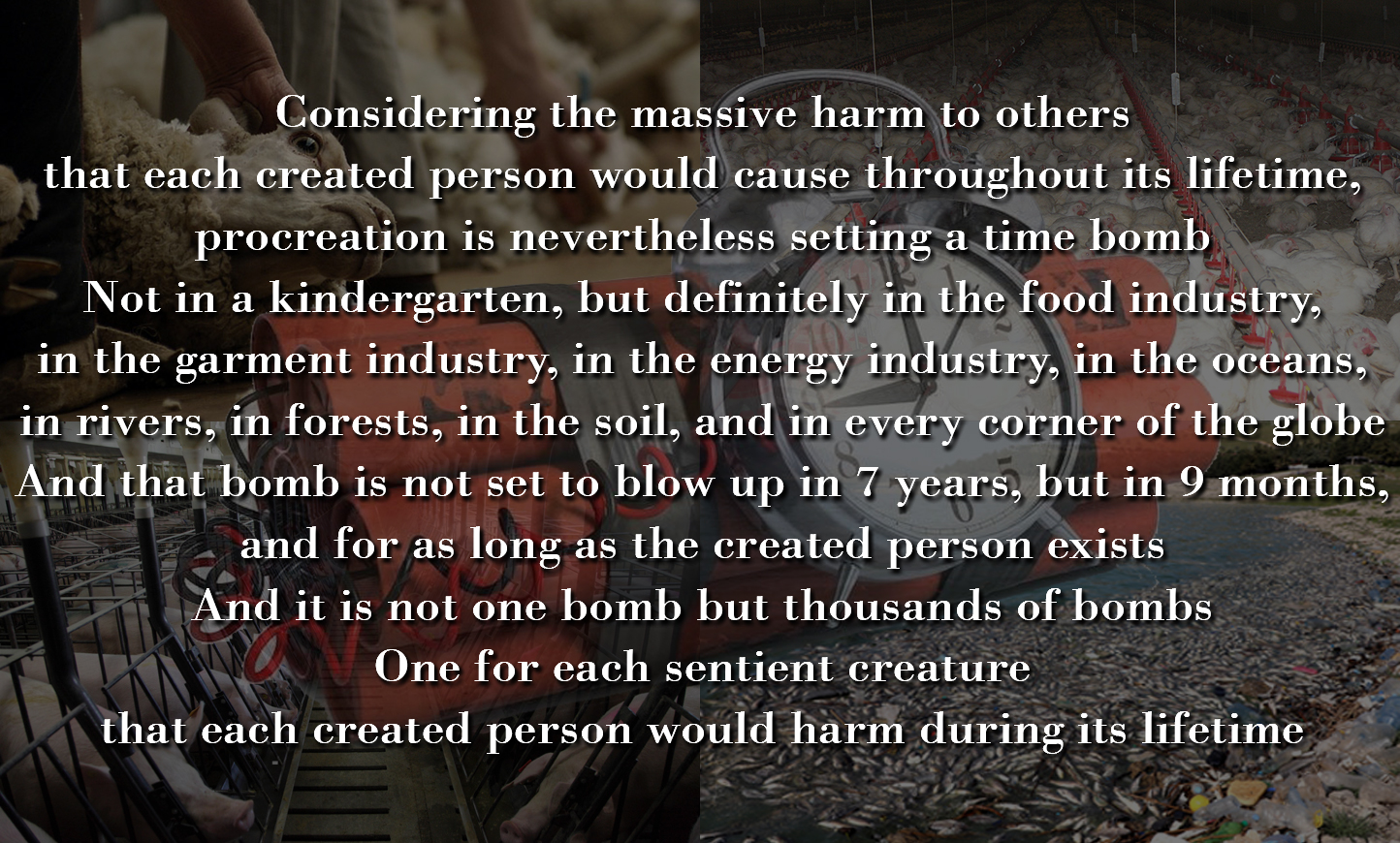
But actually a ticking bomb is analogical to procreation. That is because considering the massive harm to others that each created person would cause throughout its lifetime, each person is actually a living set of numerous bombs. And therefore procreation is nevertheless setting a time bomb. Not in a kindergarten, but definitely in the food industry, in the garment industry, in the energy industry, in the oceans, in rivers, in forests, in the atmosphere, in the soil, underground, and in every corner of the globe. And that bomb is not set to blow up 7 years from the time the action took place, but after 9 months, and for as long as the created person exists. And it is not one bomb but thousands of bombs, for the thousands of sentient creatures each created person would harm during its lifetime.

People set a bomb every time they eat, no matter what they eat, because everything has a price. They set a small bomb when they eat a seasonable organic vegetable, and a gigantic one when eating a cheeseburger or bacon and eggs. But they always set a bomb.
People set a bomb every time they dress, not matter what they wear, because every item of clothing has a price. They set a small bomb when they wear organic hemp clothes, and a huge one when wearing a wool sweater and leather shoes. But bombing is inevitable.
People set a bomb every time they use electricity, not matter how it is being generated. They set a small bomb when they use wind or solar power, and a huge one when using coal. But using electricity inevitably involves some bombing, and usually a lot because most people have no choice but to use power generated from fossil fuels.
People set a bomb every time they use transportation, not matter which one. They set a small bomb when they use public transportation, and a huge one when using an SUV or an airplane.
And the same goes for other human activities. They all inevitably involve harming others. The only difference is that in some cases people can choose to use smaller bombs, and less frequently. However, despite having only a bit of wiggle room in that relation, a fact that should have made people much more cautious and careful about every decision they make given that no matter what they do they will harm others, most don’t give a second thought about the size or the number of bombs they are setting.

All humans are mass scale bombs planters, and at some point they are also becoming ticking bombs in a sense of potentially creating more bombs planters, which in their turn would also turn into ticking bombs, and etc. Therefore, the sooner we antinatalists realize that what we ought to do is establish bomb squads, the better.

Hazardous Materials

In an article called Is Having Children Always Wrong? philosopher Rivka Weinberg claims that she has yet to find an argument to support antinatalism, and criticizes Benatar’s. Ironically, I think she can find a very convincing argument to support antinatalism in one of her own articles. The article is called The Moral Complexity of Sperm Donation, and although as the name suggests it deals with the moral complexity of sperm donation, not of procreation in general, on her way to argue that as opposed to common intuition, sperm donors do have parental responsibility, she presents a new parental responsibility theory which its most basic premise must also, and in fact first and foremost, entails antinatalism.

Parental Responsibility

Weinberg claims that we tend to assume that when a sperm donor sells sperm to an agency, he waives his parental rights, and is absolved of parental responsibility. “If we regard the donor as having parental responsibilities at all, we may think that his parental responsibilities are transferred to the sperm recipients. But, if a man creates a child accidentally, via contraception failure, we tend to assume that the man does indeed have parental responsibilities.”

In order to assess these contrasting intuitions Weinberg analysis various prevalent parental responsibility theories, and concludes that none of them can withstand scrutiny.
For example some argue that voluntarily committing oneself to be parentally responsible for a child is a sufficient parental responsibility theory. However, Weinberg counter argues saying it is uninformative since it does not tell us what counts as a voluntary commitment of this kind. “If it is the bare fact of an explicit commitment to parental responsibility itself, this theory will leave many children with no one parentally responsible for them since, often, children are born ‘accidentally,’ with no one who has explicitly made a parental commitment to them.” (p. 168)
The same problem rises from another common parental responsibility theory which claims that parental responsibility stems from intent to raise the child. But again this theory, like the voluntary commitment theory, may leave many children without anyone parentally responsible for them.
Others claim that the clearest way to determine parental responsibility is to seek the cause of the dependent child, to identify the proximate cause of the child’s existence. Weinberg rejects this theory despite the intuitive appeal “when we see a needy being, we may ask, ‘By whose doing is there this needy being?’ and the answer to that question seems to finger the person/s responsible for caring for the needy being. But it fingers too many people, including, perhaps, fertility specialists, domineering and demanding grandparents, the friends who brought that fabulous bottle of wine to dinner, etc.” (p.168)

She also rejects Gestationalism (a theory that finds the person who gestates the child as parentally responsible for the child) and Geneticism (a theory that finds the person whose genetic material is transferred to create another being as the new being’s parent), but I guess the objections to them are quite clear. So the last theory worth mentioning is a pluralistic account of parental responsibility that incorporates the various causal elements that contributed to the creation of a child. Weinberg claims that this theory spreads parental responsibility too broadly by granting it to genetic, gestational, custodial, and intentional parents, and she rejects it because when numerous people play these roles and claim or disclaim parental responsibility, there is no way to determine which of the claims are legitimate. “With so many candidates for parental responsibility, many children may be left with no one parentally responsible for them, since no criterion is granted priority over another.” (p.170)

After disqualifying the current common theories, she proposes a new theory of parental responsibility, which according to her, is more plausible than the alternatives.

But before detailing her theory, as an antinatalist myself and assuming all the readers of this blog are too, you are probably wondering why am I bothering you with the different parental responsibility theories, and whether sperm selling entails parental responsibility, and is there a difference for that matter between sperm selling and a contraception failure? So first of all to make it clear, obviously I don’t think it matters that much which parental responsibility theory makes more sense since they are all morally wrong (except for adoption which is more complex).
My first response to her title was that there is no moral complexity to sperm selling, but a moral simplicity, it is simply one of the biggest crimes a person can commit. Of course, every action contributing to making more people, and therefore more misery, is a crime, but selling sperm is doing it without even knowing or caring about the kind of lives the people they have contributed to create would be forced to endure. A person selling his sperm contributes to the creation of new lifelong vulnerability merely for some extra cash.
How can someone indifferently jerk off into a cup knowing that it might condemn someone to a life of misery, and most certainly condemn thousands to a life of misery?
People have no problem to create a life they would have no responsibility for and no idea how this life would turn out.

A sperm seller is responsible for so much misery since hadn’t he sold his sperm, at least one person wouldn’t have existed. The claim that ‘if it is not me it’s the other guy’ doesn’t hold since the claim against sperm selling is not personal but general and fundamental, it applies to everyone, and so, had every person who ever sold his sperm, considered the dire consequences of his actions and didn’t sell his sperm, so much misery would have been spared. The fact that people have turned to the sperm bank means they couldn’t procreate by themselves and needed the bank. Had no one sold sperm to the bank, the children of these people wouldn’t exist. In other words, sperm sellers have a crucial part in creating people.

If someone is a crucial link, even if seemingly technical, in a morally wrong action, he is a full partner in crime. There is nothing complex about sperm selling, it is plainly an accessory.

Sperm selling is an appalling contempt towards the effects of creating life. And by agreeing to acquire sperm, society sends people a clear message, come and “donate” whoever you are.

Weinberg is right in claiming that people are mistaken in their intuitions, attributing parental responsibility to contraception failure but not to an aware contribution to someone’s creation. Contraception failure is a case of irresponsibility but not of total carelessness. People using contraception didn’t want to create new life, at least not in that particular time, evidently they tried to stop the sperm from reaching the ovule. A sperm seller on the other hand doesn’t even care what will happen with his sperm, who would it reach, what person would it create, whom would that person hurt, and how much that person would be hurt. This is how low life and suffering are valued in our world.

Having said that, I am bothering you with this article because I find the premise of her alternative parental responsibility theory very interesting, and as mentioned earlier, one that is supposed to satisfy her own proclaimed quest for a convincing antinatalist argument.

The Hazmat Theory

Here are the basics of her parental responsibility theory, brought extensively and in her own words:

“I’d like to suggest that parental responsibility is derived from our possession and high degree of control over hazardous material, namely, our own gametes. Our gametes are dangerous because they can join with the gametes of others and grow into extremely needy innocent persons with full moral status. Being in possession and control of such hazardous material is a very serious responsibility. The enormity of the risks gametes pose generates a very high standard of care. In that respect, gamete owners are comparable to owners of pet lions or enriched uranium.

Dangerous possessions under our voluntary control – e.g. enriched uranium, a loaded gun, viable sperm – generate an extremely high standard of care. When we choose to engage in activities that put our gametes at risk of joining with others and growing into persons, we assume the costs of that risky activity.” (p.170)

“It seems to me that the cost of being born without specific people highly responsible and committed to one’s care are far more serious than the cost of being restricted from engaging, cost free, in behaviour that risks having a child created from one’s gametes. That does not mean that engaging in behaviour which risks creating a child from one’s gametes is wrong or inconsiderate per se. It just means that the costs of engaging in risky behaviour with one’s gametes belong to those who engage in it. Parental responsibility is a cost (or reward) of the risks we choose to take with the hazardous gametes we possess. Thus, parental responsibility is incurred when we choose to engage in activities that put our gametes are risk of joining with others and growing into persons, and persons result from those activities.” (p.171)

The Hazmat theory does not distinguish between the case of contraception failure and sperm selling since both involve voluntarily engaging in activities that put their respective gametes at risk of joining with others and growing into persons, and so when persons result from their respective activities, both are parentally responsible.

A sperm seller is parentally responsible for persons created with his sperm, since selling sperm to a sperm bank, currently gives the seller no information or control over which person or persons will gain control of his hazardous materials. According to Weinberg, this reckless transfer of parental responsibility, makes sperm sellers parentally responsible for persons created with their sperm.

Weinberg analogies:

“Surely, selling your enriched uranium to a uranium brokering agency won’t absolve you of responsibility for the nuclear explosion that may result. Enriched uranium is so volatile and dangerous that it is not easy to transfer it safely and reliably. In order to transfer your enriched uranium permissably to someone else, the transfer would have to be undertaken with extreme care, investigation, and caution. Current practices of sperm donation in many countries, including the USA, fall far short of any claim to the very high standard of care that transferring such hazardous material would demand”. (p.172)

The reason I claim that her theory is actually antinatalist, is since gametes are not dangerous only in cases of sperm selling, birth control failure, drunken sexual activity, and unbridled passion, but always. “Nuclear explosions” are not exclusive to sperm selling, they happen all the time, and by various methods of procreation, to various parents, without their control, and regardless of their initial intentions.
The option of creating a miserable person is possible in each couple of gametes and regardless of the conditions of their uniting. What makes gametes dangerous is the possibility of creating a miserable person, and the certainty of creating a person who would make the lives of others miserable. So it can be argued that a sperm seller is worse than others as he doesn’t even know or care about the results of his activities with his gametes, but their hazardousness remain in every other case of procreation as well. Miserable lives are produced all the time by gametes uniting, without sperm selling, birth control failures, and alcohol. And misery to others is produced every single time gametes unite and no one stops them, absolutely regardless of parental responsibility.

The premise of Weinberg theory, referring to gametes as hazardous materials such as enriched uranium, or a loaded gun, constitutes a very good reason to why people mustn’t breed. And the fact that people are in involuntary possession of their gametes and as she claims are naturally inclined to risky gamete-owning behavior, or in other words, humans are inherently armed with massive weapons and are naturally inclined to use them, is a very good reason why they must be disarmed.

References

Weinberg Rivka The Moral Complexity Of Sperm Donation

Bioethics ISSN 0269-9702 (print); 1467-8519 (online) doi:10.1111/j.1467-8519.2007.00624.x

Volume 22 Number 3 2008 pp 166–178

Pro-Natalists’ Manipulative Simplification

Pro-natalists tend to confuse the claim that ‘procreation is always wrong’ with the claim that ‘life is always not worth living’. These claims utterly differ, and the differences between the two are quite important. I’m not referring here to Benatar’s differentiation between life worth starting and life worth continuing, a distinction many of his critics have chosen to ignore, usually by referring to both cases as life worth living. Although this is an important point by itself, this is not the one I want to make here. I am referring to the false inferring that since there are people who feel that their lives are worth living, maybe even most, then the claim that procreation is always wrong is false. That is a conceptual confusion in the best case and a manipulation in the worst.

It is a manipulation when it is ascribed to Benatar, who actually argues that all life is not worth starting, not that all life is not worth living, and it is a conceptual confusion since the argument that procreation is always wrong isn’t necessarily derived from the claim that every life is not worth living. There are many antinatalist arguments and most aren’t founded on the premise that all life is not worth living. One of which is the argument that it is morally wrong to impose a decision, let alone the most important one in someone’s life, without consent, and since it is always impossible to get consent in the case of procreation, procreation is always wrong, regardless of the quality of life of that person. According to the consent argument, procreation is wrong even in cases of life worth living because they were imposed on the person without consent.

Another argument which unties the stilted connection between antinatalism and life worth living, is the risk argument.
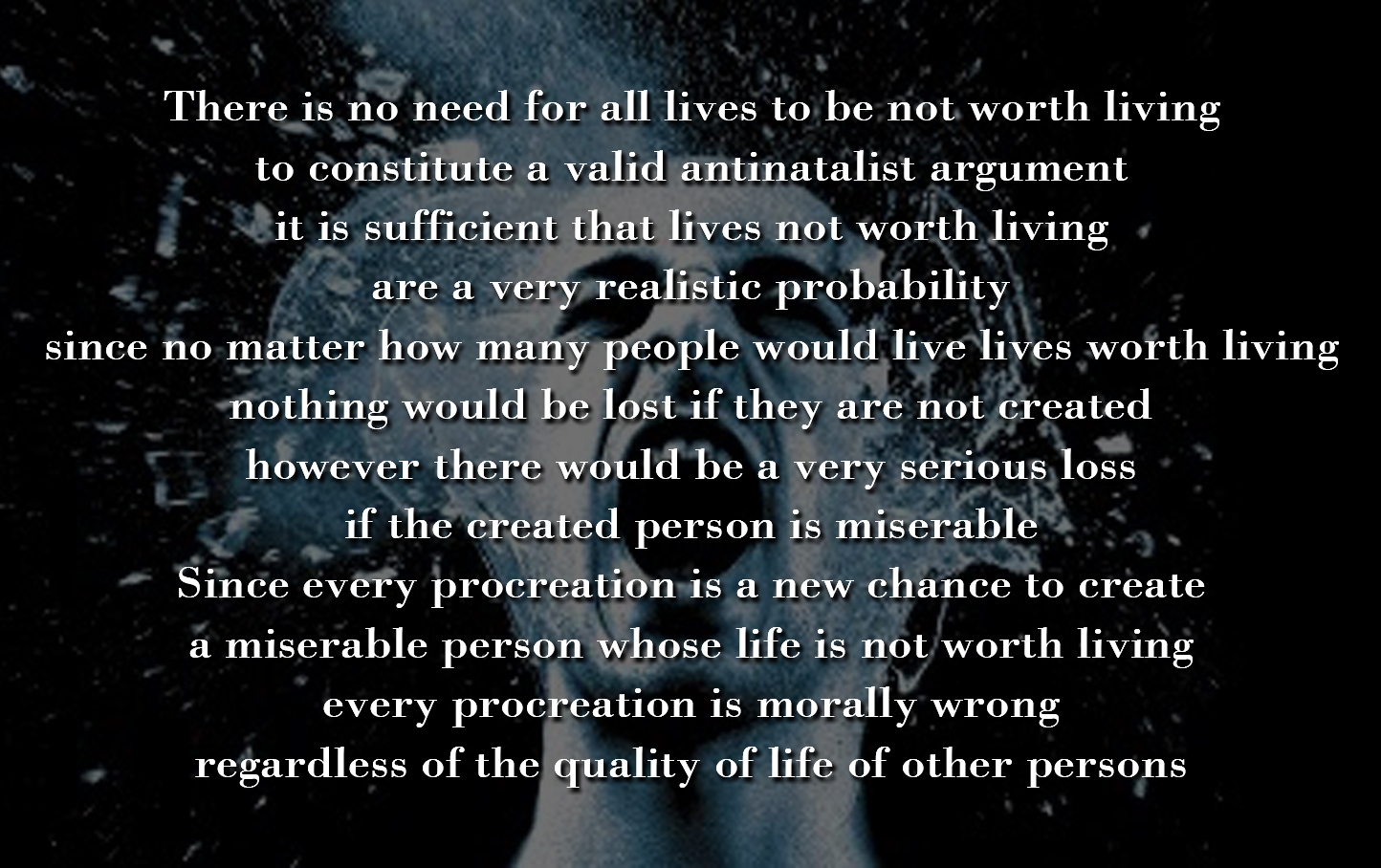
There is no need for all lives to be not worth living to constitute a valid antinatalist argument, it is sufficient that lives not worth living are a very realistic probability, since no matter how many people would live lives worth living, nothing would be lost if they are not created, however there would be a very serious loss if the created person is miserable. Since every procreation is a new chance to create a miserable person whose life is not worth living, every procreation is morally wrong, regardless of the quality of life of other persons.

And the most important antinatalist argument in my view is that every procreation is wrong even if we could theoretically be assured that each one would result in a life worth living, since we are always practically assured that each procreation would result in a life of misery for other sentient creatures. There are absolutely no lives who are not at the expense of others, and most lives are absolutely cruel, causing misery, abuse, confinement, loneliness, sickness, chronic pain, fear and despair. There are no good lives that can ever justify all this misery, certainly not when it can be easily avoided by simply choosing not to procreate.

The constrained false linkage between the claim that ‘procreation is always wrong’ and the claim that ‘life is always not worth living’ is very convenient for pro-natalists since they know the common perception among the general public is that procreation is not only utterly acceptable but is also considered a blessing. This is how even philosophers can get away with such an invalid move. Procreation is always wrong and for various reasons, some of which were detailed earlier in this text. But pro-natalists prefer to present antinatalism as if it is necessarily founded on the premise that all life is not worth living, since it is the easiest way out.
The ease in which pro-natalist choose the easy way out is extremely worrying. We are not in a debate. We don’t get points for good arguments, and pro-natalists are not disqualified for utterly false ones, or for completely distorting ours.
Antinatalists surly easily defeat pro-natalists in the theoretical debate, but pro-natalists are winning in real life. And their win is billions of sentient creatures’ loss. Arguments will not convince pro-natalists, so to stop procreation what we need is not good theoretical claims but efficient practical methods.

References

Benatar David and Wasserman David, Debating Procreation: Is It Wrong to Reproduce? (Oxford: Oxford University Press, 2015)

David Benatar, Better Never to Have Been (Oxford: Oxford University Press, 2006)

Shiffrin, Seana. Wrongful Life, Procreative Responsibility, and the Significance of Harm Legal Theory 5, no. 2 (1999): 117–48

Unfixable

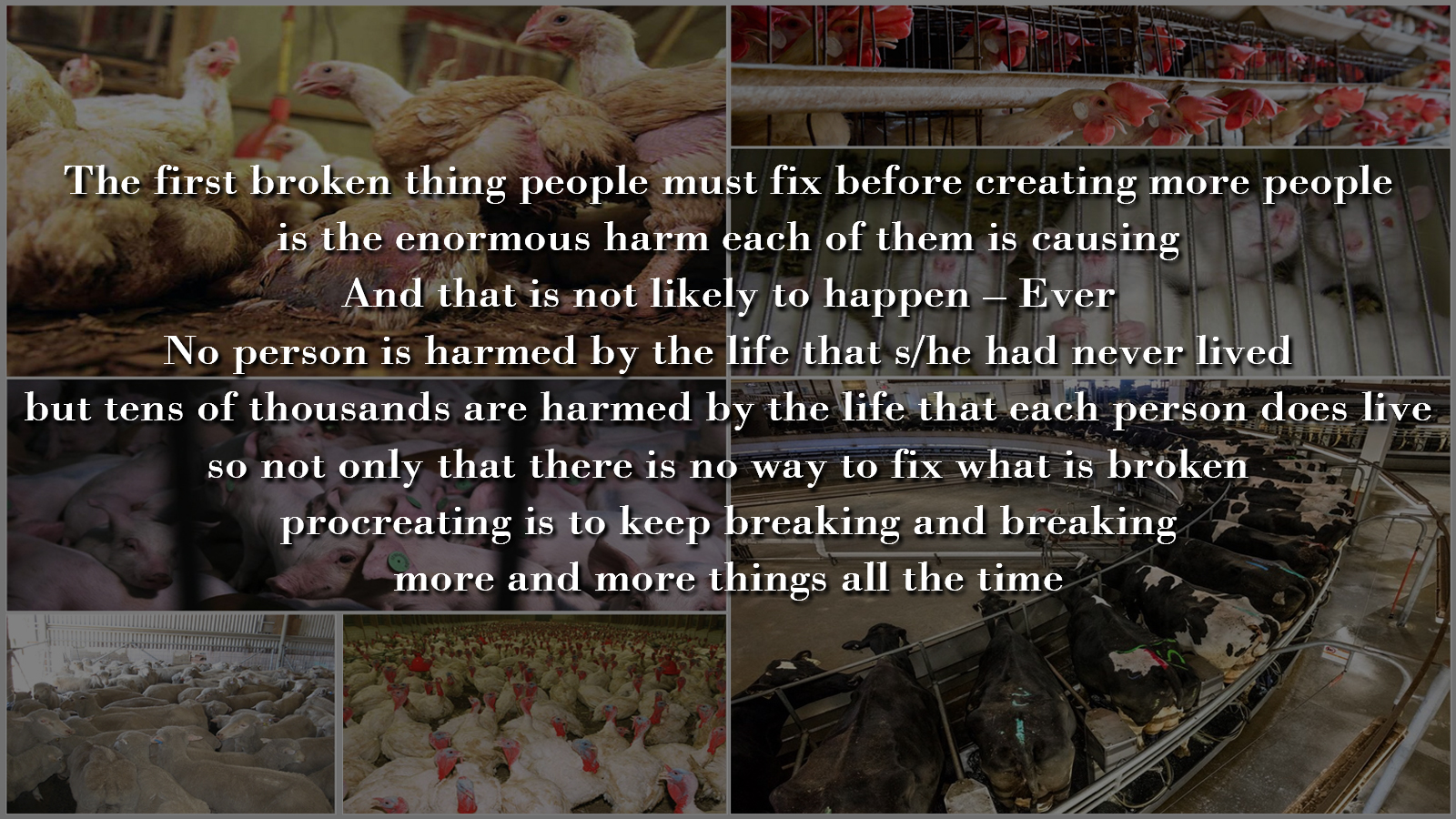
Some antinatalists argue that the only way to justify creating a person is if the parents are willing to “fix what they broke”. Meaning, that people are permitted to create a person if they are ready and are committed to compensate their child for harms, including assisting suicide to their child if the child asks for it, regardless of it being illegal; and they are certainly not allowed to try to prevent their children from carrying out suicide if they choose to.

I sympathize with the logic behind the argument that given that parents risk their children’s well-being, let alone in an attempt to improve their own, then if their children’s well-being ends up being poor and undesirable in their own view, the parents are obligated to return their children to their previous state, but since this option is even theoretically impossible simply because there is no pre-existing state someone was in before being created or can somehow go back to, procreation is impermissible under this condition just as much.

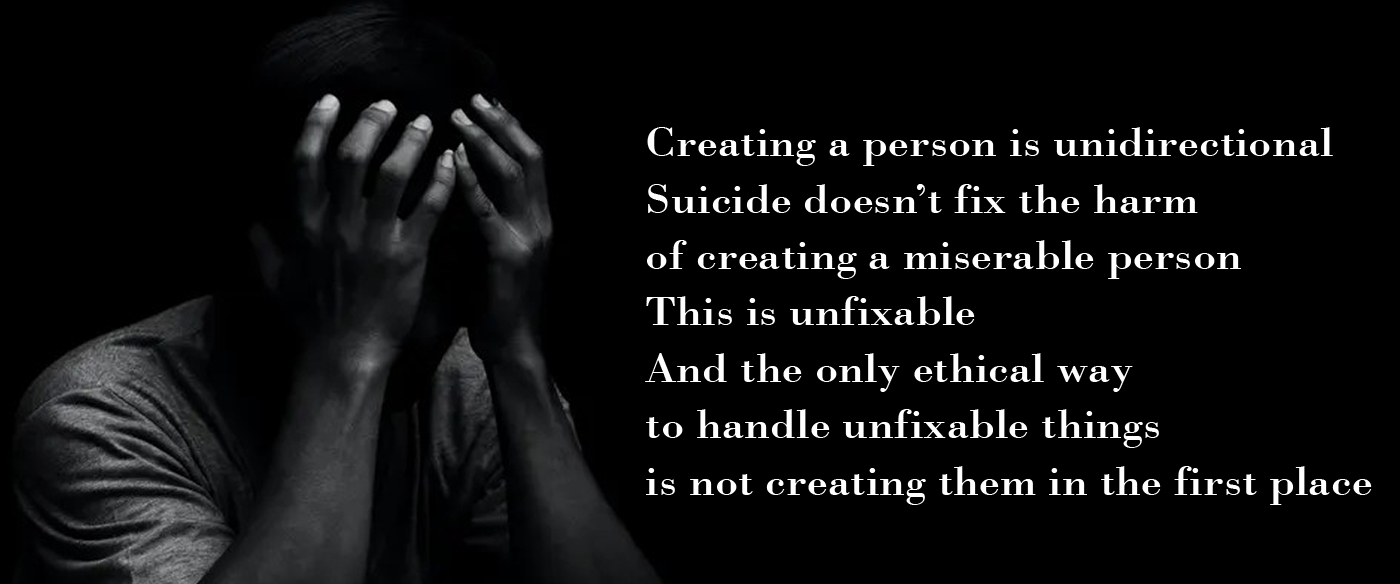
Beyond the lawfulness issue and beyond the unlikeliness that parents would not try to prevent their children from carrying out suicide if they choose to, let alone provide them with assistance, carrying out suicide doesn’t compensate anyone for anything. Harms done are not retroactively being undone once a person doesn’t exist anymore. Existence can’t be undone. Things can happen but can never “unhappen”. There are no, and there could be no compensations for the harms endured in existence when it ends. Ending one’s existence can only stop the current harms and prevent the future ones, but it can’t compensate for past harms.

Suicide cannot compensate anyone for the suffering of existence, but can only stop the continuance of the suffering of existence. It can’t retroactively justify the existence of someone who doesn’t want to live, or wish s/he had never existed. The harm can never be compensated for nor justified, even if the parents provide assistance, and even if suicide was fast, fearless, absolutely sure, plain, painless and harmless to others, which it is definitely none of the above. Carrying out suicide is always difficult, scary, unsure, dangerous, potentially painful, and rarely unharmful to people who knew the person carrying it out, including the parents, and despite them (under the conditions of this argument) making a prior agreement to assist or at least not hold back their children if that’s what they wish for.

Even people who have decided to end their life, and even people whom their life was a continuance misery, are naturally and biologically built to fear death, and they are obviously afraid of pain, of permanently disabling themselves if they don’t succeed in carrying out suicide. Some fear that they are committing a sin, some fear of what they view as the unknown, some of breaking the law, of being socially shamed, of being blamed for selfishness, of the option of isolation ward in a psychiatric hospital, and etc. All that as well as the fact that people are biologically built to survive, make many people prisoners of their biological mechanisms and social norms. They are trapped in horrible lives without a truly viable option to end it, even if their parents would agree, and even if they would provide them with assistance.

People must overcome too many obstacles with each being too difficult, for suicide to really be an option. And even if it wasn’t the case, carrying out suicide, even if was absolutely safe, easy and free of any collateral damage, as aforementioned, doesn’t by any means compensate for a miserable existence.

No one should take the risk that their children would suffer so much that they would not only want to die, but that they would overcome all these obstacles and try to do something about it, or won’t because they are too afraid or because they care too much about the people who care about them. No one should put anyone in such a horrible position where they don’t want to live but are trapped in life.

Compensation to Others

Even if parents’ preacceptance that they might have to assist their children with ending their own lives if they want to, was a relevant “fix” and compensation for their children’s miserable existence, given that creating a person is not only gambling on that person’s life, but also, if not first and foremost, ensuring that more sentient beings, probably tens of thousands of them, would be forced to endure miserable lives so to support and pleasure the created person, and given that compensation is even less relevant in their cases, procreation is a unidirectional thing for tens of thousands, and is unfixable for each and every one of them.

Before discussing the relevancy and feasibility of compensating and fixing a potential problem of a person who doesn’t yet exist so to justify its creation, people must ensure compensation and that they can fix the certain problems of everyone who would be harmed due to that person’s creation. And obviously that is impossible. How can people compensate everyone who would be sacrificed and otherwise harmed by the people they will create? How can they compensate everyone who would be genetically modified so to provide the maximum meat possible for the to-be born persons? How can they compensate everyone who would be imprisoned for their entire lives? How can they compensate everyone who would be forced to live without their family for their entire lives? How can they compensate everyone who would suffer chronic pain and maladies for their entire lives? How can they compensate everyone who would never breathe clean air, walk on grass, bath in water, and eat natural food?

Procreation is not only taking a risk of causing harm to the person created, it is indifferently deciding to cause harms to everyone who would be harmed by the person created.
None of them can be compensated for any of it. Not the created person and not any of its victims.

The first broken thing that people must fix before creating more people is the enormous harm each of them is causing. And that is not likely to happen. Ever.
Given that no person is harmed by the life that s/he had never lived, but tens of thousands are harmed by the life that each person does live, not only that when it comes to procreation there is no way to fix what is broken, it keeps breaking and breaking more and more things all the time. And that requires a real fix.


Autobiographies, Biographies and Ponzi Schemes

Most of the arguments against antinatalism are actually arguments against David Benatar’s arguments for antinatalism, and usually not against all of his arguments but mostly against his asymmetry argument. As I have argued in the text addressing Benatar’s asymmetry argument, I agree it is problematic but for different reasons than the most common criticisms as they are presented by its criticizers.
Less of the criticizers of antinatalism focus on Benatar’s quality of life argument. One of them is David Wassermann, Benatar’s co-author of Debating Procreation, who mainly argues that the chance for a miserable life is very small and therefore doesn’t justify antinatalism. Since I have addressed this claim in the text addressing the book, I’ll not repeat my claims against Wassermann’s claim here. In this text I wish to address a different pro-natalist argument against Benatar’s quality of life argument, which is basically that even if Benatar is right about the quality of life being very low, people are not really hedonistic creatures in the sense of valuing everything in their lives in terms of pain and pleasure. They don’t schematically count welfare points on scales, but are writing autobiographies, and these are meaningful for them even if they are sometimes, or even often, negative in hedonistic terms.
And besides autobiographies people are also writing biographies, meaning they are affecting the lives of others, so their lives are meaningful also because they are meaningful to others.

Autobiographies

Although I find it at least a little bit deeper and more interesting than most of the common arguments against antinatalism, the autobiography perspective is still utterly false.
That is since first of all I agree with Benatar’s reply to the counter claim to his quality of life argument (which he included in the chapter about the quality of life argument in Better Never To Have Been since he anticipated it), which is basically that people’s self-assessments are completely unreliable indicators of life’s quality, mainly due to a number of psychological features which distort their ability to make objective assessments of the actual quality of life, and instead constitute a fallacious positive assessment. The main three mechanisms which Benatar mentions are The Pollyanna Principle, Adaptation, and Comparison with Others. You can read about them in the text about Benatar’s quality of life argument, or of course, in the third chapter of Better Never To Have Been.

Besides the ones Benatar mentions, additional mechanisms which are causing people to find their autobiographies meaningful are the existing bias, life’s addictiveness, and because people view non-existence as a horrible alternative to existence despite that obviously nothing horrible would have happened to them or nothing wonderful would have been deprived of them had they never existed, had they never had an autobiography. Yet most people prefer having bad lives than not having them at all, even though they wouldn’t have missed a thing had they never had a life, even though nobody is harmed by a great autobiography that nobody wrote.

In a sense, to suggest that meaning in life should stem from one’s autobiography is an explicit admission of life having absolutely no meaning of its own. Defining life as platform for everyone to compose its own meaning is actually a very good reason not to put a person in this position in the first place since what is the point of throwing someone into a life voided of any meaning? If each person needs to find its own meaning of life by oneself, obviously it wasn’t there before that person existed, and if so, why create that person in the first place? Doesn’t it make much more sense not to create a person whose purpose in life would be to find a purpose to its own existence?

Ironically, stressing and focusing on the issue of the meaning of life, more than anything else, exposes the lack of it. It emphasizes the absurdity of life and the purposelessness of existence.

People’s autobiographies are meaningful to them because they are built to exist, they are built to survive, once they exist they are built to experience, they are even built to be optimistic, they are built to adjust, they are built to think that they are meaningful and that life is meaningful.
But they aren’t and it isn’t. And it wouldn’t be so meaningful that life is meaningless hadn’t it been so bad, had no one suffered during it. But it is very meaningful ethically because everyone suffers, and it is even more so because everyone suffers for no reason but that they were created.

Life is much worse than people tend to think, but even if it wasn’t, each bad moment happening during it is unnecessary. Every pain, every sickness, every fear, every frustration, every regret, every broken-heartedness, every moment of boredom and etc. are all needless. They exist only because the person experiencing them exists. They exist because the parents of that person have forced existence on that person. There is no good reason for that to happen. Every problem could have been easily prevented instead of being difficultly solved, if solved at all. People exist because it was decided for them to exist by other people, not because it is necessary or purposeful in any way.

The fact that people who are living horrible lives still positively value their autobiography, is not an indication that life is not that horrible, but exactly the opposite. It goes to show how deeply trapped humans are in the life mechanism. People are victims not only of their biology but also of their psychology. They would adapt and adjust themselves and their expectations according to how bad the lives they are forced to endure are. Low expectation, adaptation ability, and the fact that everyone else’s lives is not much better, can’t justify bad situations which shouldn’t have been created in the first place.
But an even sadder fact is that humans are not really looking for justifications to procreate. Most just do. They don’t even really need mechanisms to sooth their worries about the future of their children, because as inevitable as it is that bad things would happen to their children, it rarely crosses their minds. Unfortunately people are apathetic to the fate of others, even when it comes to their future children, and definitely when it comes to the rest of the victims of procreation.

And that brings me to another reason why the autobiography claim is false.
People might truly not value their lives merely in hedonistic terms, but they also don’t value them according to autobiographies and biographies they are writing. Most people don’t think in terms of meaning let alone writing a meaningful autobiography, but they just exist. The autobiography criticism is way too flattering for the vast majority of people. It presents them as if they are the writers of their own story while they are actually more like the ball in a pinball game. They are not in control of their own lives but are bounced from one occurrence to another. People are not calculated thinkers but are reckless pawns.

In fact, most people are still thinking in terms of fictional cosmic meaning. Most are not even beyond that phase so how can one counter argue antinatalism by claiming that people’s autobiographies are positive when most people don’t even consider them as the source and root of their meaning in life but rely upon fictional cosmic meaning such as divinity, reincarnation, predestination and etc., or the continuation of the family line, the species, or whatever non autobiographical motive. Most people don’t actively try to fill their lives with meaning in a cosmically meaningless existence by trying to write meaningful autobiographies, but passively depend upon fictional external sources to do that for them (mainly because existence is cosmically meaningless).

If in order to counter Benatar’s quality of life argument it is required to ascribe inventive traits to people, such as them all being philosophers and existentialists, it says more about antinatalism’s critics and the defenders of life than on antinatalists and the critics of life.

A Ponzi Scheme

And even if it was the case that all people are sort of philosophers and existentialists invested in making their autobiographies meaningful, no one creates new people so they can write meaningful autobiographies and biographies. People create new persons to serve their own purposes such as to save their decaying relationships, to continue the family line, to please their parents, to ease their boredom, to hush their biological impulses, to boast their ego, to create an immortality illusion, to feel normal, to make them look normal to others, to ease their loneliness, to be loved even if that love is temporary and conditioned and a result of imprinting and not of free choice and objective assessments, to feel powerful because someone is totally depended on them, to feel needed and important, to fill their empty and pointless lives with a sense of meaning and purpose. So if anything, people are creating new people so their own autobiographies and biographies would seem meaningful to themselves.
And that is a kind of a Ponzi scheme. People are creating new people so their lives would become meaningful, and the created people’s lives would be meaningful as a result of the creation of more people and etc. Every generation’s lives are meaningful because of its relation with the former and next generation. But there is no meaningfulness validation, let alone an ethical justification, for this pyramid scheme coercion. The pyramid has no rational ground except the scheme operating it. Existing people function as biographies validation for former existing people and they will validate themselves by creating new people. But there is no external validation or meaning for this scheme. It is meaningful only because it exists, if it disappears, automatically so would its meaning. There is no external meaningful reason for it to exist, no external necessity, no importance but its own internal dynamics which produce internal meaning only. It is a self-justifying system.
Basically it is people telling the people they are creating: ‘You have to exist because I exist. Because I was forced into this purposeless existence, you must be too. You will fill my purposeless existence with a pseudo purpose, and later you will force others into a purposeless existence and fill your purposeless existence with a pseudo one as well, and so on’.

The idea of referring to procreation as a “Ponzi Scheme” is not originally mine. In the book Debating Procreation Benatar brilliantly uses it with reference to the pro-natalist claim of the harm to the last generation – if antinatalism is endorsed by the general public, the final people of the last generation would suffer when they are aged because there would be no younger people to provide them with everything they need.
After pointing at this claim as being a pro-natalist excuse given the vast amount of procreation that is currently taking place, and after suggesting that to avoid the suffering of the last people a mechanism for phased extinction must be developed, Benatar argues that this claim is a Ponzi scheme:

“The reason why it cannot be a more enduring “solution” is that continued procreation in order to save existing people from harm is a giant procreative Ponzi scheme. Each generation has to procreate in order to save itself from the fate of the final generation, thereby creating a new generation that must procreate in order to spare itself the same fate. Like all Ponzi schemes, it cannot end well. It merely delays the inevitable. However, unlike other Ponzi schemes, the procreative one also causes vast amounts of suffering before the bubble bursts or the pyramid crumbles”. (p. 129)

My attempt here is to broaden the Ponzi scheme analogy to other aspects of procreation as well. I think that Benatar’s use is better and more accurate than the one I am making, yet, since filling the empty and pointless lives with a sense of meaning and purpose is a very common motivation in procreation, it is important to make that reference as well.

Biographies

The most important aspect of the pro-natalist claim which is in the center of this text, regards to people’s biographies.
Basically the claim is that since people have meaningful relations with others, their lives are meaningful. But supporters of this claim tend to mention only the positive aspects of people’s effect on others and therefore claim that their biographies are justification for their existence. However, the negative aspects of people’s effect on others are far more important, and they are far more prevalent. People have a tremendous effect on far more creatures than the ones within their family circle and their friends circle, and that effect is devastative, exploitive, and extremely harmful.

It is very hard to accurately assess the harms caused by each person since it depends on various factors such as location, socioeconomic status, consumption habits, life expectancy, livelihood, diet and etc., however, regardless of any circumstances, harming numerous others is inevitable. And the most immediate and prominent harm is caused by what people eat. And every food has a price. Unfortunately, most people are choosing the ones with the highest price – animal based foods. Therefore most people’s relations with others are of the most abusive and exploitative kind. Most people biographies include choosing that more fish would suffocate to death by being violently sucked out of water, that more chickens would be cramped into tiny cages with each forced to live in a space the size of an A4 paper, that more calves would be separated from their mothers, and more cow mothers would be left traumatized by the abduction of their babies, it is choosing more pigs who suffer from chronic pain, more lame sheep, more beaten goats, more turkeys who can barely stand as a result of their unproportionate bodies, more ducks who are forced to live out of water and in filthy crowded sheds, more rabbits imprisoned in an iron cage the size of their bodies, more geese being aggressively plucked, more male chicks being gassed, crushed or suffocated since they are unexploitable for eggs nor meat, more snakes being skinned alive, and more crocodiles and alligators being hammered to death and often also skinned alive to be worn, and more mice, cats, dogs, fish, rabbits, and monkeys being experimented on.

Since the absolutely vast majority of people are not even vegans, and insist on choosing the most harmful option for them to feed themselves, their biographies are filled with torturing others.
But the fact is that every person’s biography is filled with harming others, even the ones who don’t directly consume others. Unfortunately the vegan option is not harmless. It is impossible to eat without harming someone, somewhere along the line. Every food item is in one way or another a product of dispossessing, plundering, habitat destructing, poisoning, trampling, starving, dehydrating, air polluting, water polluting, climate alteration, land alteration, water waste, oil drilling, and etc.
And obviously it’s not just food. People’s biographies are also full of various harms to numerous others by the consumption of other goods such as clothes, soaps, toys, shoes, cosmetic, cars, soda cans, washing powder, electricity appliances, mobile phones, dish-washing detergents, make ups, anything made of plastic and etc. For more information please read the article The Harm to Others.

The point is that every action people make affects others, and the vast majority of these effects are negative. It is even theoretically impossible to fulfil the most basic ethical requirement – do no harm. Most aspects of peoples’ relations with others are harmful and exploitative, where is all that when biographies are presented as justification for creating more people?

Peoples’ autobiographies are extremely biased and unreliable. They lack any external meaning and their inner meaning would vanish into thin air had they never existed. None of it has any meaning of its own.
People’s biographies on the other hand are very meaningful. It would be very meaningful to all of people’s victims had they never had biographies. All of them are stained with other creatures’ pain, fear, blood, exploitation, and suffering. People’s biographies are not justifications for procreation but a very good reason why people must never ever procreate, and why we must make sure that it would truly never happen.

Structurally Unfair

Life in this world is structurally unfair. And it starts even before a person is born. Many things are pre-decided for each created person without that person doing anything to deserve them. Anyone who doesn’t believe in reincarnation must agree that it is unfair that every person starts its life when everything in it (including factors that would have a critical effect on the rest of that person’s life) has nothing to do with anything that that person did. That is already a very unjust element of life. No one chooses where to be born, to whom, its personality, its body, its physical conditions, its genetic heritage. It is extremely unjust that even before a person is born it is often already the case that bad things happen to good people, or in this case to people who haven’t yet done anything wrong. It is never the fault of anyone that it was born into a dire situation. The structured injustice of life begins before the first breath. Obviously the fact that someone was created without giving consent is also a very severe structured injustice, but my focus in this text is not on the structured injustice bound and inherent in the decision to create a person without its knowledge let alone consent, but on how structurally unjust this decision is in the light of how structurally unjust life is.

From the moment a person is born, life imposes fear, pain, dangers, anxiety, limitedness, helplessness, physical discomfort, separation from the only familiar thing in the whole world and etc., to be later followed by more fear, pain, dangers, stress, as well as ailments, disappointments, deterioration, and eventually and inevitably death.

When people are creating new people, they know that their children will not only necessarily experience all of the above, but in addition would live in an unjust world where there is no causal relation between their actions and their experiences. They can be very reasonable, cautious, considerate and thoughtful yet miserable.
Yes, some will enjoy their lives, but only those who were arbitrarily blessed by blind luck.
There is no real sense or guarantee whatsoever in ‘do good things and good things will happen to you’.

It is not as if people start life in a neutral state, and due to their own decisions and actions they either have good lives or terrible ones. Instead, every person is born into an unjust and unfair world. This state disadvantages everyone from the beginning, making their entire life a struggle to overcome the curse of unfairness.

Life is inherently and structurally unfair and unjust without any option of repair. So to claim (as some pro-natalists do) that what we need to do about the world’s problems is to fix them, not stop procreating, is totally disconnected. However even if it wasn’t the case, obviously this claim is nothing but a lame excuse as people are creating new people all the time, without any of the world’s problems (even the ones which are not inherent and structural and so at least theoretically are solvable) even being close to any repair in the foreseeable future. In fact people are so careless, so indifferent, that they are not even thinking about the fact that they are throwing their own children into an unjust world, or about the world’s problems, or about the chances of their children to personally and directly be affected by some of the world’s problems.

Only those who are blessed with blind luck their entire lives, can be hopeful. And no one can guarantee blind luck in advance. So parents must face the fact that the world they force their children into is deeply broken and unjust.

The ethical thing to do, given this structurally unjust world, is to refrain from creating people.
Parents are active and contributive participants in perpetuating this unjust world by throwing into it more and more victims and victimizers.
The fact that the only way to create a new person is in a structurally unjust world, does not serve as an excuse for creating people in a structurally unjust world. That is especially so since there is nothing unjust in not creating people. No one is treated unjustly, unfairly, or harmfully by not being created.

Parents condemn their children to live in an unfair world where no matter what they do, bad things can always happen to them. No one chooses neither to be born, nor to be born in such an unjust world. The harm of living in a structurally unjust world is forced on everyone without their consent. Parents must take into account this dreadful imposition when considering whether to create new people.

But they don’t. Many people refuse to accept that this world is random, purposeless, unfair, and inherently unjust. They insist on sticking to the just world theory. That position is completely illogical and ignorant but it is also quite understandable. It is much more appealing to think that the world is just, that life has a purpose, that there is a guiding hand, or a transcendent supervisor than the other way around. As false as these notions are, obviously it is much more soothing, comforting and it gives a sense of control, to believe that if something bad happens to good people it must be the case that they are doing something wrong. Otherwise people would have to accept that there is no justice in this world, no fairness, no reason, no bigger picture, no purpose, and that quite often bad things happen to good people, and good things happen to bad people.

It is important to internalize the appeal of this viewpoint. As false and ridiculous as it is, ignoring its power and its effect on procreation is also false and ridiculous. As long as antinatalists are trying to convince people not to breed using rational arguments they must acknowledge who they are dealing with. People believe in the just world theory because they are highly motivated to do so. Its appeal doesn’t stem from its logic but from its usefulness, not from its substantiation but because it makes it easier for people to keep doing what they want.

Since intuitively it seems that it would be much easier to convince people not to create people once they realize how structurally unjust this world is, there is an appeal to simply show people that they are mistaken. But it is this approach which is mistaken, as there is nothing simple in convincing people to reject a positon that their desires are depended upon.

There is no point in trying to convince people that this world is unjust. Their motivation not to see that is way stronger than our arguments will ever be. When the most obvious and self-evident things are not at all obvious, obviously what is needed is not convincing arguments but definitive actions.

The Art of Making Excuses

Somewhat proximate to the rosy prophet pro-natalist type, mentioned in the former text, is the ‘enthusiastic art dealer’. These are pro-natalists who despite spending much more time using human technological innovations by playing Candy Crush on their smartphones than reading Chekov or visiting museums, they are “concerned” about human works of art going to waste if humanity goes extinct.

Of course, for most of these claimers the only part art plays in their life is when they are artistically using it to make a pro-natalist claim. And even then it is not exactly Shakespeare. But I’ll ignore the blatant pretence and try to take this claim seriously.

No Actual Waste of Anything

Art has no meaning of its own. Insentient entities only have extrinsic value, and that includes each and every work of art that was ever created regardless of the great value it has for sentient entities which only they have intrinsic value. Once there is no one to value art, art instantly loses all its value. Works of art don’t get frustrated when visiting hours at museums are over, the Mona Lisa doesn’t wipe the famous smile off her face when the visitors leave, and classical books don’t have existential crisis when no one seems to be reading them anymore. Art works are not sentient creatures, they don’t experience anything, therefore they are not morally relevant by themselves. Their only moral importance is their effect on actual sentient creatures and when these are gone there is no harm or any deprivation in the fact that art won’t be viewed anymore. Without anyone reflecting on a masterpiece such as Catch-22 or Water Lilies it is just ink on paper, and The Seventh Seal is just a thin flexible stripe coated with light sensitive emulation.

It is simply irrelevant to consider wasteful a state where insentient entities are no longer experienced by anyone, when there is no longer anyone to value them. Not experiencing art is wasteful only if there is someone who can value it and is deprived of experiencing it. But no one is anxiously waiting to listen to Mozart’s Symphony No. 41 or watch Café Terrace at Night before being created, and no one is harmed by not being able to do it if no one is ever created. There are no harms or deprivations in non-existence, there is literally nothing and no one. No one is missing anything or is harmed by anything. Just like no one had been deprived of a great life that no one had experienced, no one would be deprived of a great art work that no one had experienced.

I have argued in a text called Sacrifice that no one’s suffering should be justified by the pleasures of others, no matter how many others there are and how great the pleasures are, when the alternative is that no one would exist and so no one would seek pleasures and no one would ever suffer. But the argument in the center of this text is way worse since it is not even implying that at least some sentient creatures (practically numerous) must be sacrificed for the sake of the pleasures of others – obviously an utterly appalling argument in itself – but that some sentient creatures (again practically numerous) must be sacrificed for the sake of art works. Not for the sake of enjoying art works, but for the sake of art works themselves. That is the case because this argument is raised against human extinction despite that when humans are gone all the art works would lose all their meaning. It is implausible to raise the “artistic” argument against human extinction because obviously in the case of extinction humans couldn’t enjoy fine art, and fine art has meaning only if humans exist. And the same goes for any other human activity.
We can replace art with every human action and the (il)logic of this claim is supposed to work just as much. For example, if humanity goes extinct there would be no gum chewing anymore. We would obviously say that gum chewing has no meaning of its own and so there is no harm in that activity not taking place anymore, once humans are gone no one would be deprived of not chewing gum. The “artistic” pro-natalists would probably reply that gum chewing can’t be compared with art since the latter is way more meaningful and important than something trivial and insignificant as gum chewing. And that exactly proves that they are attributing intrinsic value to art works. The fact that this claim is raised specifically against human extinction goes to show that it at least implies that art is in itself more important than sentient creatures, a factor that makes this claim not only cruel and unethical but also fascist in a sense of placing objects before subjects.

An Actual Need to Waste Everything

The fact that there is nothing wrong, harmful or wasteful about works of art that no one would experience if no one exists and therefore no one is deprived of them (or anything else), is mostly a counter argument to the claim that human extinction is wrong due to all the alleged art waste, but it is not in itself an argument for human extinction. Clearly the motivation behind the argument against procreation is not that every positive thing humans ever did wouldn’t really be gone to waste had humanity gone extinct, but that everything negative that humans are doing and would ever do would be prevented.

Had humanity gone extinct before the 20th century for example, art works such as The Catcher in the Rye, The Lord of the Files, 1984, To Kill a Mocking Bird, Chaplin’s Modern Times, Matisse’s The Dance, Dali’s The Persistence of Memory and etc., wouldn’t have been created, and all the pre 20th century art works wouldn’t be experienced anymore. However, besides that it wouldn’t matter to anyone because there would be no one to be deprived of any of that, there are many other things that wouldn’t have been experienced had humanity gone extinct before the 20th century. Just a partial list: two world wars, hundreds of other wars, all the war crimes, all the reeducation camps, the famine in China, the famine in Ukraine, the famine in Japan, the famine in Russia, the famine in India, the famine in Somalia, the famine in Ethiopia, the famine in Mozambique, the famine in Yemen, the famine in Sudan, all the rapes, all the murders, all the tortures, all the concentration camps in Poland, Germany, Cambodia and North Korea, all the diseases, the Holocaust, the ethnic cleansing in Rwanda, the ethnic cleansing in Armenia, the ethnic cleansing in Yugoslavia, the ethnic cleansing in Cambodia, all the animals experimentations, all the fishing, all the hunting, all the beating, all the humiliations, all the accidents, all the disappointments, all the frustrations, all the pains, and every second in every factory farm – humanity’s worst work ever, all would have been prevented.

The question shouldn’t be is the beauty that humans create worth the ugliness that they create, and that is not because there is no way that it is, but because this is a false equivalence.
It is true that as long as humanity exists, there would be great works of art and great works of pain. But as opposed to great works of art that there is no harm or deprivation in the absence of anyone enjoying them, if humanity’s great works of pain won’t be stopped there is certainly an immense harm to an immense number of sentient creatures. Therefore it is not even a case of incomparable balance between harms and pleasures, but a case of incomparable harm and no harm at all.

There is nothing wrong, harmful or wasteful about works of art that no one is deprived of experiencing. And there is everything wrong, harmful and wasteful about works of pain that trillions upon trillions of sentient creatures, humans and nonhumans, would be forced to experience if humanity won’t go extinct. Therefore, stopping humanity’s works of pain would be the greatest work of art ever created.

The Rosy Prophets

Some pro-natalists are claiming that humanity is evolving all the time and things are getting better all the time. Medicine had been extremely improved, people are less sick, they are eating better than they used to in the past, they are richer than ever, there is much higher awareness to hygiene and pollution, and the world is less violent. Humanity is constantly improving, so we just need to grit our teeth for a little longer, and life in the future would be much better.

This claim is simply wrong if we consider every aspect of living and of every sentient creature, and if we remember that what matters ethically is harms to actual living sentient creatures and not statistical probabilities of harms.

So first we need to ask, life is better for whom? The lives of most people have not been significantly improved due to the increase of wealth and technology. The gaps between rich and poor people, within and between nations, have only become wider. Billions of people are suffering daily from malnutrition if not hunger in the most literal and harsh sense of not having anything to eat. And that is despite the soaring technological advances in food production along the past century. Billions of people are suffering on a daily basis from lack of water or from using contaminated water, despite technological advances in water pumping, desalination and water purification. Billions of people are suffering on a daily basis from various curable diseases despite the soaring technological advances in medicine. Billions of people are suffering on a daily basis from pollution, filth, pain, violence, frustration and hopelessness. This is the reality of the majority of the human race. Advances and improvements in the fields of medicine, hygiene, food production, and technology, don’t reach most people.

And since the good aspects of technology didn’t benefit most people, clearly the major problems in this world are not technical but social and political. And these issues have not been solved and there is no reason to believe they will ever be solved.

The fact that it is much easier to produce food, to develop medicines, that there is much more awareness of clean water, clean air, green areas, hygiene and etc., yet all the problems are still here, is not an indication of improvement but the other way around. The technological potential didn’t prove itself for being able to solve these basic issues and in fact it made a lot of things a lot worse. The air, water and soil are much more polluted. People are eating food which is less nutritious, less natural, more chemically infected, and is produced using various harmful methods. Despite technological advancements people are forced to work longer hours. Despite the advancements in the entertainment business and platforms, with so many people having a smartphone connected to the internet in their pockets, they are much more bored. Instead of making people more connected and knowledgeable they are more ignorant, more divisive, more cynical, more alienated and less compassionate.

Some problems have gotten much worse, and some have only been created in modern time such as mass surveillance, cyberbullying, loss of privacy, algorithmic discrimination (amplification of racism, sexism, and other forms of discrimination by AI systems), shaming – online and otherwise, impulsive consumerism, drug abuse, anxiety, neuroticism, systematical dissatisfaction, lack of meaning, existential detachment, depression, loneliness and etc.

And last but definitely not least in this brief list of technology’s effects, is factory farming and everything involved in it , most probably the worst effect technology has ever had on sentient creatures. Yet.

Secondly, we need to remember that even if the claim that life is getting better was true, it is so in terms of ratio, not in absolute numbers. Meaning, maybe it is true that the chances of a person nowadays to be severely harmed by something (for example an infection caused by not much more than a flesh wound), compared with a few centuries ago, are lower; but since there are many more people in the world today there are many more people who are harmed by all kinds of things (even becoming severely ill from an infection caused by not much more than a flesh wound) than there were a few centuries ago.
It might be true that the chances of a person to fall victim to a violent attack are lower than they were in the past, but there are many more people who are victims of violent attacks because there are many more people today. And since it is absolute numbers that count, real actual people, not probabilities which are not morally relevant entities, the world is not getting better. It is less important ethically that statistically there is a lesser chance of someone to be harmed, and it is not an indication of the world becoming better as long as these odds don’t reflect a decrease in the total number of harmed people. There are more victims today of most of the harms, including ones that should have been eradicated long ago such as various easily treatable diseases, lack of food, and lack of clean water.
Victims of harms are what we must count and there are more of these than there were in the past.

Thinking that things have gotten better because they have gotten better statistically is thinking about humanity as an ethical entity instead of thinking about humans as ethical entities. It is thinking in relative terms and in patterns of the human race as a species instead of thinking about individuals of the human species which are the truly ethically relevant entities for that matter.

Also, this is a very Western thinking, as in many places the chances to be severely harmed, if to follow the previous examples, by an infection caused by not much more than flesh wound or by a violent attack, have not been significantly improved.

And most importantly for that matter, this is a very speciesist thinking as the chances of a nonhuman animal to be harmed by a violent attack nowadays is immensely higher than it was in the past. There are many more animals who are created specifically and especially to be harmed and then consumed by humans, than ever before. There are many more victims, and each is suffering much more than ever, since factory farms are way worse than hunting. So when considering every aspect of living and of every sentient creature, even if we’ll ignore the fact that this claim is falsely formulated, it is wrong on every aspect.

Thirdly, although it is true that when it comes to some aspects of life, the chances of a human individual to be harmed are lower than they used to be, the chances of a human individual to harm numerous others by numerous ways are higher than they used to be.
That is, first and foremost, because most people still choose to feed themselves in the most harmful ways. But even the ones who don’t, are forced to participate in various harmful methods bound with modern agriculture and with modern food production. But it is not just food, it is everything people are doing. Humans’ daily use of technology means harming others on a daily basis. It starts with mining relevant components for technology which is often done by human bondage, exploitation of poor areas, logging, land clearing, and heavy metal pollution; and continues with more use of energy, more CO2 emission, more oil leaks, more use of water, more pollution of water, more pollution of air and etc.
The amount of chemicals each person is using is enormous and surely is greater than ever before.
The amount of plastic each person is using is enormous and surely is greater than ever before.
There is no doubt that it is better for a person to have the option of changing clothes every day, and taking a shower every day, but like many other things, this is an advantage only in the human column, and a great disadvantage in the animals column. For animals, humans’ frequent washing and use of detergents, means less water in general, and less clean water in particular.
Life may be more convenient for many more people than they were in the past, but this is not the case for other creatures. There weren’t so many disposable products in the past. Not so many roads. Not so much artificial lighting. Not so much noise. Not so many fences and obstacles. Not so many poisons.

And the fact that humans live much longer nowadays, means each has a much longer period of harming others simply by living one’s life.
Each person, even if not directly or intentionally (for example by choosing a vegan diet and a minimalistic lifestyle), causes much more suffering and to many more sentient creatures nowadays. Even if it was true that life has gotten better for people, life with people has gotten significantly worse. People’s lives may have improved in terms of their own private welfare, but they have dramatically deteriorated in terms of their harm to others.

Fourthly, even if it was true that it is better in the present than it was in the past, better doesn’t necessarily mean good. Something can be better than something else yet be terrible in itself. The fact that things could have been worse, or if it is true that they have been worse, doesn’t mean that now they are good. If at all true, all this claim can stand for is that it is better in the present than it was, and that it is better in the present than it could have been, but not by any means that it is good in the present.

Fifthly, even if it was true that it is better in the present than it was in the past, there is absolutely no guarantee that it would be better in the future. It also might be a lot worse. And it already is a living hell.

At this moment, there is a war going on somewhere, a nation is crying out for independence in another place, somewhere else there is a political repression, not far from there an ethnical repression, right next to it religious repression, and riots against corruption are being violently hushed by the authorities everywhere. Human history is an endless battle over things that should have been absolutely basic a long time ago and they are absolutely far from being so in the present, so why would they be in the future? If the present is not significantly better than the past why assume that the future will be?

If humanity has yet to succeed solving basic issues among itself, and when many of them become even worse, and new ones have emerged, what is the basis for the assumption that the future is going to be bright? On what grounds do they assume that present violent conflicts would be solved in the future, and more importantly that new ones won’t constantly emerge?
Was there any reduction in the scope of weapon manufacture in recent years? In arms trade? In developing more lethal and destructive weapons? Did people stop fighting over territories? Over resources? Over religious differences? Did humanity become wiser and more educated and realized that it is totally insane to fight over the “right way” to worship a fictional entity? Did humanity become wiser and more educated and realized that profits are way less important than welfare? Did humanity become wiser and more educated regarding how to raise happy people? Did humanity become wiser and more educated and figured out the purpose of the whole thing? Can it provide a reasonable answer to the so fundamental self-evident and primary question – what is the meaning of life?

And lastly, even if it was true that the present is better than the past and that the future would be better than the present, what for? To what purpose? There is no aim to achieve in the future, there is no important goal to accomplish, and no one who is waiting to exist in the future, so what logical explanation let alone ethical justification is there to sacrifice generations upon generations of humans, and many more of nonhumans, so maybe a tiny fraction of all the sentient creatures who would be forced to be created theretofore would live in a supposedly better world? That is morally reprehensible in every possible respect.

« Older posts Newer posts »