In her book Why Have Children? The Ethical Debate, Christine Overall offers four criticisms of David Benatar’s defense of antinatalism, and I have addressed each of them in a former post.
A decade later, Overall wrote an article in which she supposedly reconsiders whether or not her decision to create two children was wrong or not, in light of the power she acknowledges in one of Benatar’s arguments against the moral permissibility of procreation – his argument from suffering.
Basically, Overall’s defense of procreation against the argument from suffering is that people can have meaningful lives, and according to her, meaningful lives are worth the suffering in it. So in a way, this text can be viewed as an additional part of the series of texts about the meaning of life.
The Central Source of Our Moral Imperativeness
Overall quotes Trevor Hedberg who writes:
“We often structure our lives around certain personal and professional pursuits, and abandoning them would seem inconsistent with our character and opposed to our long-term life goals. When moral imperatives force us to abandon the individual pursuits that serve as the central source of our lives’ meaningfulness, sometimes those imperatives ought to be rejected.” (p. 4)
And argues that for many people, having children is just such a project or a pursuit.
Arguing that we need to reject the moral imperative not to create new people because otherwise our lives would lack the central source of our meaningfulness, is actually a double reason not to procreate.
First of all, because framing the creation of people as a project, let alone one that grants meaning to the creators but not to the people being created as it is impossible to grant meaning to whom who don’t exist, implies treating people as means to others’ ends. It is viewing others in an instrumental way, especially considering that before being created no one has any interest, desire, or a need for meaningfulness, for being created, or in fact for anything. So, by definition, this “project” can only be done for the sake of the creators and never for the sake of the created people. Being created is never needed or desired by the person being created, and so, people are never created as ends in themselves but always as means to their parents’ ends. Creation is forced on each and every person, always, and necessarily for motives of others, and therefore is always wrong in that sense.
Secondly, it implies that life has no independent central source of meaningfulness but is depended on the creation of new lives to fill the existing lives with meaningfulness.
To suggest that meaning in life should stem from our creation of a new life, all the more so without the created people’s consent, while taking a risk on the lives of the created people, and while forcing the created people to face the same fate (needing to create new people by themselves so their own lives would be meaningful), is an explicit admission of life having absolutely no meaning of its own, and a very good argument for not procreating, not the other way around. If people need to create a new life so that their own lives would be meaningful, then life is not meaningful in itself.
In fact, it is a kind of a Ponzi scheme. People are creating new people so their lives would become meaningful, and the created people’s lives would be meaningful as a result of the creation of more new people and etc. Every generation’s lives are meaningful because of its relation with the former and next generation. But there is no meaningfulness validation, let alone an ethical justification, for this pyramid scheme coercion. The pyramid has no rational ground except the scheme operating it. Existing people function as meaningfulness validation for former existing people and they will validate their own meaningfulness by creating new people. But there is no external validation or meaning for this scheme. It is meaningful only because it exists, if it disappears, automatically so would its meaning. There is no external meaningful reason for it to exist, no external necessity, no importance but its own internal dynamics which produce internal meaning only. It is a self-justifying system.
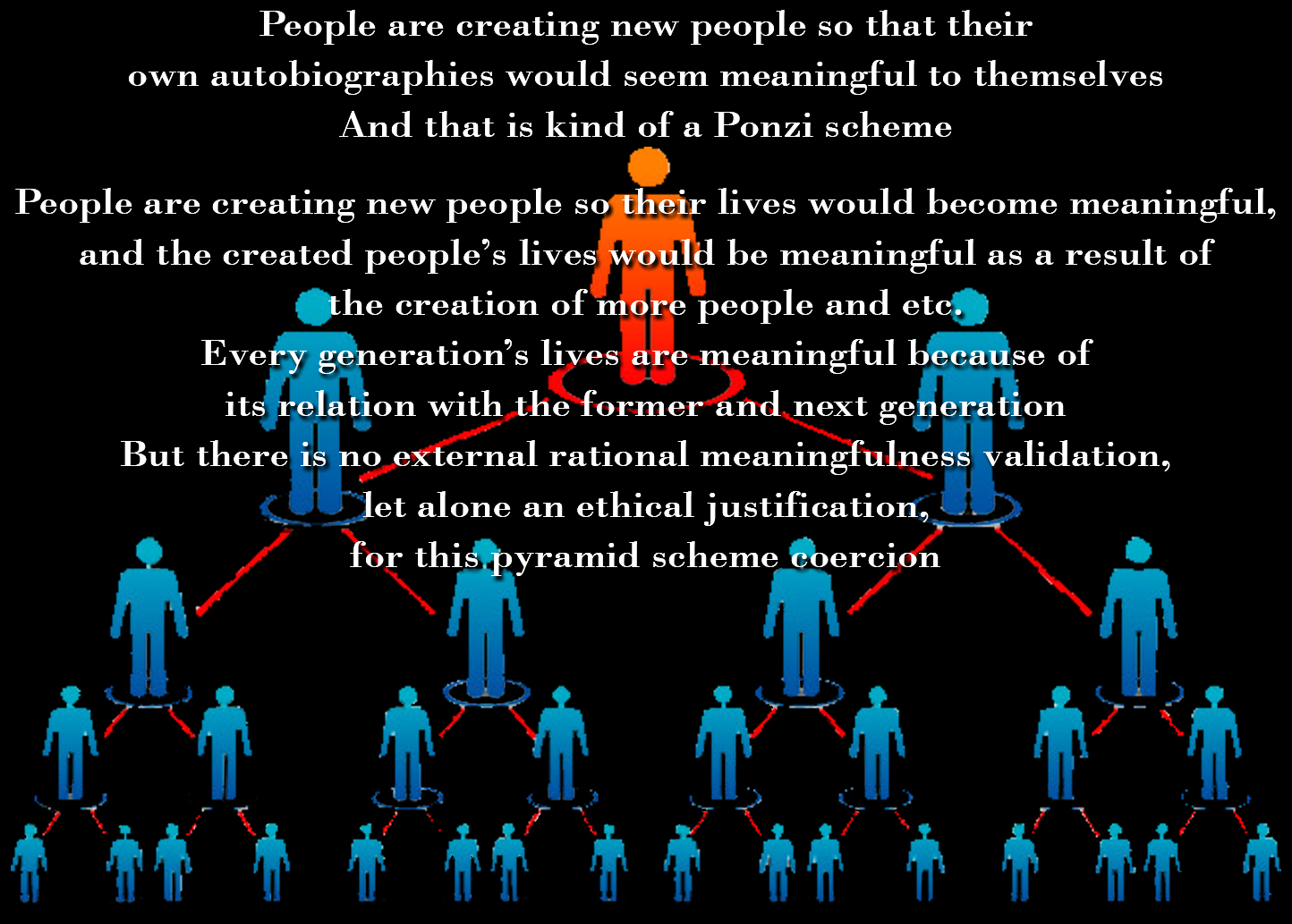
Basically it is people telling the people they are creating: ‘You have to exist because I exist. Because I was forced into this purposeless existence, you must be too. You will fill my purposeless existence with a pseudo purpose, and later you will force others into a purposeless existence and fill your purposeless existence with a pseudo one as well, and so on’.
So clearly creating new life is not a project we can justify. This is not a statement of defence, but a statement of claim.
Overall’s arguments is particularly peculiar since this whole article is about the morality of procreation, so how can it be suggested that maybe in the case of procreation moral imperatives should be rejected?
Overall tries to nevertheless defend procreation by writing about how common and socially accepted it is:
“most people sincerely congratulate women who are pregnant and women who have just given birth. We are happy for them; we see the pregnancy and birth as deserving of celebration; we see them as undertakings worthy of support. We value the woman’s labor.” (p. 4)
But these are descriptions of a pro-natalist society, not arguments or justifications of it. We know we live in one, and we knew that before reading her article. In order to morally justify procreation she needs to counter antinatalism, not to describe pro-natalism. She is a philosopher not a journalist.
However, she proceeds in this line of defense writing:
“Not only do we celebrate the woman who gestates and gives birth; we also celebrate the newborn. Almost everyone is delighted when a baby is born, at least when its creation was a matter of choice and its life prospects are reasonably good. People often feel wonder and joy when they see or hold a tiny baby.” (p. 4)
But again, these are descriptions of people being biological creatures living in a pro-natalist society, none of this can function as an ethical justification for procreation.
Overall is aware of that:
“However, at this point I am not trying to offer some form of the argument from common consent. More fundamentally, I’m pointing out just how counter-intuitive are the implications of Benatar’s anti-natalism, and how many fundamental practices it condemns. Accepting Benatar’s view requires agreeing that everyone who has been happy about a pregnancy, celebrated a birth, felt joy for a newborn, or just generally appreciated women’s procreative labor is simply mistaken. Benatar’s assessment of coming into existence requires that we see the project of having children as lamentable and morally wrong, and women’s reproductive labor as having no positive value. Benatar’s claims reject much of what humanity has, for centuries and perhaps millennia, believed and done with respect to procreation.” (p. 4)
Obviously, the fact that Benatar is making counter-intuitive and uncommon arguments is certainly not a reason to argue he is wrong. All along history there were vanguard individuals who were making counter-intuitive and uncommon arguments that in many cases were absolutory right. Overall is aware of that and writes:
“Still, Benatar writes, “[T]here is good reason to think that the majority is mistaken in judging the quality of life. Not only is there evidence that most humans are poor judges of the quality of their lives, but there are also compelling arguments that there is plenty of bad in even the best lives.” Any argument that implies that the vast majority of human beings are fundamentally mistaken about the nature of their own individual lives looks highly implausible. Of course, several philosophies imply that the majority are wrong and at least some of them have turned out to be correct: for example, advocacy of the abolition of slavery in the ante-bellum southern USA, the advocacy of human rights for women almost anywhere until the twentieth century, and the advocacy of LGBTQ rights until the twenty-first century. But notice that acceptance of slavery, of second-class status for women, and of the denial of rights for LGBTQ people are views not primarily about oneself but about other people. What Benatar’s theory commits us to is the claim that most people, if they are glad to have been born, are wrong about their very own lives.” (p. 11)
However, vanguard individuals who made claims against slavery, male chauvinism, denial of rights for LGBTQ people and against speciesism for the first time, did tell people that they are wrong about their own lives. They have claimed that white people are wrong regarding their white supremacy despite their own belief and way of living, that as far as they were concerned was genuine and natural. White people genuinely believed (and unfortunately many still do) in their natural superiority and that the natural and true order of things is that black people are inferior to them. And the first people who have made these claims argued that these people are wrong about their very own lives. We don’t look at it that way only because white supremacy is nowadays accepted as so very wrong.
All along history (and unfortunately to this very day) men were absolutely sure and so lived ‘their very own lives’ as if they are superior to women. And at some point, people told them that they are wrong about their very own lives. And just like in the case of slavery, these people were right despite telling other people that they are wrong about their very own lives. And this is also the case regarding speciesism. Most humans are still absolutely sure of their supremacy, and so, when we are fighting speciesism, we are not only claiming that other animals have rights, but considering that speciesism was and still is in everything and everywhere, that humans are wrong about their very own lives.
Historical oppressors had and still have, a certain view about their very own lives, and some vanguard individuals, told, and are still telling them that they are wrong about their very own lives.
If instead of presenting social injustice claims as that, for example, black people, women, and nonhuman animals should be equal; it was presented as that, generally speaking, white people, men and humans are wrong about their very own lives, then these and many other examples of struggles for social justice, are all cases of people telling other people that they are wrong about their very own lives.
So I don’t see how Benatar’s claim is somehow categorically different.
But even if you disagree and insist that it is, in any case, we must remember the context of Overall’s claim, and focus on that when people procreate they are not only valuing their own lives and are making decisions for themselves, but, first and foremost, valuing the lives of others, and making decisions for others. Procreation is not only undoubtedly making decisions for others, it is in fact of the most dramatic examples of making decisions for others. We need to remember and focus on that antinatalism is not about claiming that people are wrong about their very own lives, but that they are wrong about creating others’ very own lives.
And lastly for that matter, if Overall is not trying to offer some form of the argument from common consent, why bring that up? It is so common and obvious, to her and to her readers, so why even bother mentioning such a self-evident fact? Obviously we all know we live in an extremely pro-natalist society, and obviously Overall knows that we all know that, and most importantly for that matter, she knows better than to use appeal to popularity.
Appeal To Futurity
After what not only sounds like an appeal to nature and an appeal to tradition, but also sounds like an appeal to popularity, Overall’s next move may be viewed as an appeal to futurity, meaning justifying present actions based on the future:
“condemning all procreation as immoral is a repudiation of just about every activity and project that human beings, individually or collectively, undertake. As Benatar himself remarks, “It is not infrequently the case that the significance of what we do now is influenced, if not determined by, whether it will matter later.” Almost everything that human beings do is predicated upon the assumption and the hope that other people, present and future, including children yet to be born, will be around to benefit from our activities.” (p. 5)
This argument is not life affirming but the other way around as it means that life has no meaning of its own but its meaning is only a derivative of future lives, which their life meaning would also be a derivative of future lives and so on, until the extinction of the species and not until the human race achieves its purpose, as clearly it has none.
Although people can befit from actions that past people have done, people can’t benefit from being created, because no one needed, wanted or had an interest in being created before it happened. So it is not important for future people, that present people would do things that may benefit them. Present people are doing these things because they are not satisfied with focusing on their lives in the present. And that is because life in itself is purposeless. That’s one of the main reasons why people feel the need to invest in future projects, otherwise everything they are doing seems pointless. Only that it is nevertheless pointless as the future people they are supposedly doing things for, are in the same situation. They would also feel a need to invest in future projects and won’t be satisfied with their lives in their present because life in the present is pointless. But since their lives are pointless just as the lives of their predecessors were and so would be the lives of their successors, there is no point to any of it. Each generation of people creates a new one so to fill their own lives with meaning that is not really there.
The fact that people need future people so to justify their present, means that their past in a sense of them being created, is unjustified in itself. If people in the present are meaningful only since they are doing something for people who don’t exist yet but would exist only in the future, and their existence is not important in itself in any way other than to function as platform of meaning for the people who did something for future people, how can the existence of the present people matter when all it takes for it not to matter is not to create future people?
If the only thing that validates present people’s activities is that future people will be around to benefit from these activities, but the existence of future people is not needed in itself other than to justify the existence of present people, how are these activities validated? And how is it not a pyramid scheme?
Overall provides some examples for her argument regarding people’s activities being predicated upon the assumption and the hope that other people, present and future, including children yet to be born, will be around to benefit from their activities:
“Consider all of the arts: music, literature, visual art, plays, dance, film – almost no one wants their art to be ephemeral, only to be enjoyed for a brief time in the present. Almost all artists want their work to survive and to be appreciated by future generations. This is also true of architecture and engineers: While a building or a bridge may serve a useful purpose in the present, architects and engineers also intend their products to benefit people in the future, including those not born.” (p. 5)
Since I have already indirectly partly addressed this kind of argument elsewhere I will not repeat my objections here, but will shortly wonder, does she seriously suggest that in order for existing people not to feel that their art is ephemeral, new people must be created all the time, including who knows how many who would be forced with miserable lives? Is it justified to cause so many harms to so many people, not to mention to so many other sentient creatures who would be harmed by all the created people, so that some artists, architects and engineers won’t feel that their work is ephemeral?
“Consider also wide-ranging endeavors like education and healthcare: people participate in these projects not only to teach or to care for current children and patients; they also regard education and health care as crucial human activities that will continue into the indefinite future, benefiting today’s children, their children, and so on.” (p. 5)
Like art, architecture and engineering, education is also important only because and as long as people exist, but none of it is important in itself, none of it matter intrinsically, if people are gone so would the importance of their activity. Once there are no people, just like art, architecture and engineering, education immediately and automatically loses all its meaning.
Anyone who is doing things that don’t matter in themselves but matter only if there would be future people, only plays a part in the purposeless self-justifying circle of life.
Doing things for future people can’t serve as a justification for creating new people who don’t need to exist. In fact it should be exactly the opposite, since if people’s lives become meaningless if there are no future people, then absurdly the only way to justify procreation is by procreating. It is all circular, people must create new people so they can justify their own creation.
Overall argues that:
“If procreation is morally wrong because of the suffering it causes in offspring, then presumably anything that encourages and supports the existence of future people must also be wrong. Insofar as the arts, engineering, education, health care, and so on hope and plan for future people, and also contribute to their future existence, Benatar’s argument from suffering requires that they be morally condemned and discontinued.” (p. 5)
But that is not necessarily the case. People can be highly engaged in arts, engineering, education, health care and etc., for the present alone. Existing people can and should enjoy these activities if they already exist. It probably won’t happen, because people feel that many activities are pointless if they are aimed to the present alone, but that is exactly part of the problem with life, that it lacks any purpose. Otherwise why would it be so crucial for activities to affect the future? Why can’t it be for the present only?
And more specifically regarding the health care example, I find it terrible, since the high importance of health care is mostly due to people’s vulnerability which is a very good reason not to create them in the first place. To suggest that we need to create people because otherwise the health care system, which its aim is to protect them from the expected harms of life, would be meaningless, is absurd. There is a health care system because people are very vulnerable, there is no need to create more vulnerable people so to justify the health care system.
But an even worse example she gives is:
“What about farming and the production of food? People want to feed each other not only now but also in the future; to ensure that in the coming decades people will not only not starve, but also will be healthy.” (p. 5)
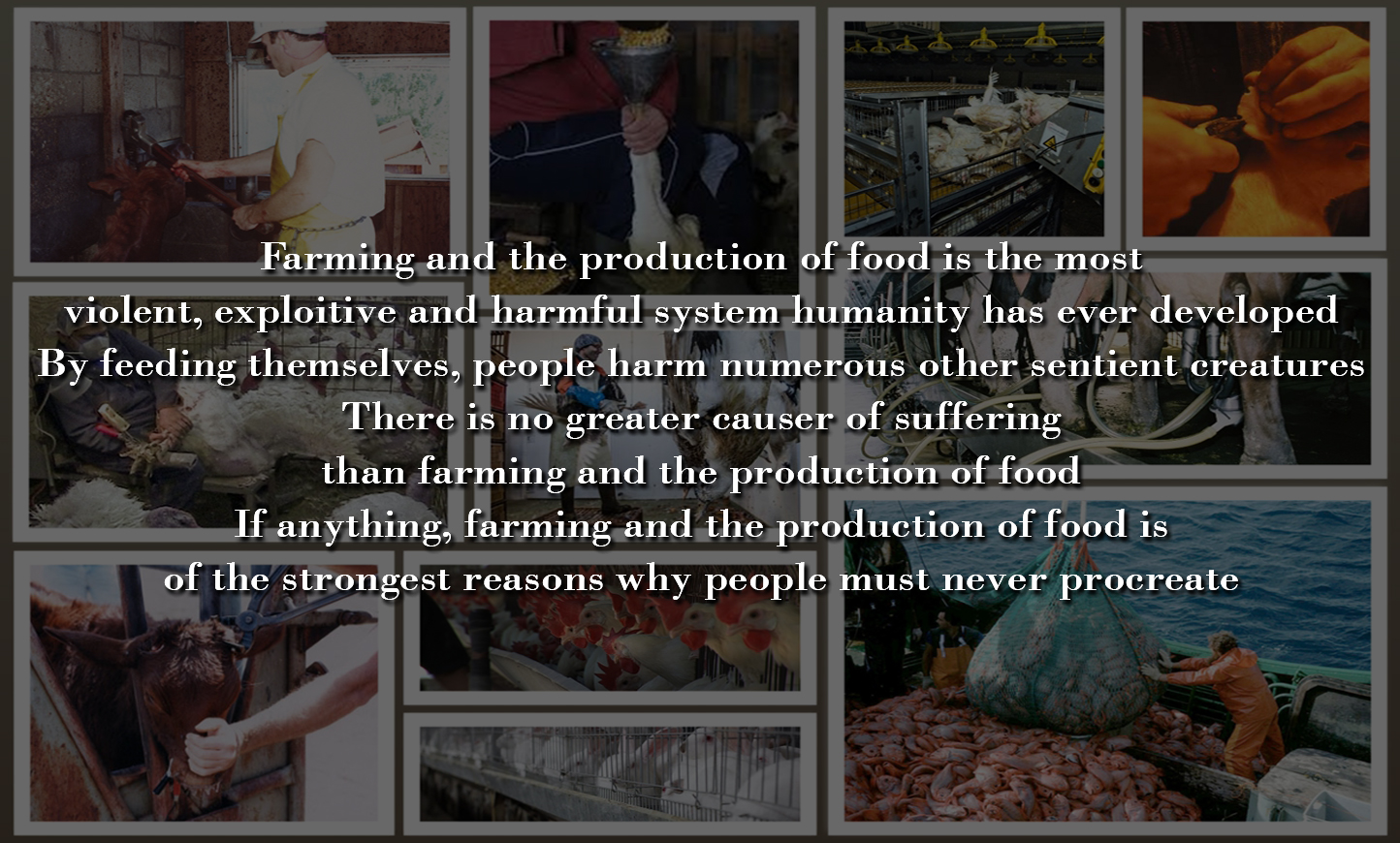
Farming and the production of food is the most violent, exploitive and harmful system humanity has ever developed. By feeding themselves, people inevitably harm numerous other sentient creatures in various ways. If anything, farming and the production of food is of the strongest reasons why people must never procreate. That is especially so, considering that the article pretend to counter the argument from suffering. There is no greater causer of suffering than farming and the production of food nowadays, and there are no greater causers of suffering than humans.
I know she means the suffering of the created person, but there is no justified reason (certainly not considering that her article is actually mostly a de facto justification of procreation) to ignore the suffering caused by the created person when discussing procreation. Furthermore, since she decided to mention humans’ supposedly positive activities, I must strongly disagree with her claim, especially in the case of one of humans’ most negative activities – farming and the production of food.
Overall argues that life can be worthwhile despite containing some suffering and gives a few examples:
“If a teacher works with children who are impoverished, ill, disabled, or have serious learning difficulties, he may find his life demanding, perhaps discouraging, yet he may very well find that life fulfilling and replete with meaningful activity. If a nurse dedicates a lifetime to caring for sick people, she may experience the process as difficult, nerve-wracking, and sometimes depressing, but nonetheless highly worthwhile and filled with purpose. Whether we measure the good in terms of intrinsic positive states, the fulfillment of desires, or the presence of supposedly objective goods, many people may very well assess them as being meaningful and well worth the miseries, pain, and suffering they may also have experienced.” (p. 7)
I allow myself to guess that it is not accidental that Overall’s examples are of people who devote their lives to somewhat alleviate the suffering of other people. It seems that, like many other people, she thinks that lives are meaningful and well worth the miseries, pain, and suffering if one alleviates the miseries, pain, and suffering of others. Why, if so, not devote one’s life to prevent, not alleviate, the miseries, pain, and suffering of so many others, by trying to prevent the creation of new people, which otherwise among them would be many miserable people?
The reason a teacher or a nurse can feel that their lives are meaningful and well worth the miseries, pain, and suffering they experience is because there are many people who are in need. Had there been no people who are impoverished, ill, disabled, or have serious learning difficulties, there would be no need for that teacher, and had there been no sick people there would be no need for that nurse.
Only since there are people who create people and some of the created people are impoverished, ill, disabled, or having serious learning difficulties, there is a need for teachers to work with them, but none of this is needed in itself. In fact, it is needed as a consequence of procreation, so it can’t be a justification of it.
Why, in a general sense, should people work hard to alleviate some of the suffering of other people instead of preventing all of it altogether?
And more importantly, why should some of people’s suffering be alleviated instead of being prevented altogether without them being harmed, by never existing?
Had everyone’s life been naturally and structurally good, there would be no need for the examples she gives for meaningful and worthwhile lives. Unintentionally, overall validates people’s lives using the suffering of others. So if to put it very bluntly, it is as if luckily there is suffering and needy people in the world as otherwise it would have been very hard to justify the existence of people. Obviously it is utterly insufficient as a justification for procreation, as the existence of needy people morally requires exiting people to provide them help, not to provide more needy people. But anyway even if it was, given that the vast majority of people are far from being engaged in making the lives of needy people better, this claim is even more ridiculous.
Most people live in an inertial way only. They wake up, they go to work, they eat, they drink, they lough a little, they hurt a little, they are sad a little, they are disappointed a little, they get tiered, and then they go to sleep so they could have strength for the next day which would be more or less the same. For most people in the world, the goal of each day is having another one tomorrow. And that goes on more or less a lifetime. Most people are living their little pointless lives without even wondering how insignificant they are.
It is indeed important to have solutions as long as problems exist, but the existence of the problems themselves is not important in itself. It is meaningful to help others because others need help, not because there is any need for any others. So the last solution to the problem of the existence of needy people is the creation of more people. If anything it is the contrary, if all people stop creating more people, all peoples’ needs would vanish with the last human generation. Once people don’t create more people there is no need to create more people supposedly to help the created needy people.
It is enough that one generation would decide that there is no longer a need to create a future generation to grant its own generation meaning, so that this whole Ponzi scheme would stop. There is no need in any generation, it’s the people who decide they need another generation because their lives are meaningless without future generations. But that will change if people of one generation would change their minds. If people of one generation would collectively decide that they need to stop this lunatic sacrificing of millions of miserable people and trillions of miserable nonhuman sentient creatures, for the sake of providing their generation a false sense of meaning which anyway doesn’t hold water, no meaning would disappear from the world. It is a matter of choice, not predestination, fate, moral obligations, physical necessity or anything of this sort.
Obviously this one generation is not about to appear, but that is a technical, psychological, sociological and biological argument, not a philosophical one, let alone ethical.
There is something awfully cruel about deciding to create another generation despite knowing that some of its people would be miserable, so not to make existing people miserable due to knowing there would be no future generations.
And anyway, clearly, it is better that one generation, of humans only, would feel that its life is meaningless, than that innumerable people from numerous generations, not to mention an infinite number of nonhuman creatures, would keep suffering from everything that vulnerable creatures suffer from in this cruel world.
An Argument for Suffering?!
Overall argues that for many people the difficulties, the efforts and even the suffering makes it all worthwhile because otherwise people would take things for granted. She writes:
“it’s not clear what an achievement would even be if it came with ease, without the discomfort of striving, being puzzled or confused, feeling doubt, working very hard. Would it still be an achievement, or would it just be something one does, like breathing?” (p.12)
But if life was structurally and naturally good, then satisfaction in achievements would indeed be something like breathing. But life is not structurally and naturally good, so it is not.
Had life been good in itself, people wouldn’t need to go through so many difficulties, put in so many efforts, and even suffer so that they would feel meaningful, because their life would just be naturally meaningful. But life is not naturally and structurally meaningful. People must make efforts and even suffer for their life to have meaning and that indicates that life has no meaning of its on and it is not good in itself.
Overall gives as an example, a writer who works very hard to write a book and it feels like an achievement because of these efforts and difficulties. But what about all the people who put a lot effort in all kinds of goals and didn’t manage to accomplish them? People usually emphasis the stories of the people who supposedly succeeded, but most don’t. And it is not because they haven’t tried really hard. Many, probably most, did try very hard and supposedly failed despite their efforts, which means that under Overall’s criterion of meaningful lives, they have suffered in vain. These are probably most of the people in the world.
But it seems that Overall is not that impressed by vulnerability to pain and suffering claiming that without them we would not be human:
“without any vulnerability to pain and suffering, we would not be human. We would not be human if there were no painful consequences when an organ is surgically removed, a triathlete struggles to finish a race, or a musician seeks to be one of the best in the world. We would have to be gods, not limited sentient beings.” (p.12)
This argument implies that being human is not only good but that it is good despite its prominent disadvantages and it is unclear why she thinks this is the case or why is it so important that there would be humans. This seems like simply a case of human chauvinism. The fact that she is a human and all her readers are humans doesn’t automatically mean that it is good to be human, or that it is good that there would be humans.
If all she argues for as a contra to human vulnerability to pain and suffering, is that without it we would not be human and therefore vulnerability to pain and suffering is not necessarily bad, she is assuming the conclusion. What we are dealing with here is human life, and one of the arguments against it is human vulnerability to pain and suffering, so human vulnerability to pain and suffering can’t serve as the basis for arguing that human life is good. It is argued that human life is not good among other things because of the vulnerability to pain and suffering, so how does arguing that had not for vulnerability to pain and suffering we would not be human, proves the opposite? If ‘being human is good’ is one of the premises then no wonder that even if human life has severe disadvantages, the conclusion would be that creating humans is basically good.
Even if I didn’t think that mankind is the worst thing to ever happen on earth (if not the whole universe), and certainly given that I do think so, I expect some justification for the claim that the human race is good and it is important that it would keep existing. But troublingly, Overall doesn’t even seem to feel any need to provide any justification or explanation for that. It is just an axiom. As far as she is concerned even the bad things turn good as otherwise we wouldn’t be humans. But according to this logic we would not be humans without wars, organized religion, male chauvinism, animal exploitation, and etc., does it make all them good as well?
Overall argues that human life, with its vulnerability and finitude, is preferable to a life that in fact cannot be instantiated. She suggests that we imagine that her desire is to “fly like a bird, or to be invisible to other human beings, or to time travel into the past or the future” (p. 14), but since “The first two are now physically impossible; the second is probably logically impossible” she argues that “Benatar’s good life requires conditions that are impossible to fulfil.” However, exactly because it is impossible to fulfil the required conditions for a good life we shouldn’t create them. Since we can’t even imagine life with no violence, exploitation, sexual offenses, bullying, pollution, natural disasters, accidents, diseases, pain, and death, life is not good. Had it been possible for all life to lack all these harms then life would have been good and it was hard to convince people not to create more of it. But exactly because life is so highly dangerous and vulnerable, and exactly because there is no possibility that they won’t include pain and suffering, they shouldn’t be created.
Life is bad because most people are unsatisfied most of the time, and when they are it is usually at the expense of others. So to nevertheless favor life is to support, even if indirectly and unintentionally, the notion that ‘the stronger one wins’. I am sure that Overall doesn’t in any way explicitly support war of ‘all against all’, and is probably a supporter of trying to level people’s conditions as far as possible. However, it would still be the case that the satisfied would be the ones who were lucky enough to be born with better natural traits, to more capable families, in better environmental conditions, or that are simply lucky in the sense of being at the right place in the right time. Life is so arbitrary and unfair, that it is better that they would not be than that the majority would be dissatisfied most of the time and the ones who are satisfied are so mostly because of luck and unfair conditions.
And more importantly, Overall insists that life without pain and suffering would be worse:
“consider what kind of beings would we be if we did not feel worry when a friend is not well, fear when a child takes a risk, regret at the end of an important relationship, or sorrow at the death of a loved one. It is hard to see how a human being could be a caring, loving person, connected to other human beings by bonds of love and friendship, in Benatar’s imagined world. Emotions like worry, fear, regret, and sorrow are painful, and if a good life, in Benatar’s terms, is devoid of significant sufferings, then either we could not form bonds, or those bonds would be strangely cool, detached, even indifferent. Surely such bonds could not be caring or loving in any current sense of those terms. Not only is it very unlikely that anyone except maybe psychopaths or robots could form such connections; it would also be a serious damage to our humanity, to our capacity for meaning, and to our moral lives. Is this truly preferable to our current lives?” (p. 13)
Only that this is not at all Benatar’s imagined world. In Benatar’s world there is no need to worry when a friend is not well, to fear when a child takes a risk, to regret the end of an important relationship, or to sorrow at the death of a loved one because none of this exists. The reason it is hard to see how a human being could be a caring, loving person, connected to other human beings by bonds of love and friendship in Benatar’s imagined world, is because there are no humans in Benatar’s imagined world. There are no emotions like worry, fear, regret, sorrow and pain because there are no people, and that’s the whole point. Exactly because all these things and many more are inevitable, exactly because all these things are unnecessary, and exactly because all the good things in life won’t be missed by anyone who was never created, we need to avoid creating new people.
Overall presents the issue as if Benatar suggests a solution which is actually worse than the problem it aims to solve, but that is not true. It is she who suggests pain and suffering and vulnerability because for reasons she refuses to share with her readers she is unwilling to depart from humanity. Benatar is not only willing to depart from humanity so to end human pain and suffering and vulnerability, but he is in favor of that. And therefore the world he describes which lacks any human being couldn’t be worse for humans. Benatar doesn’t suggest nor implies trading pain and suffering with lack of care and compassion, he suggests preventing pain and suffering along with the need for care and compassion, by not creating more people. She argues that the price in his option is higher despite that the whole point is that there is no price in his option. In his option, no one would be harmed by existing, and no one would be harmed by not existing.
Had life been good in itself, people would have simply enjoyed their very existence, and there was no need for caring and loving bonds. In fact probably the happiest people in the world are the ones who are capable of meditating in the highest level possible and these are usually the most solipsistic people alive.
The need for caring and loving bonds is an indication of vulnerability, and it creates vulnerability, as people are hurt as a consequence of their bonds all the time, in all kinds of ways, be it by the other people they bond with, or when these people are sick, harmed by accidents, wars or disasters.
Bonds are not needed in their own sake but only if and since people exist, and since life is so hard and so full of pain, fear, regrets, losses and suffering. Only because life is so hard and painful and since it is often easier to go through them when having significant caring and loving bonds, bonds are important, but had people not existed there would be no need for bonds among people and there would be no loss of bonds among people. Bonds make some people’s lives somewhat easier when they already started, but they are not by all means a reason to create them in the first place, let alone when life is full with pain and suffering. Whom who have never been created is not deprived of any bond, is not harmed by any bond, is not harmed by losing any bond, doesn’t fear of losing a bond, and has no worries, anxiety, disappointments and etc., in relation to bonds.
Her Children and Benatar’s Anti‑Natalism
Speaking of bonds, Overall mentions her daughter’s reaction to Benatar telling Overall during an antinatalism conference he hosted in 2008 – that she should contemplate the fact that if she had not had her children they would not have to suffer:
“When I later recounted Benatar’s conference statement to my daughter, she was indignant and, in her word, “ofended.” How could he possibly claim to know better than she does about her own experiences, her own assessment of her life? I agree: My children, like everyone else, are the authorities on the assessment of their lives. If they don’t think it would have been better that they had never been born, Benatar does not have the cognitive and moral authority to say they are wrong, or to claim to know better how bad their lives really are.” (p.15)
Since I have addressed Benatar’s Quality of Life Argument and its derivatives in a former text, I’ll not repeat my observations here as well, but I do wish to shortly relate to an aspect of Overall’s claim that I find important to address.
Overall’s daughter didn’t create herself, nor did she decide to be created at all, certainly not the person she ended up being. The decision to create Overall’s daughter was made by her parents, not by herself, and certainly not by David Benatar. Benatar “only” argues that creating people is morally wrong, he doesn’t decide that people would be created or not. Parents do. Benatar argues that all life is better never to have been, he doesn’t decide which life would never have been. Benatar has made an argument, he didn’t make a decision regarding Overall’s daughter based on his view that he knows better than she does about her own experiences, her own assessment of her life. On the other hand, her mother did make a decision regarding her daughter based on her view that she knows better than her daughter about her own experiences, her own assessment of her life, and that decision is to create her. When Overall created her daughter she decided that her daughter would have a good life, but how could she possibly claim to know better than her daughter about her own experiences, her own assessment of her life?
While Benatar doesn’t and can’t use any authority to force his views on people, parents are definitely using authority to force their children to accept their very existence as a fact.
Benatar creates arguments that people may accept or reject, parents create people that can’t reject their own existence. People may decide to end their existence later in life, but no one can undo its own existence. People can’t retroactively cancel their own existence. Regardless of liking it or not, existence was necessarily forced on everyone who was created, most probably by the parents.
So it is Overall who decided for her daughter despite not having any authority to make that decision. Unlike Benatar, Overall has not written, argued, or counter argued, but has decided, in the most concrete and pronounced manner possible, something for someone else.
And that something is more than the very fact of being created, but also many aspects of that person’s existence. To procreate is to place the created person in a particular position with particular conditions that include: genetic makeup, physiological traits, psychological traits, biological sex, sexual orientation, ethnicity, cultural heritage, linguistic community, religion, geographical location, country, city, street, house, social status, economic status, family, and parents; all determining the created person’s identity, character, temper, horizon in a sense of who they can be, what they can do in life, and etc., and from now on, that person, despite not choosing any of it, has no choice but to become adjusted to it.
Procreation is an imposition because people are being created in a certain point in time, in a certain place, to a certain society, culture, and history, in a certain body, to a certain set of relationships, none of which they have chosen, yet it all deeply and directly affects their existence.
Overall has decided that the children she would create would have worthwhile lives, without knowing that in advance and without having the cognitive and moral authority to make that decision.
Overall’s daughter didn’t exist before Overall decided to create a person. There was no Overall’s daughter before Overall decided to create one. It is she who made a determination not Benater.
As long as Overall’s daughter’s life would be good in her own assessment, she would probably be “offended” by Benater and not by her mother who actually made the decision for her, but what if she felt differently? It is an easier case for Overall considering that it seems that her daughter is happy that she was created, but since it is in any case Overall who has decided that her daughter would exist, had her life turned out to be miserable, it is she who decided that her daughter would live a miserable life.
Overall begins her article by arguing that she cannot bring herself to regret or feel guilty, nor to believe that it was altogether morally wrong for her to create two people. But that is most probably because she wanted to do it, because she was biologically and socially driven to do it, because she enjoyed raising them, because she enjoys their company now, and because she is sure (maybe rightfully so) that her children enjoy their lives.
However, one of the most prominent points about the argument from suffering against procreation is that you mustn’t procreate because you cannot tell beforehand whether the people you will create will severely suffer in life. Overall may be sure that her children don’t suffer in life and in fact even enjoy it very much, but she couldn’t possibly know it in advance, and she can’t possibly guarantee that this would remain the case for the rest of their lives.
That her children don’t suffer in life, at least not enough for their lives to be not worth creating in their own view, can’t be the basis for a valid ethical argument regarding procreation since it necessities creating people and only then, meaning only retroactively, consider whether it was the ethical choice or not. All that this argument can offer is, supposedly, a presumed prognosis of whether creating a specific life was justified. And even that is only retroactively, while the whole point is to tell beforehand so to prevent misery. What’s the point of stating that a life that turned out to be miserable should have not been created after it already happened? Our ethical system should be one that prevents suffering, not pointing at it after it happened. So even if we’ll accept the premises of this claim, there is nothing ethically productive in being able to state which lives were better not to have been created, after they already have.
If only after creating people we can ethically examine the decision to create them, it is always and necessarily too late, as they already exist, and so the unethical decision has always already been taken.
Some may reply that this is also the case when deciding following this logic, to never create new people, despite that some would have had joyful lives. Only that in the case of creating miserable people there are victims, but there are no victims of great lives that no one had lived and so no one had missed.
References
Benatar, D. Better Never to Have Been (Oxford: Oxford University Press, 2006)
Benatar, D. Every Conceivable Harm: A Further Defence of Anti-Natalism
S. Afr. Journal Philos., 31 (2012)
Benatar, D. Still Better Never to Have Been: A Reply to (More of) My Critics
Journal of Ethics (2013)
Overall Christine, My Children, Their Children, and Benatar’s Anti‑Natalism (2022) The Journal of Value Inquiry https://doi.org/10.1007/s10790-022-09886-6
Overall Christine, Why Have Children? : The Ethical Debate (The MIT Press 2012)
Leave a Reply