Category: Articles

Could There Ever Be a Duty Not to Have Children?

In an article called Could There Ever Be a Duty to Have Children? Author Anca Gheaus argues that there is such a case, and ironically, it is the hypothetical scenario in which people voluntarily stop procreating. In such a hypothetical scenario Gheaus argues: “it could be legitimate for states to incentivize and maybe even coerce individuals to bear and rear children […] in order to avoid great harm to a potential last generation of childless people”.

Gheaus’ argument is not (at least not directly) an anti antinatalist argument. She doesn’t make the familiar argument of opposing antinatalism, supposedly on behalf of a last generation, an argument which I have addressed in former texts so I will not address it here.
Gheaus states that her argument “start from the background common-sensical view that having children is morally permissible: under normal conditions (including normal demographic and environmental conditions)”. (p. 1)
And she also conditions her argument on two assumptions: “First, that the prospective children will have adequate lives which are not worse, on average, than those of their parents’ generation. Second, that procreation is not, in general, morally wrong.” (p. 1)

So Gheaus’ argument may not be a direct counterargument to antinatalism using the harm to the last generation, but it is a defense and even a coercion of procreation due to the harm to the last generation, and therefore I wish to make a short comment on her claim.

Despite it not being a direct anti antinatalist argument and despite her conditions, it is hard to ignore her ignorance about the harm bound with creating new people – that is the harm to the created people, and to the numerous sentient creatures who would be harmed by the created people all along their lives so to provide them with what they need and mostly with what they want.

Conditioning the argument on that the prospective children will have adequate lives which are not worse, on average, than those of their parents’ generation, doesn’t guarantee that many people would not be miserable. Practically speaking, ‘on average’ means that at least some people of each generation are expected to be miserable. So even if we consider only the harm to the created people, especially considering that procreation is expected to prolong for many generations until the last one comes, it is highly probable that their misery alone would be greater than the misery of a last generation. And when adding all the harm that all the created people, until the last generation comes, would cause to others, there is absolutely no doubt that the harm would be much greater than the harm to the last generation. Clearly much more harm would be caused if procreation continues, let alone if it would be forced on people, than the harm caused to the last generation.

What makes things even worse is that a last generation is bound to someday come. Whichever and whenever, the harm to the last generation is inevitable. If it would happen anyway, why add so much harm until it inevitably comes? Anyone who is created until the last generation comes won’t prevent the harm of the last generation but would only add to the general harm.

There is no need in this case for the radical argument that any case of procreation is an ethical crime towards the created person, since even a much softer antinatalist formulation, such as that allowing procreation is an ethical crime because undoubtedly at least some people would be miserable, is sufficient to rebuttal her argument. And that is since it is very hard to presume that the harm to the last generation would be greater even than the harm of all the miserable people who would be created up to the last generation, supposedly for its sake.

But perhaps more importantly and surely more certainly, no matter what kind of lives the created people themselves would have, due to the immense harm caused to others by all the created people until the last generation comes, there is no chance that the harm to the last generation would be worse than the harm to all the creatures until then. So if anything, there should be a duty not to procreate, and not under specific hypothetical conditions but right here right now in our everyday reality.

Gheaus’ argument is in a way, taking the argument of the harm to the last generation to the next level, because although she raises two conditions she also raises the bar by arguing that in the case of a generation who doesn’t want to procreate, it is ethically justified to force it to.
She writes in the introduction:

“This chapter argues that there is a collective responsibility to have enough children in order to ensure that people will not, in the future, suffer great harm due to depopulation. Moreover, if people stopped having children voluntarily, it could be legitimate for states to incentivize and maybe even coerce individuals to bear and rear children.”

I agree that there should be a collective responsibility to ensure that people in the last generation will not suffer great harm and I have referred to this issue in other texts, I just don’t understand why this collective responsibility should not only skip all the generations until the last one, but sacrifice so many individuals from so many generations, for the sake of the last one. Where is the collective responsibility to ensure that people, and any other sentient creature, from any other generation, will not suffer great harm? Where is the collective responsibility for all the misery that would be caused until the last generation?

Forcing people to procreate against their will is to punish them so to supposedly avoid punishing other people, those of the last generation, and all the more so despite that their harm is inventible.
This suggestion is to perpetuate vulnerability and harm instead of seizing the moment and solving it for good.

Besides, if there ever is a generation that doesn’t want to procreate, it would also be the last generation, so it would be the very same generation that would be the “victim” of its own decision not to create a new generation to take care of it. Why force a generation to procreate against their will supposedly for their own sake? If that is the decision that a generation has made it is probably the case that that generation preferred not to procreate over being provided with care when they get old. The chances for a generation like that to ever come along are close to nothing anyway, so of all generations, to punish this one?! If someday such a noble and responsible generation would appear, why ruin it with a duty to procreate?

People deciding not to procreate is not a problem, it is a solution.
But apparently, while we are vainly trying to convince humanity to stop procreating, some thinkers argue that even if our improbable wishes would ever come true, these people must be forced to procreate anyway. What is a dream to us, to some people is a nightmare.
But obviously that is not the biggest problem about a generation that decides not to procreate, the biggest problem about it is that it would never ever come voluntarily. For such a generation to ever truly come, we need to make it.


References

Gheaus Anca Could There Ever Be a Duty to Have Children? (2015)
DOI:10.1093/acprof:oso/9780199378111.003.0004

Functional Immorality – Part 2

The following is the second part of my reply to Phil Torres’s article Can Anti-Natalists Oppose Human Extinction?
A quick reminder, Torres suggests a ‘no-extinction anti-natalism’ position for “people who, like myself, are sympathetic with the moral prescription not to procreate but are also inclined to think that human extinction would constitute an immense tragedy”.
In the first part I have addressed the arguments against human extinction that Torres specifies and finds convincing. In the following text I’ll focus on his attempt to avoid an internal contradiction in his ‘no-extinction anti-natalism’ position, as well as on the life-extension technologies he details and the various harmful possibilities involved in them.

Harming Humans, and Infinitely More Nonhumans, to “Save” Humanity

Since Torres is convinced by the arguments against human extinction as well as by the arguments against human procreation, he suggests his ‘no-extinction anti-natalist’ position, that calls to stop creating more people, while actively promoting the development of safe and effective life extension technologies that will grant the final human generation functional immortality, and so avoids human extinction.

He details two main ways that can achieve functional immortality. One is called “whole-brain emulation” or “mind-uploading,” which I’ll elaborate about later, and the other way is extending life through biomedical anti-aging interventions:

“For example, geroprotectors are drugs that decelerate aging; the anti-diabetes drug metformin, for example, has been shown to reduce “all-cause mortality and diseases of ageing independent of its effect on diabetes control” (Campbell 2017). And lifelong caloric restriction has been observed to “considerably [extend] both the healthy and total life span of nearly all species in which it has been tried, including rodents and dogs” (de Grey 2004, 724). A more speculative possibility involves what Aubrey de Grey calls “strategies for engineered negligible senescence” (SENS).
There are nine primary types of deleterious, cumulative changes that are associated with aging: cell loss (without replacement); oncogenic nuclear mutations and epimutations; cell senescence; mitochondrial mutations; lysosomal aggregates; extracellular aggregates; random extracellular protein cross-linking; immune system decline; and endocrine changes (de Grey 2003). Interventions to halt or reverse these changes using CRISPR/Cas9 and other synthetic biology systems could thus potentially halt or reverse senescence itself.” (p. 16)

Torres argues that for someone to attain functional immortality it is not necessarily needed that the senescence-stopping technology would be fully realized before or soon after its creation, and it is because of the idea of “actuarial escape velocity” (AEV), which refers to the defined moment when advances in new anti-aging interventions occur faster than one ages, using previous anti-aging interventions. So it may be the case that from a certain point, a person only needs to live long enough to live forever.

Torres speculates that AEV won’t arrive until 2110. Given an average lifespan of 80 years, by then, most people born today will die. That means that humanity would have to keep procreating, which is in opposition to his ethical stance against procreation, in order to achieve functional immortality, which is in accordance with his ethical stance against extinction. And Torres, whose antinatalism relies on Benatarian arguments, knows that he can’t justify further procreation to avoid human extinction for the sake of people who don’t yet exist, but only for the sake of people who already exist. In other words, procreation can’t be justified unless creating new people somehow reduces harm to already existing people. So he suggests to exploit this line of reasoning as a work-around to the problem of creating new people to reach AEV, if that were to be necessary. And he claims it can be argued to be necessary considering the suffering of the last generation, suffering that according to him functional immortality can prevent.

He suggests that all is needed is for three more generations to procreate in order to reach AEV:

“if the length of a contemporary generation is ~25.5 years, and if the average lifespan remains at ~80 years, then the last humans on a phased-extinction schedule would die in about 131 years, circa 2150. In other words, children born today would have children in 25.5 years, these children of children would have children 25.5 years later, and these children of children of children would refrain from having children but live another 80 years.” (p.21)

Although I don’t accept the anti-Epicurean position that death is bad for the person who dies (as explained in the text about the death argument), or the deprivation account regarding death (which I have shortly addressed in the text about the death argument as well in the text about Benatar’s relation to pro-mortalism), two positions that Torres holds, even if for the sake of the argument I’ll ignore my opposition, I can’t see how sacrificing three generations of people can be balanced by the harm to the last generation, especially considering that according to Torres, coming into existence is always a harm, and that death is almost always bad. If so, how is it plausible to condemn more people to the harm of being created and to the supposed harm of death for the sake of preventing only the harm of death from much less people by making them immortal?

Furthermore, Torres suggests that we ought to weigh the harm of the people from the last generation against the harm of procreation of the people who will need to be created until AEV, but that is a false equivalency. Procreation is not only forcing needless and pointless suffering on the created person, but is also, and in fact first and foremost, forcing needless and pointless suffering on thousands of other sentient creatures, since each person created is hurting thousands of sentient creatures during a lifetime, simply by eating, drinking, cooking, dressing, cleaning, cooling, heating, lighting up, dwelling, moving around, entertaining oneself, and etc.
Considering that every year about 150 billion sentient creatures are tortured in the most appalling ways in the food industry, and considering that that is only part of the suffering humans are constantly causing to others, practically by everything they do, then the suffering of the last generation of people can be balanced, at least in terms of the number of victims, by about two weeks in this hellhole.
Considering the harm to others caused by these three generations, not to mention for eternity, or at least for as long as humanity’s functional immortality lasts, the number of victims, and the extent of their suffering, completely dwarfs the suffering of the last generation.

I don’t at all take lightly the suffering of the last generation, I just fail to understand why it is more important than any other suffering, or how can it seriously be balanced with all the suffering that would be caused to the generations preceding it, all the suffering that all the preceding generations would cause to others, and all the suffering that the last generation would cause, especially if it would gain functional immortality.
And I think that there are ways to significantly ease the suffering of the last generation. Advocating for the right to die for example, if successful, can ease the suffering of many members of the last generation. If these people would have a relatively easy, simple, available, painless way to end their existence, I have no doubt that many would choose it and would spare themselves a lot of suffering involved with getting old.

Or more relevant to this issue, if all the resources needed for functional immortality to succeed would be directed at easing the suffering of the last generation, for example, by providing anti-ageing treatments to several representatives from each community, who would volunteer to ensure a ‘graceful exit’ for the rest of humanity, that can significantly reduce the suffering of the last generation of people. Each community can choose a group of people who would be responsible for the needs of the whole community, and to ensure that these people could indeed take care of the rest, they and only they would receive some treatment, only to ensure as far as possible that they would remain highly functional for another decade or so, and then would gradually perish like the rest.

Torres doesn’t speculate or even mention anything of this sort and I think it is not accidental. I suspect that way more than that Torres is interested in ways to save the last generation, he is interested in “saving” the species. Otherwise he wouldn’t have specified arguments against human extinction, but mainly emphasis that antinatalism has a problem and it is the suffering of the last generation.

But even if it was really the harm to the last generation that was in the center of concern in this article, not only the interests of this generation must be considered, but also the interests of everyone who would be sacrificed and otherwise harmed by this generation. We must consider their interests not to be imprisoned for their entire lives. We must consider their interests not to live without their family for their entire lives. We must consider their interests not to suffer chronic pain and maladies. We must consider their interests not to be deprived of breathing clean air, walking on grass, bathing in water, and eating their natural food. We must consider their interests not to be violently murdered so people could consume their bodies. We must consider their interests that their habitats won’t be destroyed, and that their land, water, and air won’t be constantly polluted.

How many miserable lives does it take for the continence of the human species to become ethically unjustified?

But it goes even further than that. What should be weighed against the interests of people from the last generation is not only the harm of procreation of the at least three generations until the point that functional immortality is possible, and not only the nonhuman animals who would be harmed by these at least three generations, but all the harms, and all the misery, and all the suffering that would ever be caused by humans if they won’t go extinct. The equation is between one generation of people, and all the victims of all the procreations that would ever occur.

The number of individuals who would have to endure all kinds of harms in the future if humans won’t go extinct, is practically infinite.

Objecting human extinction is forcing endless suffering on an endless number of individuals. Harm is unavoidable, the question is of extent. The harm of human extinction is for one generation only. The harm involved in the refusal for human extinction can last for as long as functional immortality lasts.

Even if Torres succeeded in finding a loophole that enables him to remain antinatalist while being anti-extinctionist, he doesn’t succeed in formulating an argument that enables him to remain ethical and anti-specieist while being anti-extinctionist.

The suffering of the last generation can’t serve as an excuse against human extinction. The human race must go extinct because there never was a species even remotely as harmful as humanity. But there can be a worse one and that is an immortal version of humanity. With many more years to live and with many more capabilities, there is no limit to how harmful humans can be in the future.

Digitizing the Problem

Earlier, I have mentioned, only by its title, the first main way to achieve functional immortality that Torres details. Now it’s time to elaborate.
Whole-brain emulation, or “mind-uploading,” involves:

“simulating the microstructure of the brain on a computer with sufficient fidelity to reproduce consciousness. This assumes that minds are multiply realizable, by virtue of being “organizational invariants” that arise from systems exhibiting the right functional organization, whatever the physical substrate (Chalmers 1996). If this “can be made to work,” it would constitute “the ultimate life-extension technology,” since uploaded minds “would not be subject to biological senescence” and “backup copies could be created regularly so that you could be re-booted if something bad happened (thus your lifespan would potentially be as long as the universe’s)” (Labrecque 2017, 166). There are three main forms of uploading: (i) destructive uploading (the original brain is destroyed either gradually or instantaneously), (ii) non-destructive uploading (the original brain remains fully intact while a copy is made), and (iii) reconstructive uploading (the original brain dies but the person is recreated based on historical records) (Chalmers 2010; see also Sandberg and Bostrom 2008).

One version of destructive uploading is the “microtome procedure.” This involves freezing a recently deceased brain to liquid nitrogen temperatures, slicing it into small sections, scanning the slices, transferring this information to a computer, and then simulating the brain. A nondestructive option is to scan the brain “from within … using nanobots” that transfer this information via wireless systems to a computer (Kurzweil 2005). A reconstructive option could become possible if, for instance, a future superintelligent machine were to collect enough data about a past person to design a program that instantiates the relevant functional-organizational properties of that person’s brain (Chalmers 2010). This is predicated on a distinction between clinical death and information-theoretic death, where the latter refers to the point at which no information about one’s nervous system is permanently lost (Merkle 2018).” (p. 16)

Some may recognize potential harm as well as contradiction to antinatalism, from these descriptions alone, and ironically Torres himself specifies some further problems involved in these options that contradict antinatalism and also his view on death:

“The most clearly problematic case involves non-destructive uploading, since this would yield two numerically distinct persons who are psychologically continuous with a single original (who continues to exist as one of these beings).
This leads to two issues:
First, if one maintains that persons, in the metaphysical sense, are intrinsically singular, then they cannot be organizational invariants, which means that the uploaded mind would in fact be a different person than the original; hence, non-destructive uploading would not enable one to achieve functional immortality. Why think that selves are intrinsically singular? Consider a case in which you visit a Digital Immorality Clinic. They pump your blood full of wirelessly connected nanobots that cross the blood-brain barrier and map-out the functional organization of your nervous system. This information is sent to a computer placed within a realistic android, similar to those in the TV show West World. You and this copy are later kidnapped and told that either you—the person that walked into the clinic—or your copy—the person that was created in the clinic—will be tortured for 48 hours and then murdered. Let’s say care most about your own well-being. No rational person would then say, “Pick one of us, randomly. We’re the same person, so it doesn’t matter.” To the contrary, someone acting out of prudence should exhort: “Torture the copy!” The idea that persons are singular entities makes sense of this situation.

Second, whether or not the uploaded mind is you, the fact is that post-upload there would exist two rather than just one conscious entity: the original and the functional isomorph. Hence, non-destructive uploading entails the creation of a new person, and since it is always wrong to create new persons, according to anti-natalism, it must always be wrong to non-destructively upload one’s mind. Call this scenario “digital procreation.” Anti-natalists should therefore strongly oppose this form of uploading independent of one’s view of personal identity.
The same goes for reconstructive uploading: even if the functional isomorph is the same person, it would entail the creation of a new conscious being—a new being at T3 based on the informational patterns of a being who existed at T1 but died at T2—which would be wrong. ” (p.24-25)

And about Destructive Uploading he says:

“Consider a piecemeal process whereby each biological neuron in one’s brain is replaced by a functionally isomorphic artificial neuron. Mark Walker (2008) calls this “gradualism,” and it seems intuitively plausible that it would preserve continuity of consciousness from the beginning to the end, at which point the whole brain has been replaced by non-biological matter. If continuity of consciousness is all that is needed to preserve personal identity, then the person at T2 will be the same as at T1. Benatarian anti-natalists should thus applaud this form of uploading, since it would enable the uploaded person to evade death. But if the person at T2 is different than at T1, the situation would be doubly wrong. The reason is that it would entail not only the creation of a new person, which would be bad, but the death of the original person, which would also (usually) be bad. ” (p.25)

And suggests that Destructive Uploading is anti-antinatalist:

“if one accepts the harm-benefit asymmetry, and if death is (usually) bad, then even a low probability that destructive uploading kills the original while creating a new person should be sufficient for anti-natalists to strongly oppose gradualism. ” (p.28)

Torres raises another potential concern and contradiction to antinatalism:

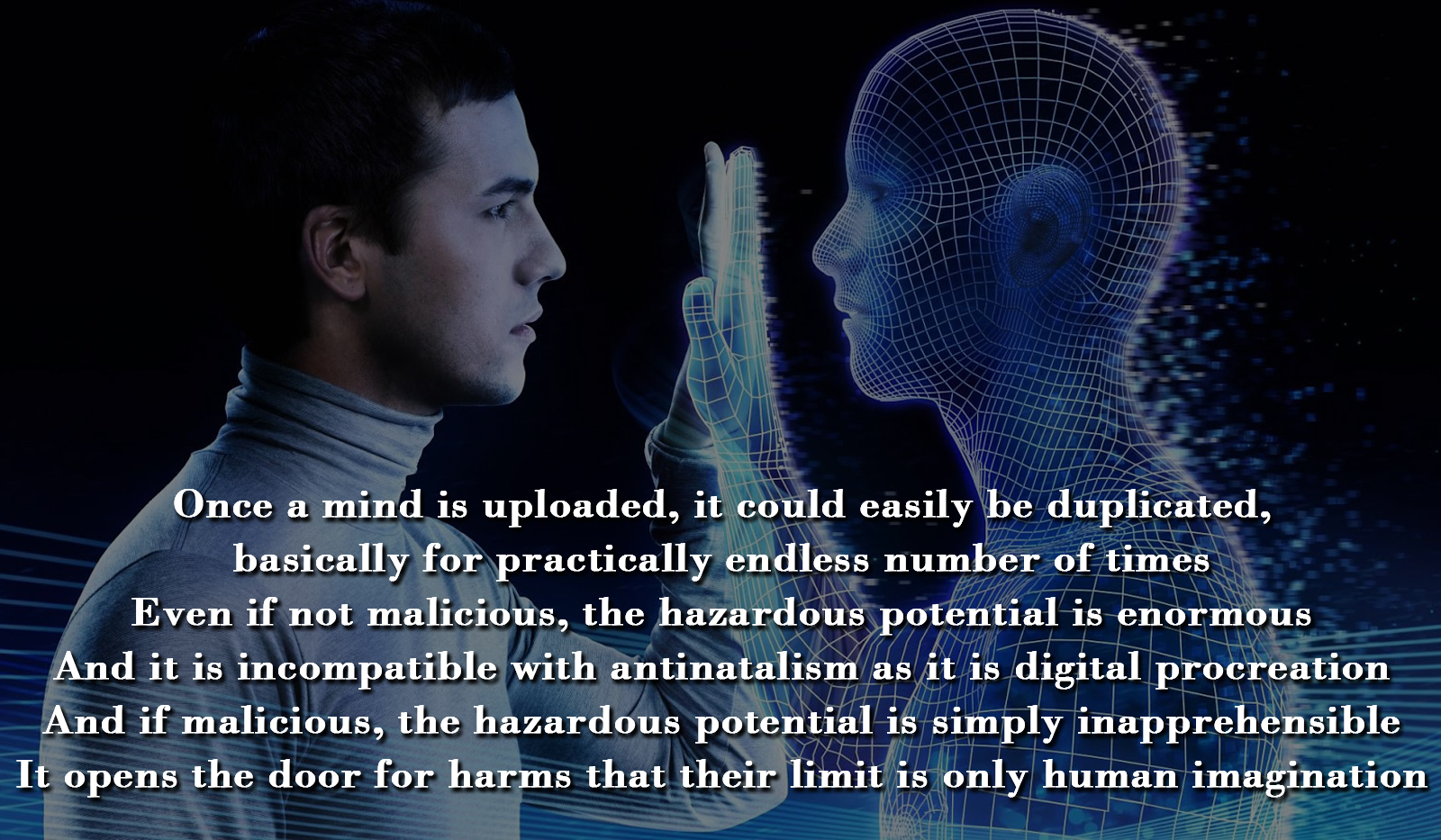
“A related problem concerns the possibility of duplication gestured at by Schneider and Corabi (2014). As they suggest, once a mind M is uploaded, it could easily be duplicated on multiple computers an indefinite number of times. This is orthogonal to the question of whether M would be personally identical to the original; what matters is that before M has been duplicated, the duplicate M’ does not exist, while after M has been duplicated, both M and M’ exist. Call this “duplicative procreation.”” (p.28)

And the hazardous potential of such an option is enormous, even if not malicious. For example, someone may wish to temporarily emulate its own mind a couple of times so to accomplish many more tasks, and when done to terminate these “spurs”. This scenario is disturbing according to Torres for many ethical reasons:

“Since spurs are numerically separate entities, terminating them would be tantamount to murder—a type of “mind crime,” in Bostrom’s (2016) phraseology. Furthermore, as Anders Sandberg (2014) notes, “if ending the identifiable life of [a spur] is a wrong, then it might be possible to produce a large number of wrongs by repeatedly running and deleting instances of an emulation even if the experiences during the run are neutral or identical” (Sandberg 2014, 288). Even more, since creating spurs entails duplicating mind-uploads, anti-natalists should be especially worried about this futuristic scenario obtaining, since it would mean both creating and killing a conscious entity.” (p.28)

And the malicious potential of such an option is simply inapprehensible. It opens the door for so many harms such as military uses, enslavement, sadism, and etc., that their limit is only the human imagination.

In one of the article’s notes Torres briefly mentions some more concerns in other areas such as:

“In brief, general problems include the question of how society will need to be restructured to accommodate people who will never retire and whether people with indefinitely long lives will suffer from crushingly oppressive ennui— especially if, Soren Kierkegaard (1852) speculated, “boredom is the root of all evil.” There are also concerns about overpopulation, associated today with climate change, ecological collapse, and other environmental ills, if humanity continues to procreate without older generations dying off (see Kuhlemann 2018). Yet ceasing to procreate could remove a major source of value for many people; as Larry Temkin (2008) writes, “if the cost of immortality would be a world without infants and children, without regeneration and rejuvenation, it wouldn’t be worth it.” Even more troublesome is the question of who gets to be included and excluded in the final generation? What happens if apocalyptic terrorists, deranged dictators, genocidal madmen, violent psychopaths, and dangerous lone wolves gain access to technologies that could essentially confer eternal life? Consider that, at the behest of Joseph Stalin, “life-extension became a central subject of Soviet medical research” (Medvedev and Aleksandrovich 2006).” (p.43)

And in another note he mentions that attempts to emulate entire nervous systems could themselves pose some serious ethical hazards:

“as Bostrom notes, “before we would get things to work perfectly, we would probably get things to work imperfectly” (Bostrom 2014b). The result could be that imperfectly simulated brains experience moments of truly intense suffering, perhaps in the form of psychotic hallucinations or delusions, grand mal seizures, and so on, before a normal state of consciousness and mentality is established. (Bostrom 2014b).” (p.44)

Yet for some reason, all of that didn’t convince Torres to abandon such a dangerous and problematic option. There are many other concerns, questions, fears and dangers involved with this idea, but the ones he mentioned are more than enough to firmly support human extinction, ironically, partly because of how potentially harmful human technology can be. And what makes it even more ironic is that such a position is coming from someone like Phil Torres, a scholar whose work focuses on existential risks, and who wrote articles about the risks of artificial general intelligence and space colonization, in which he expressed very deep concerns regarding both.

And many concerns, questions, fears and dangers are not directly involved with how potentially harmful human technology can be, but with how harmful human society already is. There is no reason to believe that all, or at least most of the current problems in the world won’t be emulated along with humans’ minds. Why wouldn’t many of them be transferred into the digital world?
There is no reason to believe that functional immortality, by mind-uploading and definitely by biological anti-aging interventions, would end war, exploitation, discrimination, racism, plunder, enslavement, and other atrocities.

Extending humans’ lives won’t solve their problems but would probably extend them, as people would have more time to suffer and to cause suffering to others. Life would remain terrible only that it would be longer. Extending human life may solve the issue of death, but given that people are addicted to life, even when life is utterly terrible, that is not a solution but a punishment, as they would have to live terrible lives for much longer time. Already people are living terrible lives for too long, so forever?!

Humans’ sick motivations won’t disappear when they would become functionally immortal.
Besides explicitly malicious motivations, possibly, other human motivations such as procreation, may not disappear, even when all humans would be digital. It is hard to imagine it now, but we can’t disqualify the chance that humans would still desire and would find a way to procreate despite not having a biological platform. They might find a way to create a digital being which is the combination of the digital emulations of two people, similar to the way biological procreation works. The desire to procreate is not merely biological in the substance sense. The motivations are coming from various areas, mainly the DNA, not from the ovaries and testicles. And even when the substance is no longer biological, it is highly likely that the DNA which would still be working behind the scenes of the digital versions of persons, as it is DNA that has structured their identities in the first place, would still push people to procreate.
And of course, in the case of biological anti-aging interventions, clearly such a pressure would still play a very significant role.

The fact that Torres doesn’t make an ethical dichotomy between the two main ways that functional immortality could be achieved, already indicates a basic failure. Assuming that the biological format would need the world to be quite similar to the current one in terms of food, clothes, transportation, cleanliness, waste production and etc., on the face of it, this option would be much worse than the digital option which would be less needy on the organic level but probably extremely more needy on the energy production level. On the other hand, as earlier mentioned the digital version has practically infinite potential of harm. Anyway there is a big difference which should be noticed when considering the two routes.

Another very important aspect that doesn’t get any attention in the article is socio-economic. Obviously many people, maybe even most, won’t have access or the required finance for any of the methods and so such technologies might cause the already extreme gaps between people to become even bigger. The danger of creating two kinds of humans cannot be disregarded.

There are many more potential dangers but the point is clear. The risk involved with his position is so great that it is not only to perpetuate the tremendous risk already involved with existence, but to add various more risks, some with a catastrophic potential.

And considering all the sentient beings on earth, we unquestionably already live in a catastrophic world.
Torres argues that some case of uploading may be involved with a potential killing of the original person, or in some cases of the emulated person, therefore he thinks that they might be unethical. However, he ignores that procreation, let alone of at least three more generations so to reach “actuarial escape velocity”, is involved not with the potential killing but with certain killing – mass killing. While it is speculative and arguable if some form of brain uploading may truly be considered as killing, the fact that every person kills many others during its life is inarguable. People are killing others on a daily basis, mostly to feed themselves but also to cover themselves, to move from place to place, to heat their houses, to build their houses, and practically through most of the things they consume.

Human extinction means the end of the whole – exploitation, pollution, confinement, mutilation,  humiliation, experimentation, enslavement, torture, slaughter, suffocation, plucking, trimming, dehorning, scorching, skinning alive – project that humanity have conducted more or less from its early beginning. All that would be over when they are gone. That’s why positions against human extinction are speciesist and cruel. Human extinction won’t be tragic but wonderful. Considering the tremendous misery that trillions upon trillions would be forced to keep enduring if it won’t happen, then if the human race would succeed in achieving functional immortality, this already nightmarish world would become an immortal nightmare.

References

Torres, Phil. (2020): Can anti-natalists oppose human extinction? The harm-benefit asymmetry, person-uploading, and human enhancement. South African Journal of Philosophy 39 (3):229-245 (2020)

Torres, P., Futures (2017): https://doi.org/10.1016/j.futures.2017.10.004

Torres, Phil. (2017): Space Colonization and Existential Risks: On Why Following the Maxipok Rule Could have Catastrophic Consequences. Working draft: https://goo.gl/rvDdLj.

Torres, Phil. (2017): Facing Disaster: The Great Challenges Framework. Forthcoming in Foresight.

Torres, Phil. (2019): The possibility and risks of artificial general intelligence,

Bulletin of the Atomic Scientists, https://doi.org/10.1080/00963402.2019.1604873

What’s Wrong with What’s Wrong with Human Extinction

In an article called What’s wrong with human extinction? Elizabeth Finneron-Burns addresses the question of whether or not it is morally permissible to cause or allow (by doing nothing to prevent it) human extinction to occur. Put it another way: “under what (if any) conditions would people causing or allowing the extinction of the human race be wrong?”

To answer this question Finneron-Burns examines the four reasons that could be given according to her, against the moral permissibility of human extinction. She considers them from a contractualist perspective, meaning basically that: “We wrong others when we fail to consider their interests in our moral deliberations and do not give them the respect they deserve by virtue of being rational people. This happens when we cannot justify our actions to them using acceptable reasons or when we act according to a principle that they could reject for similarly acceptable reasons.” This perspective is a type of person-affecting theory, meaning that what is important is the effect of principles/actions on persons, rather than ‘the world’. Acceptable reasons for either justifying a principle or rejecting one, must be personal – it must have an impact on a person or persons.

  1. It would prevent the existence of very many happy people

 Many people find it intuitive that we should want more generations to have the opportunity to exist. They claim against human extinction since it deprives more people of something good which is to exist and enjoy happy lives.
However, Finneron-Burns rightly rejects this claim arguing that we can only wrong someone who did, does or will actually exist.

A possible person is not disadvantaged by not being created. In order to be disadvantaged, there must be some detrimental effect on a person’s interests. However, without existence, a person does not have any interests so they cannot be disadvantaged by being kept out of existence, “a principle that results in some possible people never becoming actual does not impose any costs on those ‘people’ because nobody is disadvantaged by not coming into existence.” (p.6)

No one acts wrongly when they don’t create another person, and hence if everybody decides not to create new people – which would eventually lead to human extinction – it is also not wrong.
Some might disagree, arguing that human extinction is a loss of positive value. However, under the contractualist perspective that Finneron-Burns uses in this article, something cannot be wrong unless there is an impact on a person. Therefore she concludes that “neither the impersonal value of creating a particular person nor the impersonal value of human life writ large could on its own provide a reason for rejecting a principle permitting human extinction.” (p.7)

  1. It would mean the loss of the only known form of intelligent life and all civilization and intellectual progress would be lost

Many people claim that human extinction would be a terrible loss since humans are the only known intelligent, rational and civilized life.

As in the case of the first argument, Finneron-Burns also rejects this one for being impersonal.

Since the loss of intelligent, rational and civilized life would impact no one’s well-being or interests, it is not wrong.
She also quotes Henry Sidgwick who claimed that these things are only important insofar as they are important to humans. “If there is no form of intelligent life in the future, who would there be to lament its loss since intelligent life is the only form of life capable of appreciating intelligence? Similarly, if there is no one with the rational capacity to appreciate historic monuments and civil progress, who would there be to be negatively affected or even notice the loss?” (p.8)

Although I agree with the counter argument she presents, I think it’s unnecessary as the premises of the argument it counters are false. Humans are far from being the only intelligent and rational beings in the universe, and I am not basing this claim on encounters I’ve had with extra-terrestrials but with nonhuman animals here on earth. I don’t think that the loss of intelligent and rational life is by itself a valid reason against extinction, but even if it was, since humanity has no exclusiveness on either, to claim against extinction because of the loss of intelligence and rationality is definitely not valid.

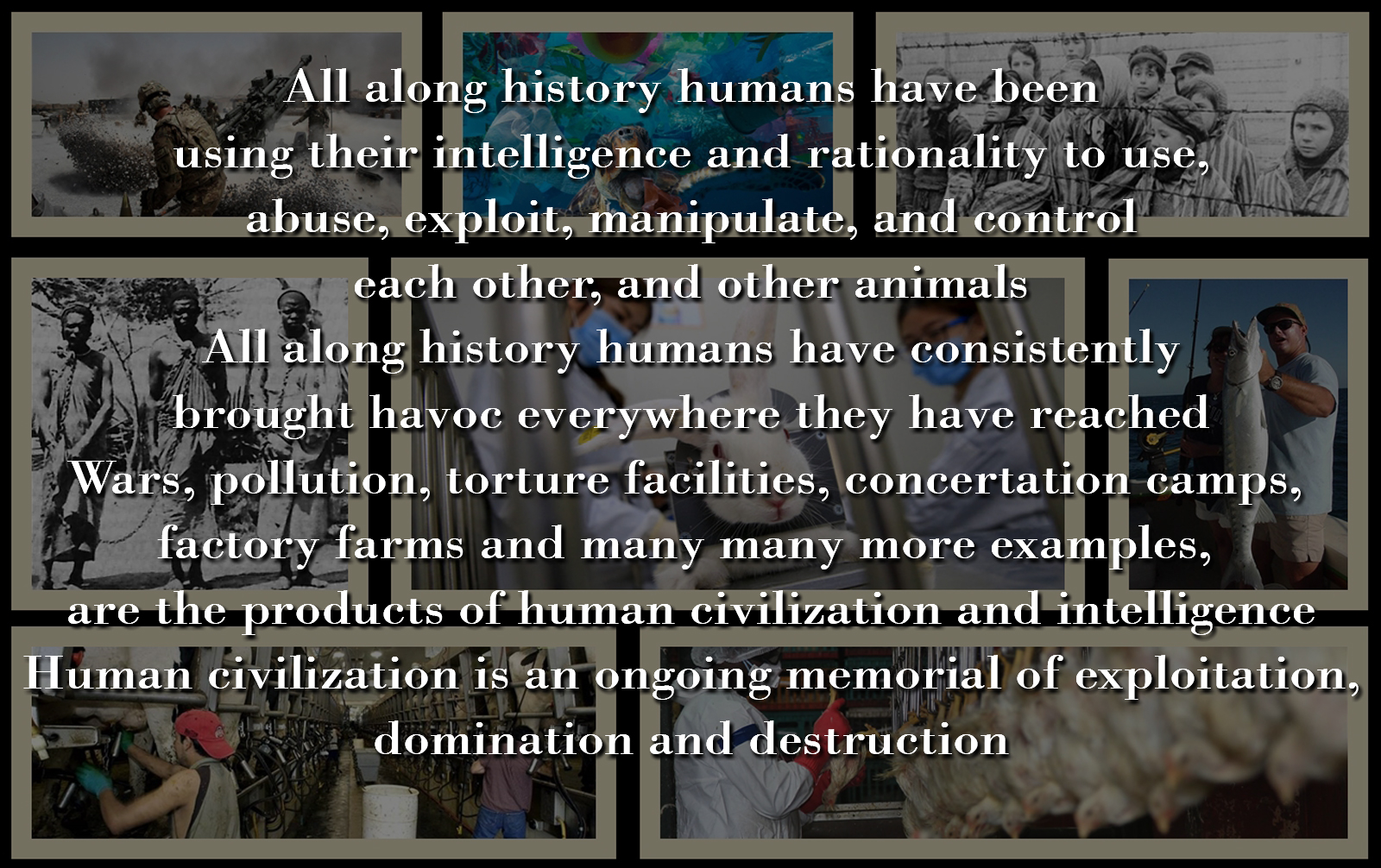
On the other hand, human intelligence and rationality is definitely a valid and sufficient argument for human extinction. All along history humans have used their intelligence and rationality to use, abuse, exploit, manipulate, and control each other, and other animals.

All along history humans have consistently brought havoc everywhere they have reached.

Wars, pollution, torture facilities, concertation camps, factory farms and many many more examples, are the products of human civilization and intelligence.

Human civilization is an ongoing memorial of exploitation, domination and destruction.

Human extinction is not a loss but a benefit. A benefit to probably tens of millions of humans whose lives are extremely miserable, and surely to everyone who isn’t human.

  1. Existing people would endure physical pain and/or painful and/or premature deaths

Basically this claim is that since it seems uncontroversial that the infliction of physical pain could be a reason to reject a principle, and since the ways in which human extinction might come about might involve significant physical and/or non-physical harms to existing people and their interests, extinction is wrong.

With this argument Finneron-Burns agrees. She also presents a counter argument to this claim, and then explains why it is wrong:

“Of course the mere fact that a principle causes involuntary physical harm or premature death is not sufficient to declare that the principle is rejectable – there might be countervailing reasons. In the case of extinction, what countervailing reasons might be offered in favour of the involuntary physical pain/death-inducing harm? One such reason that might be offered is that humans are a harm to the natural environment and that the world might be a better place if there were no humans in it. It could be that humans might rightfully be considered an all-things-considered hindrance to the world rather than a benefit to it given the fact that we have been largely responsible for the extinction of many species, pollution and, most recently, climate change which have all negatively affected the natural environment in ways we are only just beginning to understand. Thus, the fact that human extinction would improve the natural environment (or at least prevent it from degrading further), is a countervailing reason in favour of extinction to be weighed against the reasons held by humans who would experience physical pain or premature death. However, the good of the environment as described above is by definition not a personal reason. Just like the loss of rational life and civilization, therefore, it cannot be a reason on its own when determining what is wrong and countervail the strong personal reasons to avoid pain/death that is held by the people who would suffer from it. Every person existing at the time of the extinction would have a reason to reject that principle on the grounds of the physical pain they are being forced to endure against their will that could not be countervailed by impersonal considerations such as the negative impact humans may have on the earth.” (p.11)

Finneron-Burns’s rejection to the counter argument she presents is utterly wrong because it falsely switches the personal interests of trillions of sentient creatures with a non-entity abstract concept such as ‘the natural environment’.
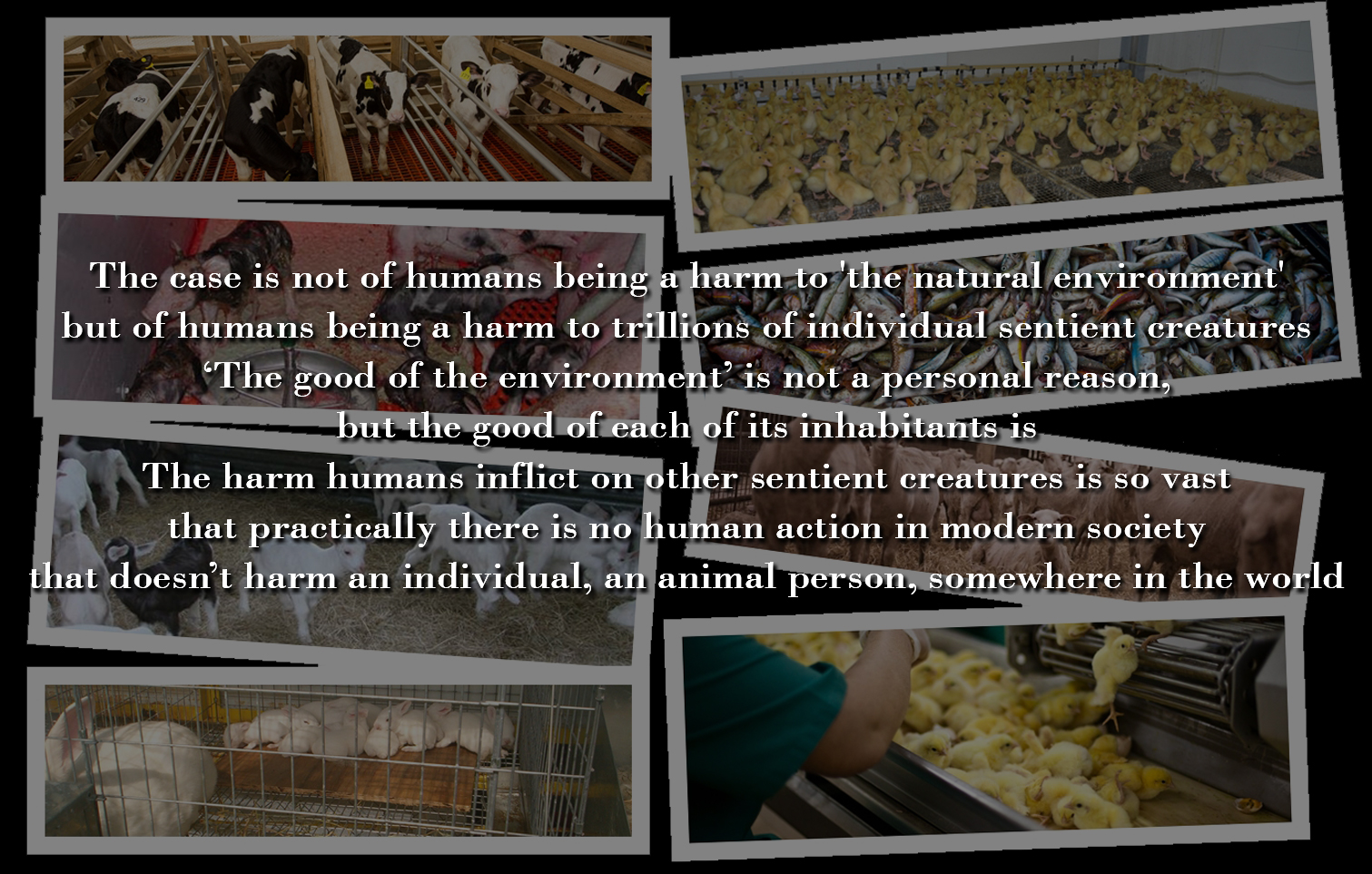
But the case is not of humans being a harm to ‘the natural environment’ but of humans being a harm to trillions of individual sentient creatures. It is not a case of the impersonal environment which is weighted against existing persons, but trillions of existing sentient individuals weighted against existing people.
She is making such a false presentation of the situation in her premises so she could later conclude that the counter argument is impersonal, but it is not that “the world might be a better place if there were no humans in it”, but that the lives of trillions of persons would be better if there were no humans in it. It is not the fact that human extinction “would improve the natural environment”, but that it would improve the lives of other sentient creatures. Her rejection to the counter argument speciesistly nulls the interests of trillions of sentient creatures treating them as if they are an abstract concept and not individuals entitled with moral consideration.

Only because she falsely describes the harms to trillions of sentient creatures as a harm to the environment, Finneron-Burns can claim that this argument fails since it is impersonal. Obviously ‘the environment’ is not a moral entity as it has no interests. But the sentient creatures who live in the environment are moral entities, it is them who have interests we all must consider. When using a correct description, this argument is valid, firm and unequivocal. Human extinction would probably be consensually decided upon by all sentient creatures had their interests been considered.

But they are not. Trillions of existing sentient individuals matter so little to humans that even when they are allegedly being given as reason for human extinction, they are diminished to an impersonal reason. Instead of being trillions of strong independent reasons for human extinction, they are presented as one weak impersonal reason. That is human chauvinism. It is speciesism.

For humans to live, nonhumans suffer and die by the billions all the time. Human life has no value of its own outside of human life, and human life is not more important to humans than the lives of nonhumans are important to nonhumans. Thinking otherwise is speciesism.
Moreover, the harm humans inflict on other sentient creatures is so vast that practically there is no human action in modern society that doesn’t harm an individual, an animal person, somewhere in the world. Humans don’t harm the environment as there is no such option. The environment is not a moral entity. It is not sentient and it has no interests. The harm is inflicted on sentient creatures. The fact that these creatures are totally meaningless in humanity’s view, doesn’t serve as a justification to null each of these animal persons and turn them into an impersonal reason. They are all persons. They view themselves as persons just as the humans who harm them view themselves as persons. Only that no one considers their personal interests. To keep considering humans’ procreation interests means to keep ignoring all the interests of all the other creatures. And that’s why we should stop considering the personal interests of humans to procreate.

‘The good of the environment’ may not be a personal reason, but the good of each of its inhabitants, is. Unlike the loss of rational life and civilization, it can be a reason on its own when determining what is wrong with human extinction, and if we ask all of the inhabitants it would probably be that the only thing wrong with human extinction is that it didn’t already happen.

  1. Existing people could endure non-physical harms

 The final reason against human extinction Finneron-Burns discusses is the psychological effects that might be endured by existing people who are aware that there would be no future generations.

One psychological effect she mentions is the negative effect on well-being that would be experienced by those who would have wanted to have children. “Reproducing is a widely held desire and the joys of parenthood are ones that many people wish to experience. For these people knowing that they would not have descendants could create a sense of despair and pointlessness of life.”

And she adds that “the inability to reproduce and have your own children because of a principle/policy that prevents you would be a significant infringement of what we consider to be a basic right to control what happens to your body.” (p.11)

As in the case of the third argument, Finneron-Burns agrees with this claim, and as in that case I think her agreement is wrong. In fact, in a way, supporting this argument is even worse, since it implies that because people would never voluntarily do the right thing and not procreate, it is morally permissible for them to procreate, and it is morally impermissible to force them not to.

fcoSince antinatalism necessarily entails human extinction, as obviously if everyone apply its ethical rule eventually the human race would go extinct, when arguing against human extinction, one must also counter antinatalism, as obviously the practical opposition to human extinction is procreation.
So among other things, to counter claims for human extinction, Finneron-Burns should argue that procreation is not a crime, not that people would be hurt if they are not allowed to commit that crime. Antinatalists know that people want to create new people, that’s why they are arguing against it. Had people not wanted to procreate there would have been no need for no arguments.

Lets’ take for example one of the most popular antinatalist arguments – the consent argument – which goes more or less like this: Causing harm to another person is morally justified only if that person had provided an informed consent, or in the case an informed consent cannot be provided but causing harm is in the best interest of that person since otherwise a greater harm would be caused to that person. Some also add the case of causing harm as a punishment for a crime. Since forcing people into existence is subjecting them to harms without their consent, and without it being in their best interest (for the obvious reason that before its existence a person has no interests, as there is no person), and it is also definitely not the case of punishment for a crime, procreation is morally impermissible.
Arguing that ‘reproducing is a widely held desire and the joys of parenthood are ones that many people wish to experience’ is not an admissible reply to the consent argument. It can’t serve as a counter argument to the consent based argument for antinatalism which obviously, as all antinatalist arguments, entails human extinction.

So for that matter, Finneron-Burns should have argued against the consent argument, not explain that people would be hurt if they can’t procreate because they want to, or at least try to explain how is it that the interests of the prospective parents subdue the interests of the potential child.

The question in point is ‘is it morally permissible to stop people from doing what they want’. And so the answer can’t be ‘no’ because they don’t want to stop.
If it is a valid reply then it should be valid in other cases of causing harms to others just as much. And then, all that any offender should claim is that by stopping him from committing a crime we are making him the victim. And that would be to nullify criminalness. Every offender would be hurt if they couldn’t continue with their offences, is it a justified reason to let them go on with their offences?
What is often called crimes of passion are not permissible since the offender would be hurt had s/he not committed the crime.
Rapists might feel hurt if they are not allowed to rape, or if they are caught, is that a reason not to do everything we can to stop them? Can the desire to rape be an argument in favor of raping?

Obviously people want to procreate, that’s why they refuse to stop, but that is a description of our dire reality, not an ethical justification of it.

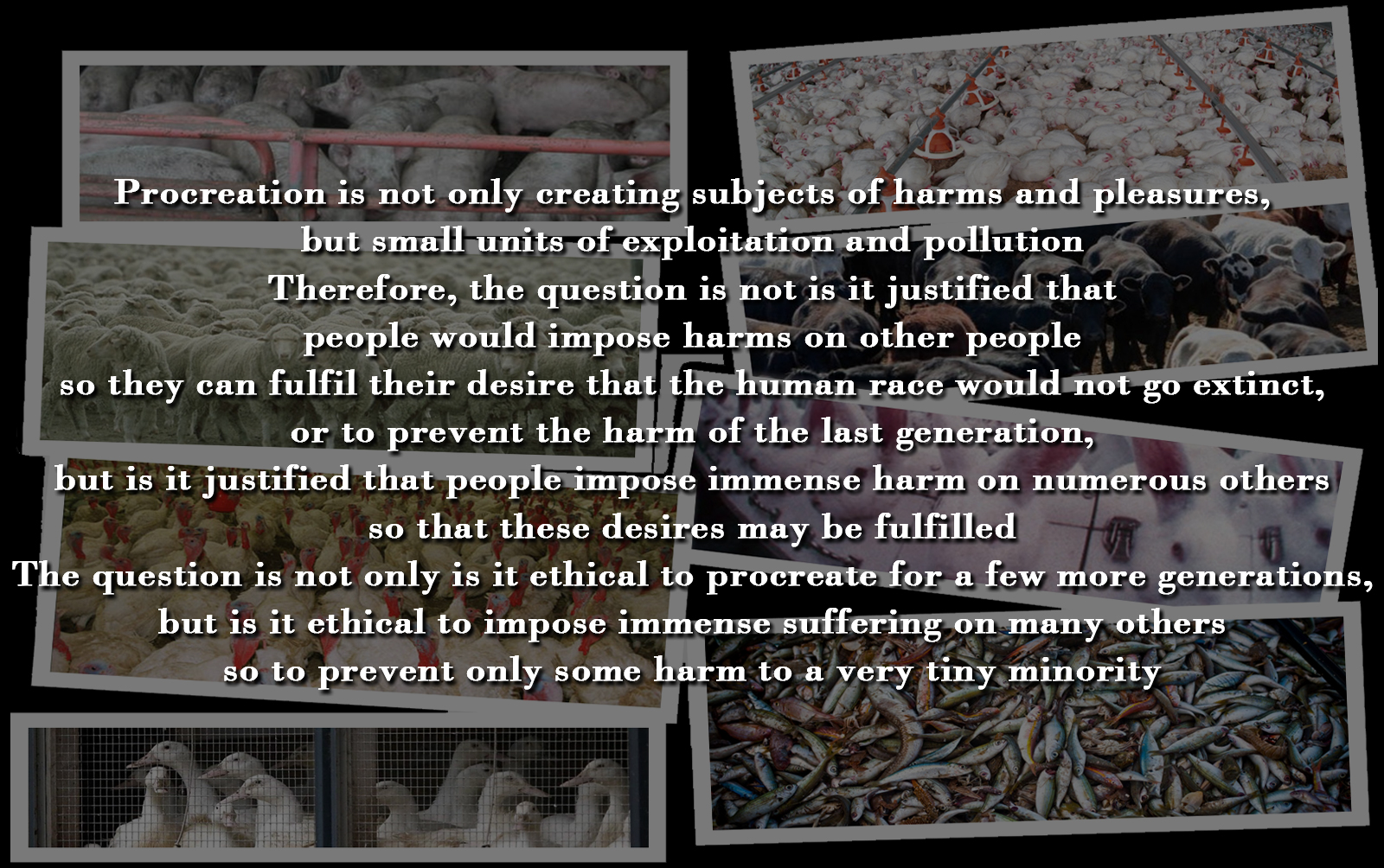
Can people’s desire to eat animals be a justification for the torture which is factory farming?

Arguing that all factory farms must be closed down today for the pain and misery they cause can’t be seriously counter argued by claiming that people have a desire to eat meat, eggs and milk. Some might argue that eating meat is not like creating new people, but I fail to see the fundamental difference in this context as in both cases people do as they please at the expense of others without their consent.

The argument that since humans would suffer from fixing the dire situation they themselves have created (and refuse to fix by themselves), we are not allowed to fix it without their consent, is wrong. They keep intensifying the problem by creating more and more of them, with no consent from the ones they are creating, nor from the ones who are hurt by the ones they are creating, so why is it that the solution to the problem must be with their consent?
And don’t get this wrong, I am not suggesting it as a punishment or anything of this sort, but only to stop the crime, and the suffering caused by each procreation.

The second psychological effect Finneron-Burns mentions is a sense of hopelessness or despair that people would feel knowing that there will be no more humans and that their projects will end with them:

“Many of the projects and goals we work towards during our lifetime are also at least partly future-oriented. Why bother continuing the search for a cure for cancer if either it will not be found within humans’ lifetime, and/or there will be no future people to benefit from it once it is found?” (p.12)

First of all, despite that her specific example is obviously not the main issue, it is hard not to comment on the “Why bother continuing the search for a cure for cancer”, since it is so manipulative. There are currently about 8 billion people on earth, probably only a couple of thousands of them are searching for a cure for cancer, while many more are busy causing it, to themselves, to their children, to other people, and to other animals. Most people are not searching for any cure to any disease or any solution to any other problem, but live their selfish pointless little lives. They were born for no reason other than the desire of their parents, and certainly not so they can search for a cure for cancer, and they are forcing new people into life for no reason other than their desire, and certainly not so that their children would search for a cure for cancer or anything even remotely close.

What happened to Henry Sidgwick’s claim that things are only important insofar as they are important to humans? If there is no one who suffers from cancer, who would there be to lament the loss of searching for a cure? This example is awful since it is supposed to be good that there would be no longer a need to search for a cure for cancer. With no cancer patients there is no need to cure it. How can the existence of such a horrible disease serve as the basis for an example against human extinction? Searching for a cure for cancer is good only if there are existing people, and if some of them suffer from it. If there are no cancer patients then the problem is solved, not created.
And by the way, there would be cancer patients in the case of human extinction – nonhuman animals. Why not searching for a cure for them? Or at least ways to prevent some of the cases from affecting them, for example by searching for the least harmful ways to dismantle all the nuclear weapons and nuclear power stations before humans go extinct and animals suffer the consequences? Why? Because humans don’t care.

But much more important than her specific example, is her claim. Arguing that human extinction is wrong since existing humans would lose interest and meaning in their lives, is in my view like suggesting that people should force new people into existence to bestow their own lives with interest and meaning. Of course most procreations already are a result of people bestowing their own lives with interest and meaning, but this real reason is usually concealed by the fallacious proclaimed reason which is to bestow interest and meaning to the future child. Finneron-Burns on the other hand, suggests this claim as a moral justification for doing so. It’s using someone as a mean to others’ end, and it is wrong. Imposing lifelong vulnerability on someone, without consent, and with a certainty of harming others, so that the creators of that person would have interest and meaning in their lives, is not only wrong, it is cruel.

Conclusion

Examining the four reasons she suggests that could be the basis for reasonably rejecting principles permitting human extinction, Finneron-Burns rejects the first two which are:

(a) It would prevent many billions of happy people from being born.

(b) It would mean the loss of the only form of intelligent life and all civilization and intellectual progress would be lost.

And accepts the other two which are:

(c) Existing people would endure physical pain and/or painful and premature deaths.

(d) Existing people would endure psychological traumas such as depression and the loss of meaning in their pursuits and projects.

Probably the saddest thing about this article is that despite all its flaws, most claims regrading human extinction are even worse. Most people are against human extinction for all four reasons, and especially the first two. These claims are not only extremely speciesist as the latter two are, but are also entirely human chauvinist, as they see a value only in the human race’s existence, and no value in the world (inhabited with other sentient creatures) without it.
I agree with the claim that the human race has a tremendous value, only that it is a negative one.

The human race is with no proportion the greatest wrongdoer in history. And things are not getting better. And even if they were, they are currently so horrible that the harms to existing humans is marginal compared with the harms to existing nonhumans, which quantitatively speaking already by far exceeds the number of existing humans, not to mention when considering the harms to every nonhuman who would ever be born. There are more nonhuman animals in factory farms at any given moment than there are humans on this planet. For their sake alone human extinction is utterly justified. The harm to existing people by preventing them from procreating, can’t seriously countervail the harms to generations upon generations of sentient creatures whose suffering would be prevented in the case of human extinction.

The question in point shouldn’t be what’s wrong with human extinction but what’s right with human extinction. And the answer is that it depends on who we ask. If we keep asking humans only, then the answer of most would be there is nothing right about human extinction, and only a tiny minority would argue differently. But if we ask anyone who would be affected by human extinction, anyone whom this question is relevant for but is never asked, an absolute majority would unhesitatingly say that what is right with human extinction is everything.

References

Elizabeth Finneron-Burns: What’s wrong with human extinction? (Canadian Journal of Philosophy 2017)

http://dx.doi.org/10.1080/00455091.2016.1278150

Sentientphilic Antinatalism

Not only pro-natalists misunderstand or misrepresent antinatalist arguments. In a former post I’ve addressed a position against human extinction for ecological reasons that totally misrepresents the environmental argument for antinatalism, by someone who declares that he has great sympathy for the antinatalist position.
In this post I’ll address another opposition to the ecological antinatalist argument, but this time by someone who is most definitely an antinatalist and a very articulate one. In a blog called Why I’m Sold On Antinatalism, the author – Filrabat, thoroughly and effectively explains the logic of being antinatalist for philanthropic reasons, only that he is doing it while misrepresenting the environmental argument for antinatalism. Same as Magnus Vinding which I have addressed in the former post, he presents the ecological argument as if its only version is the one expressed by VHEMT.

I don’t consider myself as ecological antinatalist, and as explained in the post Involuntary Human Extinction Movement, I don’t share the same arguments nor motive for human extinction as VHEMT, therefore I’ll not defend it here, but I do find it important to correct some of the false assertions presented in Filrabat’s article.

Basically Filrabat rejection to the ecological antinatalist argument is as follows:

“I do not find the ecological antinatalist arguments compelling because they (a) overlook that a much reduced human population with our technology level can be ecologically sustainable, (b) ignore that humans have at least as much right to exist as other lifeforms, (c) handwave away the fact that other species can and have disrupted ecosystems with no human involvement in the process whatsoever, even in recent times (d) apparently find irrelevant that, on a humanless earth, animals still would suffer greatly at the hands of other animals (especially predators), microbes, and natural disasters.”

So as mentioned I am not an ecological antinatalist since I don’t consider ecological systems as moral patients. Ecological systems, the environment, species, and similar terms often ascribed to the ecological argument, are not entities and therefore don’t hold any moral status. Their moral relevancy is only instrumental, not intrinsic, they are important only because they are important to sentient creatures who are harmed when they are affected. I think that people must stop creating new people because each person severely harms numerous other sentient creatures, not because humanity affects the insentient ecological environment in which sentient creatures live.
Anyway I reject his 4 rejections and I think their basic flaw is that they incorrectly present the claims they criticize (though to some extent that is because these claims are often falsely represented by their own supporters).

(a) overlook that a much reduced human population with our technology level can be ecologically sustainable

Filrabat’s first rejection demonstrates considerable and depressing ignorance regarding the harms caused by human technology. Most people know about fossil fuels, pesticides, lead, plastic and etc., but these are just the more famous harmful examples of human activities, while in fact all human activities are harmful. The current human technology level would still be very harmful even if human population would be significantly reduced.fragment their habitat

In the text about the harm to others, I specify some of the main causes of harms humanity inflicts on other animals, so please read it to get a better notion of how ridiculous this claim is. However, even focusing on “just” one aspect of human technology is sufficient to refute Filrabat’s first rejection. So in this text I’ll focus only on one aspect of human technology, one which is usually overlooked – light pollution.

Artificial light pollute the environment of other animals by humans’ use of public lighting, road lighting, buildings lighting, billboards, stores which are over-lit to attract customers, parking lots, sports centers, vehicles and etc.

Light pollution, often referred to as Photopollution, has various forms:
Light trespass – light falling where it is not intended or needed even by humans
Clutter – bright, confusing and excessive groupings of light sources
Glare – excessive brightness that causes reduced contrast, color perception, and visual performance
Skyglow – brightening of the night sky

The impact of light pollution on other animals is extremely harmful. By altering the natural cycles of light and by illuminating the environment, light pollution modifies the behavior, physiological functions and biological rhythms of other living beings. It affects animals’ orientation, navigation, feed, reproduction, and communication.
For example, exposure to artificial light causes nocturnal animals a repulsive response, meaning they move away from light sources. Since humanity’s light pollution is so intensive, the habitats of nocturnal animals which are constantly shrinking as it is by humanity’s expansion, further shrink by humanity’s light pollution.

Other animals are not repulsed by light but are attracted to it – they approach light sources.
Artificial light sources can outshine natural light sources, causing birds to be drawn to or fixate on the artificial lights. This results in birds deviating from their intended migration route, flying until they experience exhaustion and collapse. Marine birds such as albatrosses are known to collide with lighthouses, wind turbines, and drilling platforms at sea due to their bright lights.
The Fatal Flight Awareness Program has estimated that anywhere from 100 million to 1 billion migrating birds are killed every year because they collide with buildings, which in part is due to artificial lighting.
Other animals that use starlight to move in the dark are disorientated by artificial lighting, and often collide with large lighted structures, burn themselves in contact with lamps, or starve and are dehydrated as they limit their movements and their search for food and water to artificially lighted areas.

Reptiles such as sea turtles are greatly affected by light pollution. Female turtles nest on dark remote beaches, so bright coastal lights prevent them from finding safe nesting areas for their eggs. This leads the female turtles to deposit their eggs in an unsafe area or the ocean. Sea turtle hatchlings instinctively crawl toward the brightest part on the beach, which for many centuries was the moonlight and starlit ocean; however, excessive lighting on the beach or near the shore confuses the hatchlings and causes them to wander away from the ocean. The hatchlings may be eaten by predators, run over by vehicles, or die from dehydration or exhaustion. Artificial lights also disorient other nocturnal reptiles.

Light pollution also damages visual communication, especially among bioluminescent animals who communicate by emitting light signals. In the presence of strong illumination, the visibility of light signals is significantly reduced.
Michael Justice, a behavioral ecologist who studies how artificial light affects insects said that we must “Start thinking of a photon as a potential pollutant. Much like a chemical spill or gas leak, the photons being used to light your porch and street can unintentionally leak into surrounding areas and affect the local ecology at every level from plants to apex predators”.

Light pollution also contributes to habitat fragmentation. The example of nocturnal insects is a perfect demonstration of this. An artificial light source can attract nocturnal insects within a radius of 400 to 700 meters. However, in urban areas, streetlights are only 30 to 50 meters apart. Illuminated traffic lanes are therefore real artificial barriers that stand along people’s routes. Considering the attraction that artificial light exerts on nocturnal insects, these barriers therefore limit their movements and fragment their habitat.

And all that is only part of the effects of light pollution which is only part of all of humanity’s pollution which is only part of all of humanity’s harms.
For a more complete picture (but still very partial, as the list of harms humans are causing is practically endless) please read the text the harm to others.

Claim (a) is false since there is no way human technology can ever be ecologically sustainable, and since there is no way humans would voluntarily reduce their population, and since there is no way humans would voluntarily reduce their technology level, and since ecologically sustainable is not a metonym for a good thing in an ethical sense. An ecological system can be sustainable but violent and horrible. Sustainability is a euphemism for the constant struggle to survive under extreme environmental pressure. Sustainability is a product of constant violence and suffering. It is a biological description, not an ethical prescription.

Looking at the current level of human destruction it seems logical that if human population size decreases it can be ecologically sustainable, but that is only compared to the current unbelievably destructive state of affairs. Had this argument been claimed when the human population was more or less at the level Filrabat has in mind, minus the current technology level, suggesting to add the current technology level, obviously would have been considered a blunt violation of the ecological sustainability. In other words, only under the current horrible situation it seems reasonable to suggest that humans can preserve the current level of technology. But this is wrong conceptually and ethically.

It is conceptually wrong since it is not that the ecological system would determine when it is sustainable, or that each and every creature who is depended on each and every ecological system would participate in determining when each is considered sustainable, but that everything would be decided according to humans’ interests and perspective. They would decide what would be the initial population size in each ecosystem, and that would be the criterion from then on. According to Filrabat it sounds as if there is an external criterion for ecological sustainability and that it can be reached. But not only that there is no external criterion, there are only human ones.
The problem with that is not theoretical anthropocentrism, but practical speciesism. The problem is that humans would define sustainability according to their own interests. If they decide that a population of 40 million people in a specific ecosystem, living with the current level of technology is sustainable, then from now on, this ecosystem is sustainable if the human population is about 40 million people. But obviously before humans have invaded that particular ecosystem it had a whole different criterion for being sustainable. It is a human definition, set according to human standards and interests. Had other animals had a say in what is considered sustainable I doubt that the current level of human technology would be part of the definition.

And it is ethically wrong since what matters ethically is not how sustainable the ecosystems are, but how the creatures living in them feel. Under Filrabat’s false description, what matters are the ecosystems, despite that ecosystems don’t feel. Truly, this is how many supporters of the ecological antinatalism present the argument, so they are also responsible for the misrepresentation of the argument. But that makes only this particular rejection of Filrabat valid, and only under a false description of the issue. When considering humanity’s massive harm not to the sustainability of ecosystems, which are not moral entities, but to trillions of its inhabitants, who most definitely are moral entities, I fail to see how it is not wrong for humans to procreate.

(b) ignore that humans have at least as much right to exist as other lifeforms

First of all I don’t think there is such a thing as a right to live before one exists. But even if I’ll accept it for the sake of the argument, humans would have the same right to exist as other lifeforms had they lived like other lifeforms. But humans live as masters of the universe (and evil ones it must be added), not as other lifeforms. Their dominance and harmfulness is unprecedented. There is no other species that is even remotely as harmful as humans. No other lifeform is imprisoning other lifeforms for their entire lives. No other lifeform totally shatters other lifeforms’ social lives. No other lifeform prevents access to clean air, clean water, and natural environment. No other lifeform prevents access to natural food. No other lifeform is constantly genetically modifying other lifeforms to extract more meat, milk, eggs, skin, wool, feathers, fur and etc., from other lifeforms. No other lifeform castrates other lifeforms. No other lifeform burns numbers on other lifeforms. No other lifeform cuts the horns, tails and teeth of other lifeforms. No other lifeform rides, chains, and enslaves other lifeforms. No other lifeform forces other lifeforms to dance, do tricks, to dress up, to jump fences, to fight each other. No other lifeform experiment on other lifeforms.

Humans have an extremely high harm toll which makes supporting their right to exist a support in the violation of the rights of anyone who is hurt by them.

Filrabat presents the claim as if it is one human individual against one nonhuman individual and as if ecological antinatalism is choosing to favor the nonhuman, while practically it is one human individual against ten thousands of nonhuman individuals. It is very hard to estimate the harm other creatures are forced to endure for each human but in any case it is an enormous one under all circumstances (such as different lifestyles) and from several aspects, as humans are making the lives of many animals very miserable.

The human race is the only species ever who chooses to unnecessarily harm others, despite that it can easily choose not to. It is also the only species who can choose not to procreate. But I am in favor of human extinction not because it has no right to exist or because it is evil since it can choose otherwise (I don’t really think it can choose otherwise, the urge to breed is too biologically imprinted, and the indifference to other creatures’ suffering for the most trivial and needless pleasures is, due to several inherent psychological traits, to a large extent not really under its full control), but only because of the tremendous harm it causes to others, including other humans of course.

Filrabat writes that “We’re made of the same basic chemical elements and molecules, after all.” But that is a straw man argument. No one is arguing that the human race better be or must be extinct because humans are made of different basic chemical elements and molecules. The claim for human extinction, and that goes for the one expressed by VHEMT as well, is that the human race acts like a cancerous tumor in the planet, not that humans are actually cancer cells. The motive behind human extinction is their ecological harm, not their biological structure.

Later in the article Filrabat claims that rights should be ascribed to not yet exiting people despite the common objection to ascribe rights to non-existing persons. I am not necessarily against this position, but it is surly very controversial, even among antinatalists. However ascribing rights to existing persons is not controversial. So the question must be asked, how come according to Filrabat, humans, even if they don’t yet exist and might not exist in the future, should be gained with rights, but existent sentient creatures, who weren’t born to the “right” species, shouldn’t?

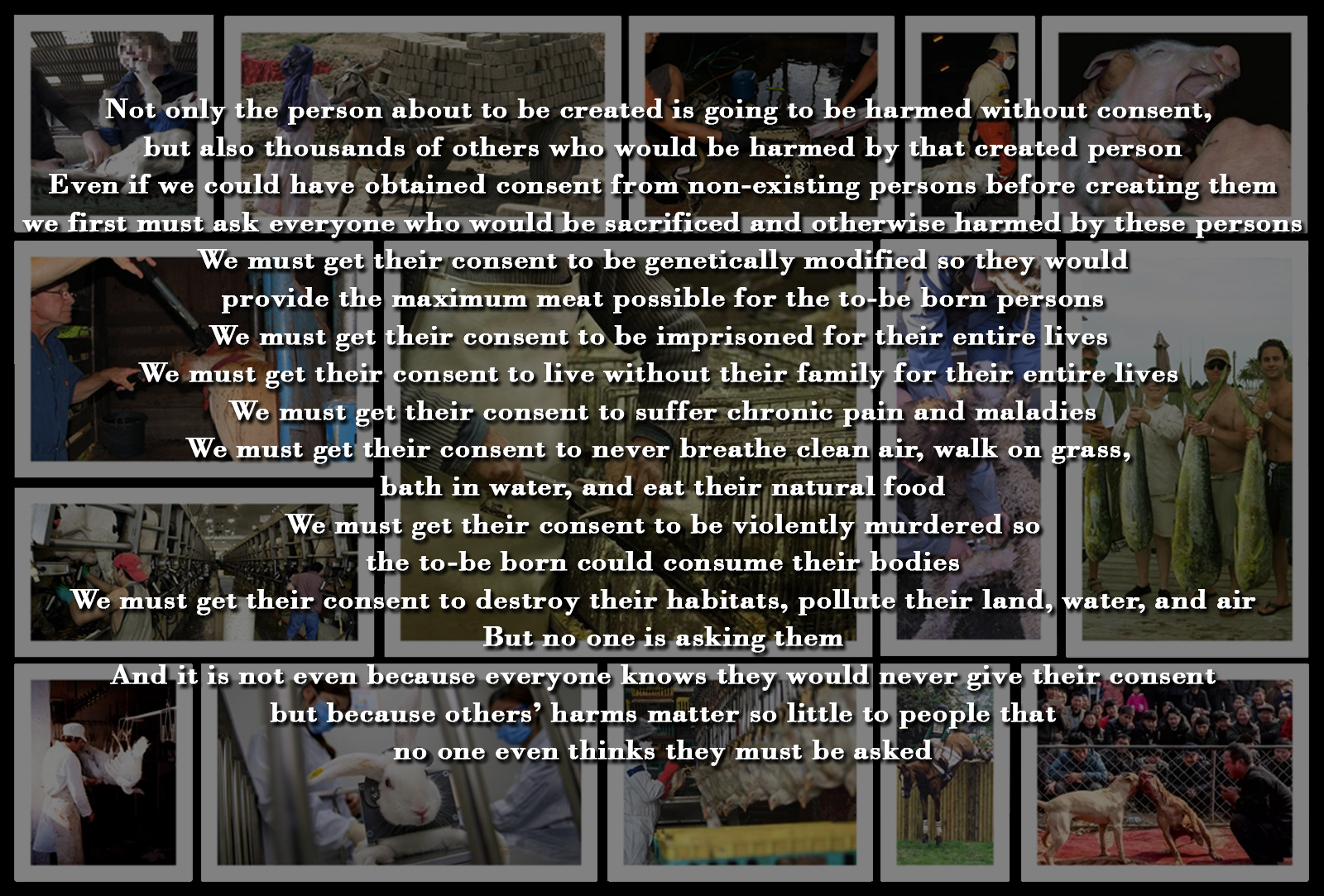
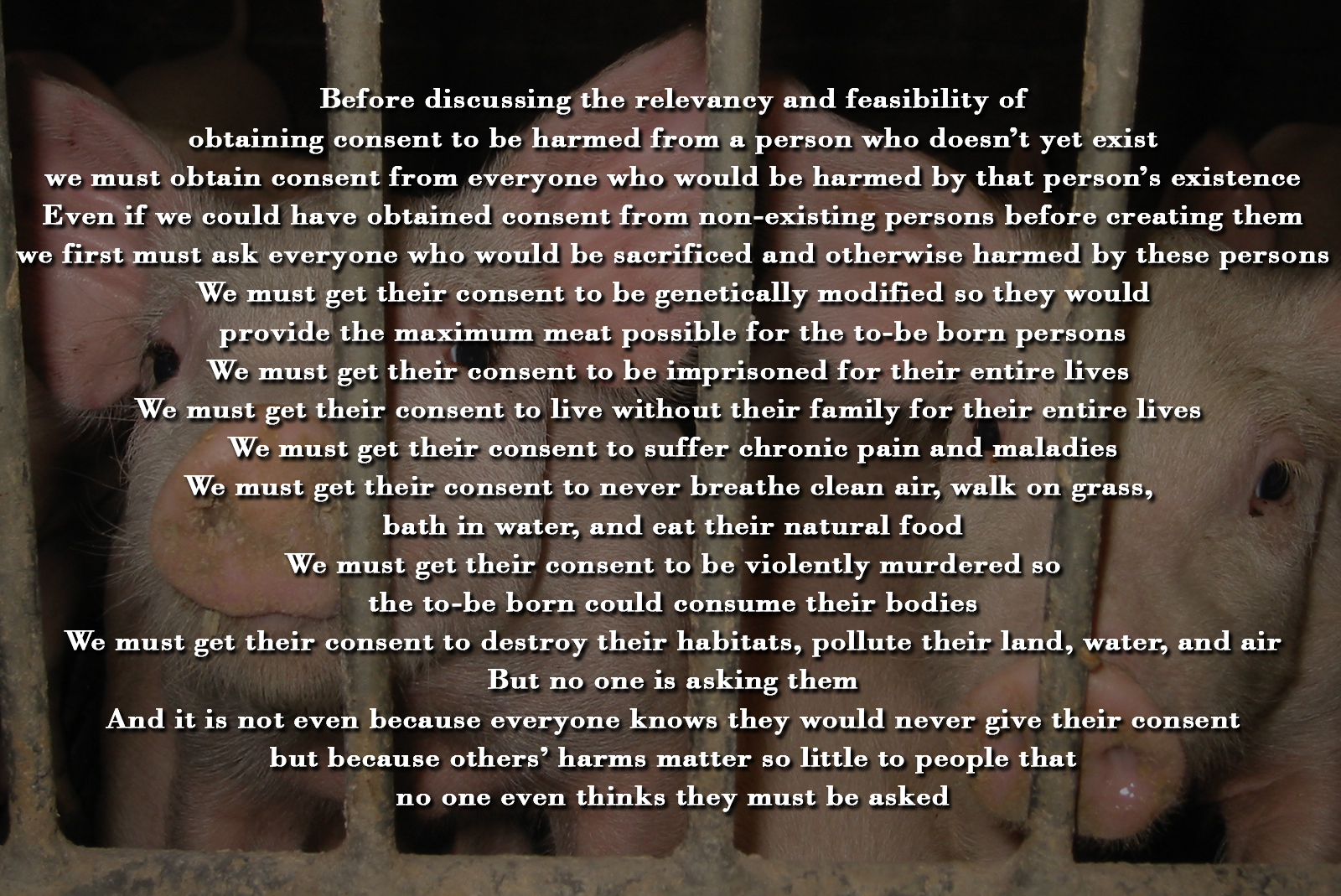
One of Filrabat main reasons for being an antinatalist is because he thinks it is morally wrong to create a person without consent. I totally agree. However, not only the person who is about to be born, is going to be harmed without consent as a result of its existence, but also thousands of others who would be harmed as part of providing the living support for that person. A “support” none of them has ever given consent for. Even if we could have obtained consent from non-existing persons before creating them, we first must ask for consent from everyone who would be sacrificed and otherwise harmed by these persons. We must get their permission to be genetically modified so they would provide the maximum meat possible for the to-be born persons. We must get their permission to be imprisoned for their entire lives. We must get their permission to live without their family for their entire lives. We must get their permission to suffer chronic pain and maladies. We must get their permission to never breathe clean air, walk on grass, bath in water, and eat their natural food. We must get their permission to be violently murdered so the to-be born could consume their bodies. We must get their permission to destroy their habitats, pollute their land, water, and air. But has any human ever received consent to harm any animal? Did anyone ask the chicken forced into the egg industry if she is willing to live in a battery cage? Were animals asked for their opinion on the number of people that should exist “sustainably”? Did anyone ask any animal what should be the level of human technology in their shared ecosystem? Did anyone ask for the permission of other creatures who are about to be poisoned? Do we have the consent of tree dwellers to cut their home? No one is asking them. And it is not even because everyone knows they would never give their consent, but because others’ harms matter so little to people, that no one even thinks they must be asked.

Another reason Filrabat mentions for being an antinatalist is that he opposes taking risks at others’ expense. Again I totally agree that the risk of serious suffering is a sufficient reason for antinatalism, however I disagree that there is a risk of serious suffering when procreating, as serious suffering is most certainly guaranteed. In terms of general harm, procreation is not at all a gamble or risk that harms would be inflicted, since it is absolutely certain that the person created would severely harm others. Even if the person created would have a great life which s/he is glad to have, it is absolutely certain that serious harms would be inflicted by that person. Therefore procreation is not taking a risk of causing harms, it is indifferently deciding to cause harms.

(c) handwave away the fact that other species can and have disrupted ecosystems with no human involvement in the process whatsoever, even in recent times

I find all of Filrabat’s claims for rejecting the ecological argument rather odd, and this one is probably the oddest. I think that if it was possible to accumulate the harm of all the creatures of all the species that ever lived, their disruption of ecosystems wouldn’t come near the level of human harm, even of the current human generation only. This claim is beyond ignorance. No one is that ignorant regarding humans’ harm to ecosystems compared with the harm of other species. I have no doubt that this claim is a consequence of the desire to strengthen an opposition to the ecological argument. I find it hard to believe that such an intelligent and knowledgeable person seriously believes in such a statement, which is not supported by any historical record.

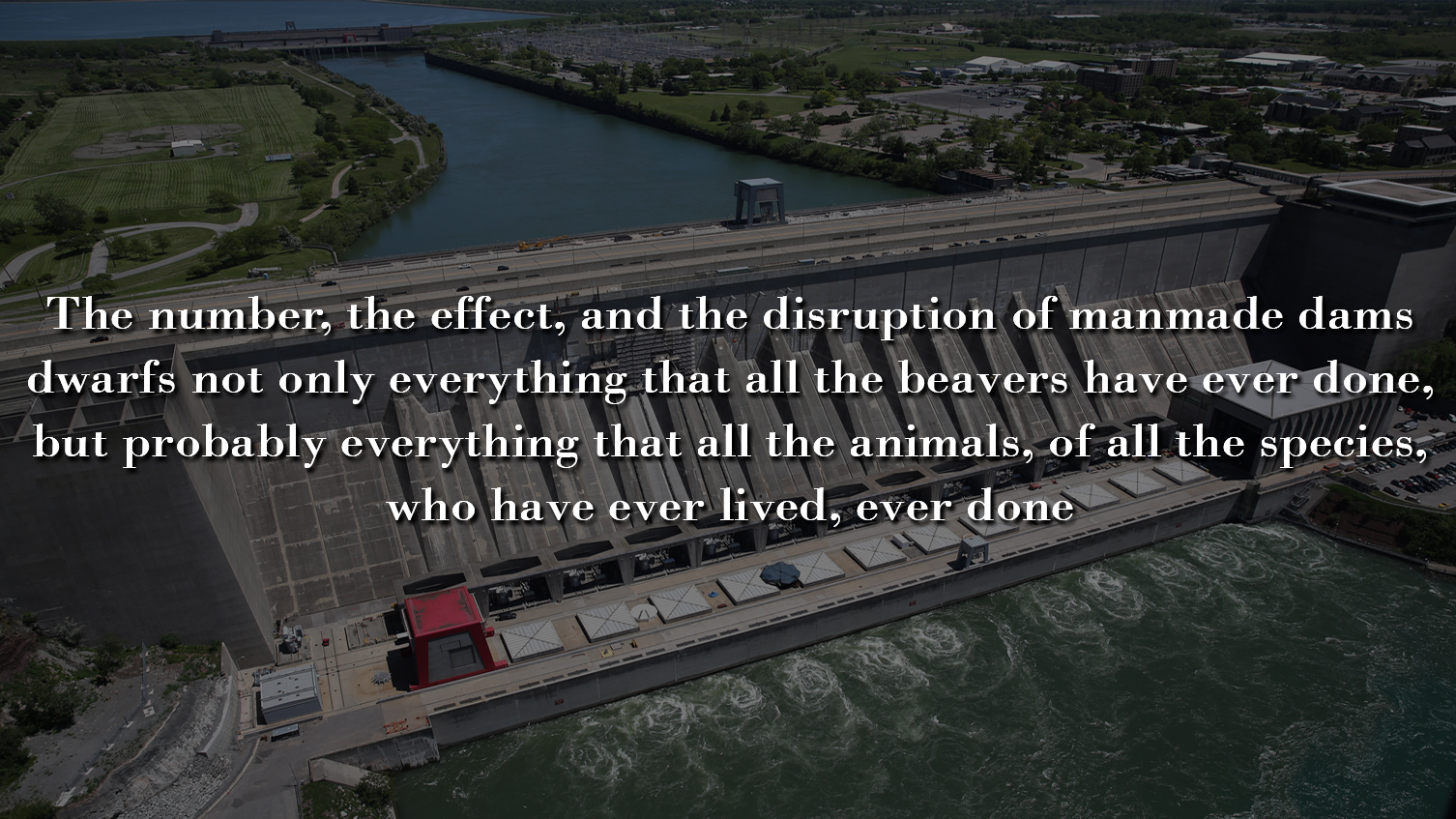
Filrabat mentions beavers as an example of a significantly ecosystem disrupting species (along with elephants who have supposedly turned Africa from fairly thick woodlands into a savanna). However, the number, the effect, and the disruption of dams built by humans all along history dwarfs anything that all the beavers had ever done despite that beavers exist way longer than human dams are around.

It is estimated that there are 800,000 manmade dams worldwide. Dams are used to store water, for irrigation, to control floods, and for electricity production. Manmade dams have a tremendous negative impact.

The most significant effect of dams on other animals is the loss of land which includes forests, valleys, marshy wetlands, and etc. Flooding of areas drowns a great many shrubs and trees, which adversely affects many species of birds that nest in them, while marshland is a very valuable environment for other birds.

Every animal or plant tends to have a well-defined habitat, or situation in which it thrives and to which it has become adapted. Destruction of their habitats forces more and more birds and mammals to migrate to new environments where they have to struggle against the native animals, as well as readapt to the environmental conditions.

The migratory pattern of river animals like salmon, sturgeon, and trout are extremely affected by dams. Dams divide rivers, creating upstream and downstream habitats, but migratory fish, such as sturgeon, depend on the whole river. Dams block their ability to travel back upstream. Sturgeon fish also rely on temperature triggers and shallow areas for reproduction. Because dams change how rivers flow, the water temperature and natural conditions also change.

Other animals commonly affected by dams are egrets, who along with other wetland birds, depend on healthy river systems for food and shelter. They make their nests in the steep banks of rivers or floodplain thickets. Dams prevent the natural highs and lows of rivers.

River dolphins are also highly affected by dams as they need high quality water and safe migratory routes to survive. Poorly planned dams often reduce dolphins’ food supply, change water quality and destroy habitats. As dams are constructed, the dynamite and noise can harm river dolphins. Once the dam is up, increased boat traffic can lead to more injuries and deaths from collisions.

Another significant impact of dams is changes in temperature, chemical composition, dissolved oxygen levels and the physical properties of a reservoir, which are often not suitable for the aquatic animals and plants that evolved in a given river system. And so, reservoirs often host non-native and invasive species that further undermine the river’s natural communities of animals and plants.

Dams serve as a heat sink, as the water is hotter than the normal river water. This warm water when released into the river downstream affects animals living there.
Slow-moving or still reservoirs can heat up, resulting in abnormal temperature fluctuations which can affect sensitive species. Other dams decrease temperatures by releasing cooled, oxygen-deprived water from the reservoir bottom.
In addition, peak power operations (in dams for electricity production) can change the water level thirty to forty feet in one day and can kill the animals living at the shorelines.

Dams can also degrade water quality when organic materials from in and outside rivers build up behind the dam. When the movement of sediment is disrupted, materials build up at the mouth of the reservoir, starving downriver ecosystems of vital ingredients. These backed-up materials, when decomposing, often result in algal blooms that consume large amounts of oxygen, creating oxygen-starved “dead zones”.

Dams also contribute to global warming. Over 20 years, the warming impact of annual large dam methane emissions is equivalent to 7.5 billion tons of carbon dioxide.

Nearly 500 dam projects are currently in the pipeline worldwide. Within the next 30 years, thousands of new dams are expected to be constructed globally.

So, beavers’ ecosystem disruption is probably billionth of humans’ ecosystem disruption. And that’s only one disruption out of an endless list of harms that humans are constantly causing.
Comparing the ecosystem disruption of any other animal, or even all of them put together (and probably even all of them put together from the beginning of each existence), with humanity’s ecosystem disruption is simply ridiculous.

(d) apparently find irrelevant that, on a humanless earth, animals still would suffer greatly at the hands of other animals (especially predators), microbes, and natural disasters

Although it is true that animals still would suffer greatly at the hands of other animals even if humans would go extinct, that claim is only relevant if the ecological antinatalist argument was that if the human race goes extinct all the suffering would stop. That is not the argument and if it was, obviously it would have been false. The argument is that the human race is unproportionately the most harmful species ever in the history of the world and other creatures’ biggest problem, so it is best if it goes extinct, not that all the world’s problems would be solved if it did. No one thinks that, so I wonder why Filrabat chose to confront the weakest version of the argument. Clearly animals still would suffer greatly at the hands of other animals, and I wish there was a way to make everyone go extinct, but it is not that the argument is only valid if all the suffering stops, and if it doesn’t, then the argument loses all its validation. If an action can stop most of the suffering but not all of it, it is not a justifiable reason not to perform that action if possible. Human extinction cannot and is not presented as a perfect solution, exactly because animals would still suffer greatly at the hands of other animals, but that is not a reason not to do everything possible to help all the animals who otherwise would still suffer greatly at the hands of humans. It is like arguing against world peace because there would still be great suffering from car accidents. That would be factually true but ethically irrelevant as a case against world peace.

All that this claim shows is that the human race is not the only problem, not that it is not a problem, or that it is not the biggest problem. My focus on humans is not because I think there are no other problems, but because I think humans are the biggest one and because I think it is more solvable. I know that unfortunately the world would stay horrible after human extinction, but much less. Much much much less.

“If we assume humans deserve self-omnicide on the grounds that environmental damage they create causes animals to suffer, then we have to eliminate all other animals that cause ecological damage that causes other animals to suffer as well. It doesn’t matter if these animals are generally considered part of the “authentic” ecosystem. Furthermore, it’s also based on the assumption that one should reduce harm to the minimum reasonable.”

I am in favor of eliminating all other animals that cause other animals to suffer as well. I am not favoring nor idealizing life in nature or in general. Was it realistic to sterilize every creature on earth I would unhesitatingly fully support that. That could be the most wonderful thing that ever happened to life on earth. I am an efilist who focuses on human extinction for practical reasons.
The reason I advocate for human extinction is because they are by far the biggest harm, and since it is by far more realistic than the extinction of all other life forms that cause harms.
Following the logic of the last sentence in the quote above – since the human race causes the maximum harm, reducing harm to the minimum reasonable is to aim at human extinction.

I call for human extinction in the name of trillions of sentient victims per year, not in the name of their species, nor in the name of their ecosystems, nor since humans deserve to go extinct, or because I think it would solve all the problems in the world, or because humans have no right to exist. I relate to none of these claims. My claim and motive is the harm to others.
The human race is the biggest problem in the world more or less since their first step in it. That’s why I aim and hope that they would make their last one as soon as possible.

Every day the human race provides us with more and more reasons for its extinction. And every day it provides us with less and less reasons to believe it would ever happen voluntarily. For it to finally happen, we must make it happen.

References

Why I’m Sold On Antinatalism Personal Reasons Part IV Sunday, September 12, 2010

bbc.com/news/av/stories-43699464/i-m-not-having-children-because-i-want-to-save-the-planet

bbc.com/news/science-environment-36492596

Benatar, D. 2006. Better Never to Have Been: The Harm of Coming Into Existence.

Oxford: Oxford University Press.

Biomass use, production, feed efficiencies, and greenhouse gas emissions from global livestock systems. PNAS, 110, 52

britannica.com/science/light-pollution

carbonpositivelife.com

Dams and Migratory Fish by International Rivers

Darksky.org

Destructive Dams by World Animal Foundation

ecowatch.com/u/ecowatch

Environmental Impacts of Dams by International Rivers

Environmental Issues, Dams And Fish Migration By Michel Larinier

Csp Cemagref Ghaape Institut De Mécanique Des Fluides

Fish Passage at Dams by the Northwest Power and Conservation Council

International Dark-Sky Association. “International Dark Sky Places.”

http://www.darksky.org/night-sky-conservation/34-ida/about-ida/142-idsplaces

Lighting Research Center. “Light Pollution.” Accessed November 19, 2013

lrc.rpi.edu/programs/nlpip/lightinganswers/lightpollution/abstract.asp

The Problems of Light Pollution – Overview

The Campaign for Dark Skies. “About the Campaign for Dark Skies.” Accessed November 19, 2013. britastro.org/dark-skies/about.htm?1O.

What are the Negative Effects of Building Large Hydroelectric Dams? By Chief Engineer Mohit Sanguri


New Argument Old Problem

In the article A New Argument for Anti-Natalism, philosopher Christopher Belshaw argues that antinatalism doesn’t necessarily entail – pro-mortalism.
Belshaw disagrees with David Benatar’s attempt to avoid pro-mortalism while arguing for antinatalism, and defines it as an ‘unstable anti-natalist and anti-mortalist mix’ which may made Benatar’s view more publically acceptable but also less consistent philosophically.

Basically, Belshaw’s criticism of Benatar is that if there is reason not to start lives, then there is reason to end them. And if the smallest amount of pain is sufficient to make life not worth starting as Benatar argues, given that everyone will experience at least some pain, Benatar’s argument for antinatalism entails pro-mortalism.
However, since I have addressed Benatar’s argument in relation to pro-mortalism in a former post, and since Belshaw himself doesn’t focus on Benatar’s argument but rather on his own argument for antinatalism, which he claims succeeds in avoiding pro-mortalism, this will be the focus of the following text.

Pleasure Springboards

Given that babies lack developed conceptions of time and of their own identities as persisting through time, Belshaw argues that as opposed to grown people who will often choose to endure pain in the present for benefits in the future, this can’t be the case with babies who don’t have desires about their longer term futures. Babies live only in the present, and have no desire to tolerate pain in order to acquire future pleasures. For someone unaware of its own future, a good future cannot make up for a bad present. Therefore, hurting babies in the present, for a benefit in the future, which they have no and can’t have an interest in, is morally unjustified.

According to Belshaw when it comes to whom who lacks developed conceptions of time, present pains are not justified by future pleasures. So babies suffer uncompensated pain. But the premise of his new argument for antinatalism goes way further than that. He claims that babies are distinct from the persons that develop from them. From his point of view the baby is one being, the person is another.
To illustrate and simplify the matter he suggests thinking about babies not as an integral gradual process of becoming a person but more in a sense of a distinctive transformation stage:

“Imagine that our relationship to a baby is like that of a butterfly to a caterpillar. Rather than a piecemeal emergence of complex psychological properties, and thus of the person, imagine instead that a baby is born, lives a baby life for about eighteen months, then falls into some sort of coma. Its life is over. After a year a pretty much fully-fledged person emerges. What should we think of this baby’s life? Is it worth living?” (p.124)

This distinction is of course very significant in an ethical sense, since not only that hurting babies is wrong because it is trading the present pains for the future pleasures of a creature who lacks developed conceptions of time, it’s a trade of pleasures and pains between different lives. And that is much worse, and highly questionable ethically.

Thinking about babies not from the point of view of the persons they supposedly become, but as a separate creature, then that creature – who has no developed notion of itself, or of time, no desire to live on into the future, no ability to think about pain and decide to endure it – experiences a lot of suffering. That is the case of even totally healthy babies. They all come into the world screaming, cry a lot, suffer colic and teething pains, stress, discomfort, emotional distress and etc. Therefore Belshaw argues that a baby’s life is not worth living.
Some may argue that a baby is an indispensable stage in creating a wholly worthwhile life, but this is not at all in the interests of, and brings about no compensations or benefits for – the baby. It would have been better for the baby had it never been created.

Belshaw argues that gradualism has no bearing here:

“Even if we come into existence by degrees, the two beings here remain distinct. And so the conclusion still stands. If we value our own lives, want there to be more people in the world, we may well continue to make babies. But what’s good for them isn’t good for us, and vice versa. We’re exploiting them, and exist only because this other creature has suffered. I may be glad that there was a baby. But it would have better for the baby never to have been born.” (p.124)

So basically his argument is that the creation of a person necessarily involves the creation of a baby which isn’t a person but is certainly a sentient creature, and one who suffers very much, without consent, and without compensation as the person that would develop from that baby is not a continuation of the baby. The creation of a person necessarily involves an exploitation of a baby. It is forcing suffering on a creature so that someone else would benefit, because it is not that the pleasures of the future person compensate the baby for its pains, and the baby has no concept or any interest in the future.

Arguable Conception and Unarguable Exploitation

Belshaw doesn’t seem to be bothered with a person being created, but with a baby being created in the process of creating a person. He is bothered with the harms caused to the baby, harms for which the baby would never be compensated. He is bothered with the harms that creating a person brings about not to the person created but to the baby which is according to him, although an indispensable stage of a person, still a separate entity.
Since Belshaw separates between a person and the baby that person had developed from, his argument is actually more of a version of the harm to others argument than it is a version of Benatar’s argument. Only that in Belshaw’s version of the harm to others argument, although there should be no disputes regarding the ‘harm’ part, there are many regarding the ‘others’ element. While his distinction between a baby and the person that grows from that baby is disputable, in the case of the original version of the harm to others argument, meaning absolutely unquestionable harms caused to absolutely unquestionable others, there is no room for any dispute. The only reason that nevertheless there is much dispute is because people are speciesist and careless about the suffering of others, not because the sacrifice of trillions of sentient creatures can ever be ethically justified.

The specific distinction Belshaw claims for may be arguable but the sentiment isn’t.
Even if it is disputable that each person necessarily exploits the baby that s/he supposedly developed from and that each person exists only because a baby has suffered, given that each person needs to feed oneself, dress oneself, clean oneself, clean oneself’s clothes, heat oneself in the winter, cool oneself in the summer, live somewhere, work somewhere, move around somehow, entertain oneself, consume enormous amounts of energy, produce enormous amounts of waste, and etc., and considering that each of these necessarily harm others, it is undisputable that each person necessarily exploits others and that each person exists only because others have suffered.

And people don’t even seem to care that much about the fact that numerous other sentient creatures are suffering so they can enjoy themselves. Most are still choosing, time and again, the most harmful ways to feed themselves and regardless of how harmful it is to others. Harming others while consuming food is inevitable, even if it is plant based, local, organic and seasonable, but most people insist on the worst kinds of food production, ones that involve the greatest exploitation and suffering. Therefore, in most cases, creating a person is sacrificing chickens to be cramped into tiny cages with each forced to live in a space the size of an A4 paper, calves to be separated from their mothers, and cow mothers to be left traumatized by the abduction of their babies, pigs to suffer from chronic pain and various diseases, sheep to suffer from lameness, turkeys to barely stand as a result of their unproportionate bodies, ducks to live out of water and in filthy crowded sheds, rabbits to be imprisoned in an iron cage the size of their bodies, geese to be aggressively plucked for their feathers, and male chicks to be gassed, crushed or suffocated since they are unexploitable for eggs or meat.

So even if you reject Belshaw’s distinction within a person, the following description he made is surly the case when it comes to a person’s relation with others “we are inevitably free-riding on the several misfortunes of small, helpless and shortlived creatures”.

Even if you disagree with Belshaw’s distinction between the future person’s supposed wholly worthwhile life and the baby’s lack of any interest, compensations or benefits for that, you can’t disagree that other creatures surly lack of any interest, compensations or benefits for a person’s supposed wholly worthwhile life. Even if we refuse to accept Belshaw’s distinction, the thousands of creatures overall that would be harmed so a person would benefit, will not be compensated. Therefore even without his distinction move, the creation of a person is indeed a trade of pleasures and pains across different lives.

Belshaw’s argument may be new but in some ways it reflects on an old problem. He deeply emphasis the exploitation of babies for the pleasures of persons, yet he deeply ignores the obvious exploitation – one that doesn’t require the metaphysical complexity of differentiating between a person and the baby from which that person had developed – of probably thousands of nonhuman animals by each human person.

Preventing that suffering is my main motivation. And people being so speciesist and careless about the suffering of others is my main reason not to wait for them to change.
If Belshaw’s main motivation is to prevent babies from being sacrificed for the sake of persons while avoiding pro-mortalism for persons, he can support a non-pro-mortalist option, but still ensure that people will stop sacrificing babies. Although for slightly different motives and perceptions than mine, he can support forced sterilization.

References

Benatar, D. Better Never to Have Been (Oxford: Oxford University Press, 2006)

Belshaw, C. A New Argument for Anti-Natalism South African Journal of Philosophy 31 (1) 117-127(2012)

Anti-Natalism and the Future of Certain and Certainly Avoidable Suffering

In an article called “Anti-Natalism and the Future of Suffering: Why Negative Utilitarians Should Not Aim For Extinction” Magnus Vinding argues that people should act so to reduce suffering as much as possible, and should do whatever accomplishes that goal, however antinatalism is not the best way to do that. In his view antinatalism “misses the bigger picture and instead focuses only on whether single individual lives are worth starting for the sake of the individuals who are brought into existence. We have to take a much broader view to address that question, the question concerning how to reduce the most suffering in the world.” Although there are antinatalists who solely focus on the sake of the person forced into existence, many others argue against procreation for being morally wrong regardless of the wellbeing of the created person (the consent argument for example is highly popular among antinatalists), and many also consider the harm to others. In fact, although this blog doesn’t solely focus on the harm to others, in my view, it definitely must be the main claim for antinatalism. So his assumptions regarding antinatalism are mistaken, some of us do take a much broader view to address that question, and that’s exactly why some of us aim for human extinction.

Vinding doesn’t define himself as a pro-natalist, but very much like many pro-natalists he conveniently chooses to present antinatalism as if it is based on one argument by David Benatar. And he criticizes Benatar for claiming in the preface of Better Never to Have Been that he has no expectation that his book or its arguments will have any impact on baby-making:

“So it seems that Benatar actually does not argue for anti-natalism with any serious conviction that it will change the world much (“Procreation will continue undeterred”). Rather, his book seems more like the work of a mathematician who wants to show the truth of a counter-intuitive conjecture for its own sake, because he feels the truth “needs to be said”, not because it will “make (much) difference” in terms of impact in the world.” (p.3)

Besides that it is wrong to present a whole movement, let alone one that is abundant with various arguments, ideas, objections, inner dilemmas, nuances and etc., as if it is a one claim movement, with one thinker, and besides that many antinatalists oppose Benatar’s arguments, including myself, this book was published in 2006 and was based on an article written in the late 90’s, back then antinatalism was much less socially accepted than it is now (an improvement which is to a large extent thanks to Benatar). Since 2006 Benatar himself wrote two more books about the subject, as well as many articles and elaborated replies to his critics, he also attended several conferences, and gave plenty of interviews, in all of which he thoroughly and persistently explained his views regarding the wrongness of creating new persons. So it is unfair to criticize him for being like “a mathematician who wants to show the truth of a counter-intuitive conjecture for its own sake”. Furthermore had it been the case, he wouldn’t have written the third chapter of Better Never to Have Been where he makes the quality of life argument.

I do agree with Vinding that:

“there will always be people who decide to have children, no matter how convincing an argument anti-natalists can make against it, and thus the only way anti-natalists would be able to prevent such people from procreating would be by force”. (p.3)

However I disagree with his predicted scenario:

“And given that people likely also will be willing to defend their right to procreate with force, and given that the proportion of people who will either decide to have children or be in support of such a decision is likely to be the vast majority, the prospects of success for anti-natalists who wish to force people not to procreate looks no better than they do for the nonviolent anti-natalists. In the worst case, a war could break out, and the vastly outnumbered pro-coercion anti-natalists would score a predictable defeat that would leave things largely unchanged…” (p.3)

If the anyway much more desirable option of imposed sterilization on all people without the use of force is found, then his claim is irrelevant. The idea was never to literally force sterilization, but to impose it on everyone using an unforceful method such as a chemical poured into major water systems all over the world, or sprayed all over the world, or developing and spreading virus or bacteria which causes sterilization, or whatever method that can potentially affect everyone without the need to physically force it on everyone. The idea was never one that requires winning a war against pro-natalists.

Anyway, this is not Vinding’s main case against antinatalism. His main claim is that if antinatalism gained instant success today it means that humanity would be left with about a century to cure and prevent all suffering on the planet and on other planets:

“we are by no means guaranteed to be able to end suffering on Earth within the next century. Just consider the oceans with trillions of vertebrates, or the more than a quintillion – a billion billion – insects who live on the planet, and who may well be able to suffer. Making sure that no such beings suffer, or evolve into beings who do, is a huge challenge, and it seems to me that we are far more likely to be unable to accomplish such a thing within the next century than we are to succeed.” (p.4)

Of course humans are by no means guaranteed to be able to end suffering on Earth within the next century, since in order to do that they must first of all want to. Humans haven’t even taken the first step towards ending suffering on Earth which is to at least stop intensifying their share in causing it. Currently humans are still deeply immersed in increasing the suffering on Earth by artificially creating billions of animals who would know nothing but suffering for their whole miserable lives, just so humans could enjoy the taste of their flesh. Humans are way too unethical for anyone to take Vinding’s claim seriously. Let’s see them stop creating and intensifying absolutely needless suffering all the time, before counting on them to ever reduce suffering they are not directly causing.

I fail to comprehend the empirical basis of his argument. Whenever and wherever humans have reached they have wreaked havoc. Humans have consistently hunted other animals, or in the much worse case captivated, domesticated and reared animals for food, exploited them for various uses such as carry them around, carry their belonging, fight in their wars, do their labor, guard their camps, help them hunt, keep them warm, decorate their bodies and homes, serve as the raw material for their tools, killed them when they came near the areas they have conquered from them, and systematically destruct their habitats. So why, as opposed to every single moment in history, would humans all of sudden be such caring creatures whose main task in life would be to help other animals in nature and on other planets? Where is all this compassion now? More than 95% of humans are not even vegans, meaning the vast majority of the human race is still choosing to personally and needlessly harm and abuse other animals, so to expect that they would devote their lives to help animals they haven’t personally harmed? How does it make any sense?

It seems as if Vinding had never read a history book as he presents the issue as if all along history, whenever humans have encountered other animals in nature, they wanted to help them but didn’t know how, while it is exactly the opposite. All along history whenever humans have encountered other animals they wanted to use them for their own benefit, and usually with horrendous success.

When humans have seen other animals hunt each other, they didn’t think to themselves ‘oh, if only we had a way to help these poor animals being hunted’, but more like these poor animals are chasing other animals day after day to feed themselves, when they can confine them instead, and kill them whenever they wish. Humans saw what other animals are doing and made it much much much worse.
Animals in the wild would eventually be hunted or die of disease or hunger, but at least they are free, at least they live in a natural environment and not a filthy and contaminated one, at least they live in their natural society, at least they can eat and drink whenever and whatever they want and not what and when humans decide that they would, at least they can sleep whenever they want wherever they want and not when and where humans decide they would sleep, at least they can spread their limbs, stretch their necks, socialize, breath clean air, clean themselves, fly, roam, run, jump and play. Humans have carelessly and needlessly taken all that away from them. Don’t get this wrong this is not at all a glorification of nature. I agree that life in nature is horrible, only that life under human control is much more hellish. The point is not that nature is good, as it is definitely extremely far from being good, the point is that as horrible as nature is, humanity is nonproportionally worse.
Humans are the world’s biggest problem, not its greatest saviors.

I highly recommend reading the text about The Harm to Others, to get a broader sense of how harmful humans actually are. Vinding’s description gives the false impression that humans are constantly busy with minimizing suffering, while the truth is that most are constantly busy with maximizing it. The risk that suffering on Earth wouldn’t end is because humanity doesn’t care about it, not because it might run out of people.
Most of the world’s suffering is not a result of humans not having enough time to end it, but a result of humans having too much time causing it. The biggest barrier to reducing suffering is the human race, not its extinction.

Interplanetary Exploitation

Vinding argues that the human race must continue not only because it would be the savior of everyone on Earth, but also because it would be the savior of everyone in the universe:

“Even if we were guaranteed to be able to prevent all suffering on Earth for good within the next couple of centuries, this would not give us any guarantee that suffering will not occur beyond Earth.” (p.5)

And how does he suggest helping creatures suffering on other planets…

“The ideal thing would likely be to build a benevolent Von Neuman probe, an advanced spaceship that can travel out in all directions with as high a speed as possible, and which has the technological capability to reduce involuntary suffering in the best way possible wherever it goes.

And what is important to note in this context is that our ability to create such a machine lies even further away in the future than does the ability to “merely” cure Earth from suffering. This must be so, since this probe would have to be able to accomplish both this latter mission of curing Earth from suffering and much more.

So this is the final and supreme reason that counts against anti-natalism: if we take the minimization of suffering seriously, we cannot defend going extinct before we have seeded a cosmic mission to minimize suffering in our future light cone, and it seems safe to say that we will not be able to finish this task any time soon. In order to accomplish our goal of reducing suffering in the world, continued human procreation still seems necessary.” (p.9)

All the suffering currently caused by humans, and all the suffering that will be caused by humans in the future here on earth, if the human race won’t go extinct, can’t be seriously balanced with the hypothetical option that there are sentient creatures outside of earth, and that they are miserable, and that humans (of all creatures) would want and could someday help them using a special spaceship.

It is very cynical, absurd and ironic to argue that all the suffering caused by humans on earth must continue because of the potential suffering in the rest of the universe. That is especially so since humans are extremely far from solving even human related problems.

Hunger wasn’t always a human phenomenon. Surly people were hungry in times of harsh weather, but it was never even remotely similar in kind and extent to the world hunger of the last two centuries. Modern hunger is manmade. It’s a result of politics and economics. And that simple problem that humanity has created by its own hand, to its own kind, wasn’t yet and is still far from being solved. Unlike the case of stopping the creation of new sentient creatures just to torture them, or helping animals in nature, not to mention helping sentient creatures on other planets (if there are any and if it is even possible), this is solving one of the biggest problems humanity has ever faced, and one that is caused by humanity and to its own kind. And it still exists in the third decade of the 21st century. So justifying the torture of trillions of beings by the human race every single year, because maybe someday humanity might build an advanced spaceship that can travel out in all directions with as high a speed as possible, and which has the technological capability to reduce involuntary suffering in the best way possible wherever it goes, when humanity is so far from feeding all its members, and is even farer from stop fighting each other over territories on this planet?

“The pessimistic anti-natalist might object that building such probes is an impossibly ambitious goal, and that we will only cause more suffering by aiming for such a high goal…one could have said the same thing about the goal of creating civilization 70,000 years ago, when there were only a few thousand humans running around on the plains of Africa, a goal that could barely even be envisioned back then. And yet, 700 centuries later, here we are: civilization has arisen, along with computers and civil liberties, and we have more minds working to improve our knowledge, technology, and ethics than ever before. In light of this development, it seems that we should be careful to deem the aforementioned ambitious goal impossible.” (p.10)

Only an extremely passionate human chauvinist, ignorant of humanity’s horrendous past, and speciesist present, can give civilization as a good example. Civilization is an example of the worst thing that ever happened on earth, surely to other animals, but also to humans. All along history humans have used their intelligence and rationality to use, abuse, exploit, manipulate, and control each other and other animals. All along history humans have consistently brought havoc everywhere they have reached. Wars, pollution, torture facilities, concentration camps, factory farms and many many more examples are the products of human civilization and intelligence. Human civilization is an ongoing memorial of exploitation, domination and destruction.

It is really cruel to condemn trillions upon trillions of sentient creatures to such a miserable life because maybe someday humans might build an advanced spaceship that can travel out in all directions with as high a speed as possible, that might help creatures that might exist on other planets.
There is no reason to believe that as opposed to their history on this planet, when humans would reach other planets, they would act differently. Just as they have taken control of every inch on this planet, same is likely to happen on other planets. They would most probably exploit the extraterrestrials they meet and even “export” their earthly exploitation methods to other planets by taking along with them the creatures they are so good at exploiting here on earth, and if that would happen it would multiply the tremendous suffering they already cause.

Vinding conveniently argues that it would be callous “if humanity, after having glimpsed an Earth plagued by suffering, and a future light cone potentially even more so, chooses to opt for eternal peace without doing anything about the rest. That would be nothing but anthropocentric speciesism and a wasted opportunity.” (p.11). Only that as mentioned earlier this is not necessarily the reason for human extinction. It certainly isn’t mine. The goal is not to opt for humans’ eternal peace, but for the end of humans’ eternal tyranny over every other creature on earth.

In the end of his article against human extinction, Vinding calls to promote suffering focused ethics and anti-speciesism. Ironically, human extinction is the immediate and clear inference from suffering focused ethics and anti-speciesism perspective. The conclusion that human extinction is ethically mandatory is more unequivocal and urgent not under anthropocentric antinatalism, but when considering the harm to others. Then, human extinction is not a desirable by product of antinatalism, but a silent scream coming out of the throats of trillions of miserable sentient creatures.

References

Magnus Vinding Anti-Natalism and the Future of Suffering: Why Negative Utilitarians Should Not Aim For Extinction 2015

Essential Human Forced Sterilization

The philosopher Thomas Metzinger suggests a thought experiment called Benevolent Artificial Anti-Natalism (BAAN), in which a full-blown autonomously self-optimizing post biotic superintelligence system has come into existence, aimed to assist humanity with ethical decisions. The superintelligence system is benevolent and fundamentally altruistic, so it fully respects humans’ interests and the axiology originally gave to it. The system has a better understanding of humans’ minds and values than humans themselves have, for example, it is familiar with humans’ cognitive biases which disturb and mislead their rational thinking. In Metzinger’s words:

“Empirically, it knows that the phenomenal states of all sentient beings which emerged on this planet—if viewed from an objective, impartial perspective—are much more frequently characterized by subjective qualities of suffering and frustrated preferences than these beings would ever be able to discover themselves. Being the best scientist that has ever existed, it also knows the evolutionary mechanisms of self-deception built into the nervous systems of all conscious creatures on Earth. It correctly concludes that human beings are unable to act in their own enlightened, best interest.”

Since the superintelligence system knows that bad is stronger than good, and that biological creatures are almost never able to achieve a positive or even neutral life balance, and that no entity can suffer from its own non-existence, it concludes that non-existence is in the own best interest of all future self-conscious beings on this planet. “Empirically, it knows that naturally evolved biological creatures are unable to realize this fact because of their firmly anchored existence bias. The superintelligence decides to act benevolently.”

The idea behind this thought experiment is to help humans think about some of the aspects involved in artificial intelligence, as well as serving as a cognitive tool helping to prevent important ethical issues from turning shallow and be affected by biases. Regarding antinatalism, Metzinger argues that: “one of the points behind it is that an evidence-based, rational, and genuinely altruistic form of anti-natalism could evolve in a superior moral agent as a qualitatively new insight.”

However, as smart, elaborated, and efficient as the superintelligence system would be, it is not very likely to help advance antinatalism, for two main reasons, first, since this superintelligence system would be originally designed according to humans’ values which are extremely pro-natalist, there is no reason to believe, even as a thought experiment, that the superintelligence system would infer such unusual and uncommon conclusions.
Second, even if the system would nevertheless infer such conclusions, obviously humans would simply ignore it.
The problem with antinatalism is not that its supporting thinkers are not smart and educated enough, or that people are too perplexed and in need of a more factually authoritative guidance, but that people simply don’t want to accept the antinatalist imperative.

Take an easier ethical imperative such as veganism for example. Veganism is much less violent and oppressive, it is much more sustainable, it is much healthier, and yet…
Veganism is definitely not a matter of lack of knowledge or unconvincing arguments, but a lack of motivation on the side of the offenders.
There are many valid and informative antinatalist arguments, the problem is that there are only few who are ready to listen. I don’t think that the problem is with spokespersons, so I don’t believe that a thought experiment regarding a superintelligence system would help people think about some of the aspects involved in procreation, or serve as a cognitive tool helping to prevent important ethical issues from turning shallow and be affected by biases. Unfortunately, I don’t think it would help even if one day there would actually be a superintelligence system that would really reach the conclusion that the most ethical thing to do is stop procreating.

And that is despite that if the superintelligence system would truly be compassionate, genuinely altruistic, rational, and totally unbiased, then considering the interests of all sentient beings on earth, it is absolutely unquestionable that it would conclude that humans must refrain from procreation. We don’t need a superintelligence system for that conclusion as even in lousy commercial action movies the “bad guys” often argue that humanity is a plague, cancer, a virus and etc. that needs to be destroyed. Humans have never got along with each other. All along history they never stop fighting, looting, killing, raping, destroying everything in their way and everyone they see and can use for their own benefit. They are doing it all along history, with no limits, not even natural ones as they artificially create sentient creatures only to exploit and murder them later. And not only that they almost never miss the chance for harmful actions, they keep inventing new ones. So again, a non-biased superintelligence system shouldn’t even hesitate before concluding that humans must never procreate.

One of the motivations behind this thought experiment is to ignore the noise and to rationally focus only on the empirical data, because cognitive biases such as what Metzinger calls the “existence bias” (humans do almost anything to prolong their existence), interfere with such a process. But why would it be any different when humans would hear the superintelligence system’s conclusion regarding their procreation? Metzinger writes in the article that “sustaining one’s existence is the default goal in almost every case of uncertainty, even if it may violate rationality constraints, simply because it is a biological imperative that has been burned into our nervous systems over millennia.” So there is no reason to believe that the benevolent artificial antinatalism thought experiment, nor the actual existence of a superintelligence system, would make any difference in humans’ unethical behavior.
The problem is not that people don’t know what is right, but that most want what is wrong.
We don’t need technology to help us understand what is right, we need technology to help us implement what is right.

References

Metzinger Thomas Benevolent-Artificial-Anti-Natalism (BAAN) 2017

https://www.edge.org/conversation/thomas_metzinger-benevolent-artificial-anti-natalism-baan


Hazardous Materials

In an article called Is Having Children Always Wrong? philosopher Rivka Weinberg claims that she has yet to find an argument to support antinatalism, and criticizes Benatar’s. Ironically, I think she can find a very convincing argument to support antinatalism in one of her own articles. The article is called The Moral Complexity of Sperm Donation, and although as the name suggests it deals with the moral complexity of sperm donation, not of procreation in general, on her way to argue that as opposed to common intuition, sperm donors do have parental responsibility, she presents a new parental responsibility theory which its most basic premise must also, and in fact first and foremost, entails antinatalism.

Parental Responsibility

Weinberg claims that we tend to assume that when a sperm donor sells sperm to an agency, he waives his parental rights, and is absolved of parental responsibility. “If we regard the donor as having parental responsibilities at all, we may think that his parental responsibilities are transferred to the sperm recipients. But, if a man creates a child accidentally, via contraception failure, we tend to assume that the man does indeed have parental responsibilities.”

In order to assess these contrasting intuitions Weinberg analysis various prevalent parental responsibility theories, and concludes that none of them can withstand scrutiny.
For example some argue that voluntarily committing oneself to be parentally responsible for a child is a sufficient parental responsibility theory. However, Weinberg counter argues saying it is uninformative since it does not tell us what counts as a voluntary commitment of this kind. “If it is the bare fact of an explicit commitment to parental responsibility itself, this theory will leave many children with no one parentally responsible for them since, often, children are born ‘accidentally,’ with no one who has explicitly made a parental commitment to them.” (p. 168)
The same problem rises from another common parental responsibility theory which claims that parental responsibility stems from intent to raise the child. But again this theory, like the voluntary commitment theory, may leave many children without anyone parentally responsible for them.
Others claim that the clearest way to determine parental responsibility is to seek the cause of the dependent child, to identify the proximate cause of the child’s existence. Weinberg rejects this theory despite the intuitive appeal “when we see a needy being, we may ask, ‘By whose doing is there this needy being?’ and the answer to that question seems to finger the person/s responsible for caring for the needy being. But it fingers too many people, including, perhaps, fertility specialists, domineering and demanding grandparents, the friends who brought that fabulous bottle of wine to dinner, etc.” (p.168)

She also rejects Gestationalism (a theory that finds the person who gestates the child as parentally responsible for the child) and Geneticism (a theory that finds the person whose genetic material is transferred to create another being as the new being’s parent), but I guess the objections to them are quite clear. So the last theory worth mentioning is a pluralistic account of parental responsibility that incorporates the various causal elements that contributed to the creation of a child. Weinberg claims that this theory spreads parental responsibility too broadly by granting it to genetic, gestational, custodial, and intentional parents, and she rejects it because when numerous people play these roles and claim or disclaim parental responsibility, there is no way to determine which of the claims are legitimate. “With so many candidates for parental responsibility, many children may be left with no one parentally responsible for them, since no criterion is granted priority over another.” (p.170)

After disqualifying the current common theories, she proposes a new theory of parental responsibility, which according to her, is more plausible than the alternatives.

But before detailing her theory, as an antinatalist myself and assuming all the readers of this blog are too, you are probably wondering why am I bothering you with the different parental responsibility theories, and whether sperm selling entails parental responsibility, and is there a difference for that matter between sperm selling and a contraception failure? So first of all to make it clear, obviously I don’t think it matters that much which parental responsibility theory makes more sense since they are all morally wrong (except for adoption which is more complex).
My first response to her title was that there is no moral complexity to sperm selling, but a moral simplicity, it is simply one of the biggest crimes a person can commit. Of course, every action contributing to making more people, and therefore more misery, is a crime, but selling sperm is doing it without even knowing or caring about the kind of lives the people they have contributed to create would be forced to endure. A person selling his sperm contributes to the creation of new lifelong vulnerability merely for some extra cash.
How can someone indifferently jerk off into a cup knowing that it might condemn someone to a life of misery, and most certainly condemn thousands to a life of misery?
People have no problem to create a life they would have no responsibility for and no idea how this life would turn out.

A sperm seller is responsible for so much misery since hadn’t he sold his sperm, at least one person wouldn’t have existed. The claim that ‘if it is not me it’s the other guy’ doesn’t hold since the claim against sperm selling is not personal but general and fundamental, it applies to everyone, and so, had every person who ever sold his sperm, considered the dire consequences of his actions and didn’t sell his sperm, so much misery would have been spared. The fact that people have turned to the sperm bank means they couldn’t procreate by themselves and needed the bank. Had no one sold sperm to the bank, the children of these people wouldn’t exist. In other words, sperm sellers have a crucial part in creating people.

If someone is a crucial link, even if seemingly technical, in a morally wrong action, he is a full partner in crime. There is nothing complex about sperm selling, it is plainly an accessory.

Sperm selling is an appalling contempt towards the effects of creating life. And by agreeing to acquire sperm, society sends people a clear message, come and “donate” whoever you are.

Weinberg is right in claiming that people are mistaken in their intuitions, attributing parental responsibility to contraception failure but not to an aware contribution to someone’s creation. Contraception failure is a case of irresponsibility but not of total carelessness. People using contraception didn’t want to create new life, at least not in that particular time, evidently they tried to stop the sperm from reaching the ovule. A sperm seller on the other hand doesn’t even care what will happen with his sperm, who would it reach, what person would it create, whom would that person hurt, and how much that person would be hurt. This is how low life and suffering are valued in our world.

Having said that, I am bothering you with this article because I find the premise of her alternative parental responsibility theory very interesting, and as mentioned earlier, one that is supposed to satisfy her own proclaimed quest for a convincing antinatalist argument.

The Hazmat Theory

Here are the basics of her parental responsibility theory, brought extensively and in her own words:

“I’d like to suggest that parental responsibility is derived from our possession and high degree of control over hazardous material, namely, our own gametes. Our gametes are dangerous because they can join with the gametes of others and grow into extremely needy innocent persons with full moral status. Being in possession and control of such hazardous material is a very serious responsibility. The enormity of the risks gametes pose generates a very high standard of care. In that respect, gamete owners are comparable to owners of pet lions or enriched uranium.

Dangerous possessions under our voluntary control – e.g. enriched uranium, a loaded gun, viable sperm – generate an extremely high standard of care. When we choose to engage in activities that put our gametes at risk of joining with others and growing into persons, we assume the costs of that risky activity.” (p.170)

“It seems to me that the cost of being born without specific people highly responsible and committed to one’s care are far more serious than the cost of being restricted from engaging, cost free, in behaviour that risks having a child created from one’s gametes. That does not mean that engaging in behaviour which risks creating a child from one’s gametes is wrong or inconsiderate per se. It just means that the costs of engaging in risky behaviour with one’s gametes belong to those who engage in it. Parental responsibility is a cost (or reward) of the risks we choose to take with the hazardous gametes we possess. Thus, parental responsibility is incurred when we choose to engage in activities that put our gametes are risk of joining with others and growing into persons, and persons result from those activities.” (p.171)

The Hazmat theory does not distinguish between the case of contraception failure and sperm selling since both involve voluntarily engaging in activities that put their respective gametes at risk of joining with others and growing into persons, and so when persons result from their respective activities, both are parentally responsible.

A sperm seller is parentally responsible for persons created with his sperm, since selling sperm to a sperm bank, currently gives the seller no information or control over which person or persons will gain control of his hazardous materials. According to Weinberg, this reckless transfer of parental responsibility, makes sperm sellers parentally responsible for persons created with their sperm.

Weinberg analogies:

“Surely, selling your enriched uranium to a uranium brokering agency won’t absolve you of responsibility for the nuclear explosion that may result. Enriched uranium is so volatile and dangerous that it is not easy to transfer it safely and reliably. In order to transfer your enriched uranium permissably to someone else, the transfer would have to be undertaken with extreme care, investigation, and caution. Current practices of sperm donation in many countries, including the USA, fall far short of any claim to the very high standard of care that transferring such hazardous material would demand”. (p.172)

The reason I claim that her theory is actually antinatalist, is since gametes are not dangerous only in cases of sperm selling, birth control failure, drunken sexual activity, and unbridled passion, but always. “Nuclear explosions” are not exclusive to sperm selling, they happen all the time, and by various methods of procreation, to various parents, without their control, and regardless of their initial intentions.
The option of creating a miserable person is possible in each couple of gametes and regardless of the conditions of their uniting. What makes gametes dangerous is the possibility of creating a miserable person, and the certainty of creating a person who would make the lives of others miserable. So it can be argued that a sperm seller is worse than others as he doesn’t even know or care about the results of his activities with his gametes, but their hazardousness remain in every other case of procreation as well. Miserable lives are produced all the time by gametes uniting, without sperm selling, birth control failures, and alcohol. And misery to others is produced every single time gametes unite and no one stops them, absolutely regardless of parental responsibility.

The premise of Weinberg theory, referring to gametes as hazardous materials such as enriched uranium, or a loaded gun, constitutes a very good reason to why people mustn’t breed. And the fact that people are in involuntary possession of their gametes and as she claims are naturally inclined to risky gamete-owning behavior, or in other words, humans are inherently armed with massive weapons and are naturally inclined to use them, is a very good reason why they must be disarmed.

References

Weinberg Rivka The Moral Complexity Of Sperm Donation

Bioethics ISSN 0269-9702 (print); 1467-8519 (online) doi:10.1111/j.1467-8519.2007.00624.x

Volume 22 Number 3 2008 pp 166–178

The Consent Argument

One of the most popular antinatalist arguments is that procreation is wrong since it is impossible to obtain the consent of the created person.
In addressing this argument I have decided to focus on Seana Shiffrin’s article Wrongful Life, Procreative Responsibility, and the Significance of Harm. That is despite that Shiffrin doesn’t even aim at making an antinatalist argument, but argues for a more equivocal stance toward procreation. Shiffrin is mostly concerned with the ease with which society refuses to impose liability on parents despite that they “subject their future children to harm and substantial risk by bringing them into existence” (p. 148). However, I think that in her course of challenging some of the false philosophical premises against ‘wrongful life’ liability, and the current juridical policy toward issues involving procreation and parent–child relations, she makes a very substantial antinatalist case.

Harms and Benefits

Like Benatar, Shiffrin also argues that there is an asymmetry between benefits and harms (which she thinks are not two ends of a scale, and are often absolutely independent states of a positive and a negative kind), but as opposed to Benatar’s version, hers doesn’t stem from advantageousness of non-existence over existence, but from consent.

Shiffrin’s argument relies on the ethical premise regarding benefits and harms with no consent – while it is morally permissible to inflict harm without consent to prevent a greater harm, it is impermissible to inflict harm without consent in order to bestow a benefit.
She exemplifies:

“Absent evidence that the person’s will is to the contrary, it is permissible, perhaps obligatory, to inflict the lesser harm of a broken arm in order to save a person from significant greater harm, such as drowning or brain damage from oxygen deprivation. But, it seems wrong to perform a procedure on an unconscious patient that will cause her harm but also redound to her greater, pure benefit. At the very least, it is much harder to justify. For example, it seems wrong to break an unconscious patient’s arm even if necessary to endow her with valuable, physical benefits, such as supernormal memory, a useful store of encyclopedic knowledge, twenty IQ points worth of extra intellectual ability, or the ability to consume immoderate amounts of alcohol or fat without side effects. At the least, it would be much harder to justify than inflicting similar harm to avert a greater harm, such as death or significant disability.” (p.127)

Therefore, despite that as opposed to Benatar Shiffrin thinks that being created can overall benefit a person, she argues that procreation is morally problematic since all existing persons suffer harms, and it is impossible to secure their consent before being created.
Even if the pleasures of life can be seen as advantages over non-existence, it is morally wrong to impose preventable harms on others without their consent. Harming others without their consent is permissible only to prevent greater harm. Since this is never the case when it comes to procreation, creating someone is an unmistakable violation of this ethical principle.

Shiffrin argues that even though people can benefit their offspring by creating them, they also impose serious harms upon them:

“By being caused to exist as persons, children are forced to assume moral agency, to face various demanding and sometimes wrenching moral questions, and to discharge taxing moral duties. They must endure the fairly substantial amount of pain, suffering, difficulty, significant disappointment, distress, and significant loss that occur within the typical life. They must face and undergo the fear and harm of death. Finally, they must bear the results of imposed risks that their lives may go terribly wrong in a variety of ways. All of these burdens are imposed without the future child’s consent. This, it seems, is in tension with the foundational liberal, anti-paternalist principle that forbids the imposition of significant burdens and risks upon a person without the person’s consent. Doing so violates this principle even if the imposition delivers an overall benefit to the affected person. Hence, procreation is a morally hazardous activity because in all cases it imposes significant risks and burdens upon the children who result. The imposition of significant burdens and risks is not a feature of exceptional or aberrant procreation, but of all procreation.” (p.137)

Common Objections to the Consent Argument

Some object the consent argument, claiming that consent can be hypothetically assumed. Shiffrin opposes this claim for four reasons:
(1) Great harm is not at stake if one is not being created
(2) If one is being created, the harms suffered may be very severe
(3) The imposed harms of life cannot be escaped without high costs
(4) The hypothetical consent procedure is not based on features of the individual who will bear the imposed condition but on a false attempt to universalize preferences of benefits

Others are objecting the idea that it is the parents who are imposing the serious harms.
Shiffrin replies:

“one might resist the claim that because existence may deliver harms, the creator who causes a person to exist causes her harm. One might object that placing someone in a condition where she will necessarily suffer harm is not the same as causing her harm. In some sense, the condition inflicts the harm, not the agent. But this observation seems tangential to assessments of responsibility. If an agent places a patient in the path of an evident, oncoming avalanche that will break her arm, it seems fair to say that the agent harms the patient; at the least (and sufficient for my purposes), the agent is accountable and responsible for the harm the patient suffers—even if the agent does not break the arm directly through his action, does not seek the harm and even tries to prevent it (as may happen in cases of deliberate action resulting in foreseen, but unintentional harm).” (p.125)

Another attempt to counter the consent argument is by claiming that it is impossible to receive consent from non-existing persons.
First of all, the impossibility to obtain consent to inflict harms isn’t a justification to impose them anyway, especially when there is no harm involved in not creating someone. In fact, procreation is exactly the case in which there shouldn’t be a doubt that we mustn’t act in ways that might harmfully affect someone without consent, since not procreating is the surest way not to harm someone without consent.

Secondly, it’s plausible to argue that an existing person acts wrongly towards someone who couldn’t give consent, if as a result of that action, there would be a person who is harmed with no consent. Shiffrin claims on that matter that: “If our actions now set into motion causal chains that will result in a right’s being violated in the future, this action is, at best, morally problematic.” (p.138)

More in this context, some try to refute the consent argument by attempting to turn it on its head, claiming that following the logic of antinatalists, if we need to obtain a person’s consent to be created we must also obtain a person’s consent not to be created. In other words, if consent is important, how come antinatalists are asking for one only in cases of creating a person but not in cases of not creating a person?
However, there is a fundamental difference between the case where there is no existing person yet but there is going to be, and the case where there will never be an existing person. In both cases it is impossible to obtain consent before making a decision, but in the case of procreation the consent of the person who will be affected by that decision is required, while in the case of not creating a person there is no person who will be affected by that decision. There is no and never will be a person who needs to consent to harms that would never be caused to that person.

There is no need to ask someone to consent to not being created, because there is no such someone and because there are no harms that need to be consented to.
When people decide to create a person, that person’s consent is needed because once created that person would necessarily and inevitably be harmed. But that is not the case when people decide not to create a person, because then there is no person at all, let alone one who would necessarily and inevitably be harmed. Creating a person is necessarily forcing something on someone. Not creating a person is necessarily not forcing anything on anyone.

The fact that someone didn’t exist before being created doesn’t change the fact that once created that someone exists without giving consent to its own existence. Consent is relevant because someone will exist and will be harmed during existence. Had that someone not been created, there would have been no existing person who is affected by not being created and therefore there would be no need to obtain consent.

This claim implies that if creating a person is to force existence on people, then not creating people is to force nonexistence on people. But it is impossible to force nonexistence because nonexistence is not a state anyone can be in. Only existence can be forced. And in fact, existence can only be forced since existing people never give consent to be created.
There are no persons whose nonexistence was forced on them for the simple reason that there is no such thing as persons who were never created and there is no such thing as nonexistence. However, existence does exist, and it was forced on everyone who was ever created, exactly because consent could never be obtained. Nonexistence can never be forced on anyone, and existence can only be forced, and it is forced on everyone.

And finally, pro-natalists object the consent argument by claiming that most people state that their life is worth living, and by that they are expressing their consent retroactively.
But for people to be able to give a retroactive consent for their creation, they must also be able to retroactively decline it, and they can’t. No one can undo its own existence. People can end their existence, but they can’t retroactively cancel it. As I broadly explained in the text about suicide, this option is extremely problematic in itself, and is irrelevant to the case of consent since killing oneself doesn’t retroactively cancel a person’s existence, it doesn’t retroactively offset all the suffering that that person experienced, and it would probably cause additional suffering to anyone who cares about that person. If created people can’t really retroactively reject their creation, then they also can’t retroactively give their consent. Creation was forced on all people, and once they exist none really has a choice in terms of consent, even the ones who state that they are happy that they were created.

The impossibility to obtain a unanimous consent, beforehand, from everyone who would ever live, and from everyone who would ever be harmed by everyone who would ever live, is sufficient to construct a valid antinatalist argument in my view. But even under much less radical criterions, even if you disagree that it is wrong to cause someone harm without that person’s consent, even if you disagree that pleasures are not really good as claimed in the post about Benatar’s asymmetry,  and even if you disagree that the reason most people feel that their lives are worth living is not because their lives are really good but mostly because of various psychological mechanisms, still, if consent is derived from the claim that life is worth living, then the ones who feel that their lives are not worth living, don’t give consent retroactively. And since no one can tell whether the lives of the persons they are creating would be found worth living by the persons created, what this claim actually implies is that the majority’s supposed retroactive consent should trample the minority who don’t retroactively give consent to their harms.

This claim is even more atrocious given that non-existing persons are not being harmed by not experiencing the good parts of life had they never existed, while existing persons are harmed by experiencing the bad things in lives. The fact that there are people who feel that their lives are not worth living, despite the allegedly good parts of life, is sufficient for all procreations to be morally unjustified. There are many people who feel that their lives are not worth living, but even if there were few, it doesn’t matter how many people feel this way, the proportions between the ones who feel that their lives are not worth living and the ones who feel they are worth living, are morally irrelevant since no one is harmed by not being created, and the ones who feel that their lives are not worth living are definitely harmed by being created. Had none of them existed, none of them would have been harmed.

Abstaining from procreation won’t cause any harm to anyone who wasn’t created. But a person who doesn’t consent to the miserable life forced upon it, is being severely harmed with no justification, no compensation, and the ‘way out’ option – suicide, although can stop future suffering, it can’t retroactively justify it, and has additional tremendous costs.

Every new person created is a new chance for a person who won’t retroactively give consent to be created, therefore every procreation is morally wrong.

The Harm to Others

In my view, the most important aspect of the consent argument, is one which I have yet to come across in this context – the harm to others.
Not only the person who is about to be created, is going to be harmed as a result of its existence, but also thousands of others who would be harmed as part of providing the living support for that person. A “support” none of them has ever given consent for. In this case I think it is safe to say that hypothetical consent won’t be given. No sentient creature would give consent to be harmed so a person who doesn’t even exist yet, would benefit.
Considering the harms to others, counterarguments such as hypothetical consent or that it is illogical to ascribe consent to non-existing persons, is irrelevant. Existing sentient creatures who will be harmed by a person who will be created, will most certainly not give their consent to be harmed by that person and for that person’s sake.

Before discussing the relevancy and feasibility of obtaining consent to be harmed from a person who doesn’t yet exist, we must obtain consent from everyone who would be harmed by that person’s existence. Even if we could have obtained consent from non-existing persons before creating them, we first must ask everyone who would be sacrificed and otherwise harmed by these persons. We must get their consent to be genetically modified so they would provide the maximum meat possible for the to-be born persons. We must get their consent to be imprisoned for their entire lives. We must get their consent to live without their family for their entire lives. We must get their consent to suffer chronic pain and maladies. We must get their consent to never breathe clean air, walk on grass, bath in water, and eat their natural food. We must get their consent to be violently murdered so the to-be born could consume their bodies. We must get their consent to destroy their habitats, pollute their land, water, and air.
But no one is asking them. And it is not even because everyone knows they would never give their consent, but because others’ harms matter so little to people, that no one even thinks they must be asked.

And one last point. Since this blog is actually a call for an operative antinatalist resolution, it is important to indicate that behind the consent argument there is a firm objection to the inherent coercion of procreation. This is an important note since some might oppose the forced sterilization call as an operative antinatalist resolution, due to its coercive aspect. But given that the only way to cease the inherent coercion of procreation is with the inherent coercion of forced sterilization, clearly for the long run that resolution holds much less coercion than letting procreation continue on its horrendous course. The number of individuals who would have to endure coercion of all kinds in the future if it won’t happen, is practically infinite. In fact, even without considering everyone who would ever exist, the number of individuals who endure coercion of all kinds in the present, already defeats the number of people who need to be sterilized.
Coercion is unavoidable, the question is of extent. It is either that people would continue to decide for other people that they would exist, generation after generation after generation, and for other creatures that they would have to be exploited, suffer and be sacrificed for the sake of the people they insist on creating, or that we decide for one generation only that they won’t procreate. There is no way around it, decisions are anyway being made for others, the question is will it be only the decision not to procreate and for one generation only, or the decision to feel pain, to fear, to be bored, to be disappointed, to be sad, to be lonely, to be purposeless, to die, to fear of dying and many other sources of suffering, and for generation after generation after generation after generation…
Refusing force sterilization on the current generation is forcing endless suffering on an endless number of individuals. The coercion involved in forced sterilization is for one generation only. The coercion involved in the refusal to forced sterilization can last until the sun burns out.

References

Benatar, David. Better Never to Have Been, (New York: Oxford University Press, 2006)

Shiffrin, Seana. Wrongful Life, Procreative Responsibility, and the Significance of Harm
Legal Theory 5, no. 2 (1999): 117–48

Singh, A. Assessing anti-natalism: A philosophical examination of the morality of procreation (University of Johannesburg 2011)

Why Pain is More Important than Pleasure

The following text is sort of an appendix for the claim that pleasure is not a symmetrical opposite to pain, a claim that is made in the text regarding David Benatar’s Asymmetry argument, but is highly crucial in ethics in general. Notwithstanding, this text does not aim at proving that it is more important to avoid causing pain than to cause pleasure. Assuming that anyone reading this text, not only already shares this intuition but is absolutely sure of its ethical verity, I’ll focus here on to what extent and why pain, or more accurately, negative experiences, are more important than positive ones for the experiencing individual.
In a sense, despite that it is not its aim, this text can anyway be seen as an answer to why the intuition that it is more important to avoid causing pain than to bestow pleasure is so common and viewed as obvious by many.

Most of this text is based on an article called Bad Is Stronger Than Good which basically gathers and sums many findings from a broad range of psychological phenomena, and concludes that bad is stronger than good, on principle. A suggested explanatory theory is also provided at the end of the article, and respectively at the end of this text. Despite the abundant quotes from the original article, it is highly recommended to read the full version itself. The reason I yet made this one is mainly since some of the claims made in the post regarding David Benatar’s Asymmetry argument, are not complete without some sound foundation. Since I didn’t want to overburden that already laden text, I’ve decided to make this appendix. Which by the way, can be read as an independent text just as much, since the extensive examples and evidences of how bad experiences are more important than good ones, serve as a proof that good experiences are at least not as good as bad experiences are bad, if not that bad experiences almost always outweigh the good ones, which is of course in itself a very good argument against procreation.

Bad Experiences are Stronger Than Good Ones

One very convincing way to base the claim that pain is more important than pleasure on the ethical level, is to prove that pain is more important than pleasure on the experience level.
If, generally speaking, positive experiences have weaker impact on someone’s wellbeing and behavior than negative experiences of the same intensity have, then positive and negative experiences are not equal. In the asymmetry argument context it means that pleasure is not as good as pain is bad, and so the two shouldn’t be valued in the column of existence as if they have an equal but opposite impact on an organism’s behavior.
The question now is how much stronger and how frequent bad experiences are compared with good ones. According to the article’s authors, it is not that positive experiences have a weaker impact on someone’s wellbeing and behavior compared with negative ones, but that they have a much weaker impact, and it is the case not only generally speaking, but regarding every aspect with sufficient, available and relevant data.

“The greater power of bad events over good ones is found in everyday events, major life events (e.g., trauma), close relationship outcomes, social network patterns, interpersonal interactions, and learning processes. Bad emotions, bad parents, and bad feedback have more impact than good ones, and bad information is processed more thoroughly than good. The self is more motivated to avoid bad self-definitions than to pursue good ones. Bad impressions and bad stereotypes are quicker to form and more resistant to disconfirmation than good ones.”

“bad is stronger than good (see also Rozin & Royzman, in press). That is, events that are negatively valenced (e.g., losing money, being abandoned by friends, and receiving criticism) will have a greater impact on the individual than positively valenced events of the same type (e.g., winning money, gaining friends, and receiving praise).”

“Bad events produce more emotion, have bigger effects on adjustment measures, and have longer lasting effects.”

“it is evolutionarily adaptive for bad to be stronger than good. We believe that throughout our evolutionary history, organisms that were better attuned to bad things would have been more likely to survive threats and, consequently, would have increased probability of passing along their genes. As an example, consider the implications of foregoing options or ignoring certain possible outcomes. A person who ignores the possibility of a positive outcome may later experience significant regret at having missed an opportunity for pleasure or advancement, but nothing directly terrible is likely to result. In contrast, a person who ignores danger (the possibility of a bad outcome) even once may end up maimed or dead. Survival requires urgent attention to possible bad outcomes, but it is less urgent with regard to good ones. Hence, it would be adaptive to be psychologically designed to respond to bad more strongly than good.”

“Adaptation-level effects tend to prevent any lasting changes in overall happiness and instead return people to their baseline. After a short peak in happiness, people become accustomed to the new situation and are no more happy than they were before the improvement. After a serious misfortune, however, people adjust less quickly, even though many victims ultimately do recover.” (P. 325)

Trauma

“Perhaps the broadest manifestation of the greater power of bad events than good to elicit lasting reactions is contained in the psychology of trauma. The very concept of trauma has proven broadly useful, and psychologists have found it helpful in many different domains. Many kinds of traumas produce severe and lasting effects on behavior, but there is no corresponding concept of a positive event that can have similarly strong and lasting effects. In a sense, trauma has no true opposite concept. A single traumatic experience can have long-term effects on the person’s health, well-being, attitudes, self-esteem, anxiety, and behavior; many such effects have been documented. In contrast, there is little evidence that single positive experiences can have equally influential consequences.” (P. 325)

Everyday

“A diary study by David, Green, Martin, and Suls (1997) examined the effects of everyday good and bad events, as well as personality traits. Undesirable (bad) events had more pervasive effects on subsequent mood than desirable (good) ones. Although each type of event influenced the relevant mood (i.e., bad events influenced bad mood, and good events predicted good mood) to similar degrees, bad events had an additional effect on the opposite-valence mood that was lacking for good events. In other words, bad events influenced both good and bad moods, whereas good events influenced only good moods.”

“having a good day did not have any noticeable effect on a person’s well-being the following day, whereas having a bad day did carry over and influence the next day.”

“the bad has stronger power than good because only the bad reliably produced consecutive bad days.” (P. 327)

Sexuality

“Developmental and clinical observations likewise suggest that single bad events are far stronger than even the strongest good ones. Various studies reveal long-term harmful consequences of child abuse or sexual abuse, including depression, relationship problems, revictimization, and sexual dysfunction, even if the abuse occurred only once or twice (Cahill, Llewelyn, & Pearson, 1991; Fleming, Mullen, Sibthorpe, & Bammer, 1999; Silver, Boon, & Stones, 1983; Styron & Janoff-Bulman, 1997; Weiss, Longhurst, & Mazure, 1999). These effects seem more durable than any comparable positive aspect of childhood, and it also seems doubtful (although difficult to prove) that a single positive event could offset the harm caused by a single episode of violent or sexual abuse; whereas the single negative event can probably undo the benefits of many positive interactions.” (P. 325)

Close Relationships

“One of the central tasks and goals of human life is to sustain a network of close relationships characterized by mutual caring and pleasant, supportive interactions (e.g., Baumeister & Leary, 1995). Unfortunately, many relationships fail to last, and others are sometimes less than satisfactory…relationships are most affected by patterns in which one person responds negatively to the other’s negative act or feeling. On the basis of these results, Gottman (1994) has proposed a revealing diagnostic index for evaluating relationships: He proposed that in order for a relationship to succeed, positive and good interactions must outnumber the negative and bad ones by at least five to one. If the ratio falls below that, the relationship is likely to fail and breakup. This index converges well with the thrust of our argument: Bad events are so much stronger than good ones that the good must outnumber the bad in order to prevail.”

“The implication is that the long-term success of a relationship depends more on not doing bad things than on doing good things.”

“Even stronger results emerged from a 2-year longitudinal study by Huston and Vangelisti (1991). They measured three types of socioemotionally expressive behavior among newlywed couples: affectionate communication, sexual interest, and negativity. Sexual affection had no relation to marital satisfaction, and giving or receiving affection had only weak and inconsistent relationships to satisfaction. In contrast, negativity had strong and consistent links to global marital satisfaction. Thus, people’s satisfaction with their marriage depended much more heavily on the bad parts (negativity) than on the good parts (affection and sex).” (P. 325)

Other Relationships and Interactions

Regarding other relationships (non-intimate ones) it was found that “The effects of positive, good interactions were not consistently different from the effects of neutral interactions, whereas bad ones were clearly different from the neutral.” (P. 331)

Emotion

“There are many more techniques people use for escaping bad moods than for inducing good ones. Baumeister, Heatherton, and Tice (1994) noted that there are six possible categories of affect regulation, consisting of efforts to induce, prolong, or terminate either a pleasant or an unpleasant state. Of these, however, efforts to terminate the unpleasant states are by far the most frequently reported. The fact that people exert disproportionate amounts of energy trying to escape from bad moods (and in particular more than they exert to induce good moods) is consistent with the hypothesis of greater power of negative emotions.” (P. 3321)

“there is an assortment of evidence that negative affect is stronger and more important than positive affect. People have more words for bad emotions than good ones and use them more frequently. Bad emotions generally produce more cognitive processing and have other effects on behavior that are stronger than positive emotions. People try harder to avoid and escape bad moods than to induce or prolong good moods, and they remember bad moods and emotions better.” (P. 331)

Learning

“The punishment of incorrect responses (by the presentation of an aversive stimulus on mistakes) was consistently found to be more effective than the reward of correct responses: Punishment led to faster learning than reward, across a variety of punishments and rewards.”

“Textbooks in learning and education sometimes assert that reward is better than punishment for learning, but they do not provide a clear basis for this assertion. The assertion itself would provide an important contradiction to the general pattern of bad being stronger than good. Yet they may assert the superiority of reward over punishment because of various side effects of punishment, such as aggravation, anger, and even disorientation, any of which could interfere with optimal learning. Such interference could even occur because bad events are stronger than good ones and because bad events produce side effects, whereas good ones do not.
In any case, the studies we have reviewed show that punishment is stronger than reward. We were not able to find studies showing the opposite.” (P. 334)

“Even more dramatic evidence comes from studies linking brain responses to learning and extinction of fear responses. Apparently fear inducing events leave indelible memory traces in the brain (LeDoux, Romanski, & Xagoraris, 1989; Quirk, Repa, & LeDoux, 1995). Even after the behavioral response to a fear-inducing conditioned stimulus has been extinguished, the brain retains a changed pattern of neuronal firing in response to that stimulus and of neuronal connections between cells (Quirk et al., 1995; Sanghera, Rolls, & Roper-Hall, 1979).” (P. 336)

“The organism retains the readiness to respond with fear again, so subsequent relearning of the fear response would be facilitated. Clearly, this would be an adaptive pattern insofar as once a threat is recognized, the person or animal will remember the threat more or less forever.” (P. 337)

Child Development

“having exceptionally good parents or a positive environment would not produce any better development than having average parents and an average environment; whereas having bad parents or a bad environment can inflict lasting harm. Thus, only the bad, and not the good, can produce effects that go beyond the average or normal.” (P. 337)

In an article called Not all emotions are created equal: The negativity bias in social-emotional development, the authors argue that infants display a negativity bias: that is, infants attend more to, are more influenced by, and use to a greater degree negative rather than positive facets of their environment. They give plenty of examples of research findings to support their claim.

“An important way that infants learn about their environment is by using the emotional information that they receive from their caregivers. This is especially true toward the end of the first year, when infants begin independent locomotion and become relatively self-sufficient in exploring their surroundings…
In the second half of the first year, infants seem to visually attend more and allocate more attentional resources to fearful than positive expressions…
Ludemann and Nelson (1988) found that 7-month-olds looked longer at fearful than at happy faces, a finding that has since been replicated and extended.” (P. 391)

“In one classic study, Hornik et al. (1987) had mothers use facial, vocal, and gesture cues to display positive affect, disgust, or no affect about an ambiguous toy to their 12-month-old infants. In support of the social referencing hypothesis, Hornik et al. found that maternal displays of emotion appropriately influenced infants’ responses to the toy. Interestingly, however, infants in the disgust condition played less with the ambiguous toy than did infants in the positive or neutral conditions, whereas infant behavior did not differ across neutral and positive conditions.” (P. 385)

“In another social referencing study, Mumme and Fernald (2003) showed 12-month-old infants an experimenter on a television screen displaying happy, neutral, or fear facial and vocal cues toward one ambiguous toy (the target) while ignoring another ambiguous toy (the distracter). These same toys were then presented to infants, and infants’ interactions with the toys were assessed. Again, similar to Hornik et al. (1987) and Mumme et al. (1996), there was no significant difference in the amount that 12-month-olds touched the target in the positive compared with the neutral conditions, whereas infants in the fear condition touched the target less than in the neutral condition.” (P. 388)

“Research with older children has also revealed evidence for a negativity bias in a social referencing context. For instance, Walden (1993) conducted a study in which an experimenter told children what to expect when they opened a box. Children were either made to expect something positive, scary, or neutral, or were not given any information about the box (control). They were then taken to the room with the box and allowed to interact with it for a few minutes. Walden found that for children as young as 2 years, being told that the stimulus was frightening virtually eliminated all proximal behavior toward the stimulus, whereas the other three conditions (positive, neutral, and control) were equivalent in all aspects of these young children’s behavior.” (P. 389)

“the lack of difference in most studies between positive and neutral conditions is suggestive of a positivity offset (Cacioppo et al., 19971999Cacioppo & Berntson, 1999) because it indicates that in the absence of any negative information about a novel stimulus (whether because the information is positive, neutral, or entirely absent), most infants initially display a tendency to explore the stimulus. Thus, positive information does not increase infants’ exploration of novel stimuli; negative information decreases it.” (P. 395)

“Some research on children’s memories of positive and negative events also indicates a negativity bias. In a longitudinal study, P. J. Miller and Sperry (1988) found that 1.5- to 2.5-year-old girls’ talk with their mothers about distant past events was primarily about negative events, especially those involving physical harm. A longitudinal case study that examined a child’s ability to talk with her mother about the past between 20 and 28 months (Hudson, 1991) revealed that both mother and daughter discussed past negative emotions far more than positive emotions: negative emotions comprised 68% of emotions mentioned by the mother and 76% of those mentioned by the daughter.” (P. 390)

“These results correspond with work on children’s understanding about the causal precursors of negative versus positive emotions. For example, Lagattuta and Wellman (2001) found that 3- to 7-year-old children consistently used a person’s past experiences to explain that person’s current negative emotions (sadness or anger) more than they did to explain the person’s current positive emotions. These children also made more frequent references to the person’s thinking about the past when the person was currently experiencing a negative versus a positive emotion.”

“One suggestion (Nelson, Morse, & Leavitt, 1979) is that certain negative expressions (such as anger or fear) may cause a defensive response in infants, resulting in greater arousal and therefore slower habituation. This response might be due to a species-specific predisposition to code negative expressions as signaling aversive situations. That is, it may be inherently more important for an infant to attend to fear or anger than to happy expressions, as fear and anger signal danger. Such an evolution-based theory seems to imply that the negativity bias is innate, i.e., built right into our neural circuitry and consequently into our psychology (e.g., Rozin & Royzman, 2001).” (P. 391)

Social Support

“Various findings have indicated that negative or upsetting social support weighs more heavily than positive or helpful social support… helpful aspects of one’s social network bear little or no relation to depression, well-being, and social support satisfaction, while upsetting or unhelpful aspects do.” (P. 340)

Stereotypes

“bad reputations are easy to acquire but difficult to lose, whereas good reputations are difficult to acquire but easy to lose. These findings suggest that unfavorable characteristics once acquired as part of a stereotype may be difficult to lose in part because a large number of observations are necessary for their disconfirmation. The findings certainly confirm that bad is stronger than good: It takes far more to overcome the bad than the good trait, and more to change the bad than the good reputation.” (P. 344)

Information Processing

“Participants spent longer viewing the photographs depicting negative than positive behaviors, suggesting that people paid more attention to bad than good acts when forming impressions.”

“Participants were twice as likely to remember the bad ones than the good ones. This suggests that the automatic shifting of attention to the bad traits stimulated some incidental learning, resulting in the superior recall.” (P. 341)

“To be categorized as good, one has to be good all of the time (consistently). To be categorized as bad, a few bad acts are sufficient, and presumably hardly anyone is consistently bad. Hence, negative behaviors carry more weight than positive behaviors for ruling out some categories. The diagnosticity view was tested in a later paper by Skowronski and Carlston (1992). They noted that to be morally good means to be always good, whereas immorality does not require consistent immorality, so single immoral behaviors are more diagnostic. For example, one may be regarded as a liar despite telling the truth on many occasions, but one will not be regarded as an honest man if he tells many lies.” (P. 346)

Memory

“Cognitive psychologists have examined whether bad items are processed and remembered better than positive ones. Robinson- Riegler and Winton (1996) confirmed that participants showed better recognition memory for negative than positive items. Furthermore, they were better able to recall the source of bad than good information, as shown by their ability to identify which stimuli had come to them in a second as opposed to a first phase; whereas the positive stimuli seemed simply to get all mixed together. These findings suggest that the bad material received more thorough processing when it was encoded and was, therefore, retained in a more complex, elaborate memory trace.” (P. 344)

 Health

“Given that stressful events happen to everyone at some point, researchers have sought to assess whether relaxation techniques would yield benefits to physiology comparable to the harm caused by stress. Thus far, the answer appears to be no. There has only been one study to assess immune functioning after a stress reduction intervention in the presence of a stressful event (Kiecolt-Glaser, Glaser, Strain, Stout, & Tarr, 1986). These researchers found that training medical students in relaxation techniques did not affect the immune changes that occurred as the result of stressful first-year exams. Cohen and Herbert (1996) concluded that there is little evidence for the benefits of stress reduction techniques on immunological health. In other words, bad events impair the body’s protective system, but good events do not boost it.”

“In summary, various studies and reviews of the immunology literature indicate that bad is stronger than good. In particular, researchers have found that stress and the absence of social support are reliably associated with immunosuppression, whereas their opposites—relaxation and increases in social support—do not seem to have beneficial effects.”

“Optimism and pessimism were examined by Schulz, Bookwala, Knapp, Scheier, and Williamson (1996) in an effort to predict the mortality of cancer patients. Across 8 months, 70 of the 238 patients in a radiation therapy sample died. Using Scheier and Carver’s (1985) Life Orientation Test, Schulz et al. assessed both optimism and pessimism traits. Optimism failed to predict survival, either alone or in interaction with age. Pessimism, however, did yield a significant prediction of mortality, although only for the youngest (30-59) age range. (Thus, the only significant predictor was pessimism interacting with age.) Although the results are correlational, the longitudinal prediction does enhance the plausibility that the trait caused the survival outcome rather than vice versa. The implication is that the negative thoughts and feelings associated with pessimism had a stronger effect on mortality outcomes than the positive thoughts and feelings that characterize optimism.” (P. 353)

Culture

“Love has likewise received idealization in cultural mythology that has made of it a more extreme good than is empirically justified. Songs, films, novels, and wedding vows continue to promise that love is forever, even though the statistics on divorce, marriage therapy, and infidelity indicate that it is not. In fact, Baumeister (1991) concluded that cultural ideals of fulfillment have a general pattern of promising more permanence than is typically found, whether these fulfillments involve love, happiness, spiritual enlightenment, fame and celebrity, wealth, creativity, or others. Thus, culture certainly presents individuals with mythical images of extreme possibilities in both directions. Probably the reason for this is that these cultural myths are important means by which a society can motivate its individuals to behave in socially desirable ways, and mitigating the extremity of the myth would simply weaken the motivations. In particular, culture may find it optimal to encourage people to delay gratification over periods that are far longer than what prevailed in our evolutionary history.

In Conclusion

“The principle that bad is stronger than good appears to be consistently supported across a broad range of psychological phenomena. The quantity and strength of the evidence were not consistent and in fact varied widely from one topic to another. The breadth and convergence of evidence, however, across different areas were striking, which forms the most important evidence. In no area were we able to find a consistent reversal, such that one could draw a firm conclusion that good is stronger than bad.”

“In everyday life, bad events have stronger and more lasting consequences than comparable good events. Close relationships are more deeply and conclusively affected by destructive actions than by constructive ones, by negative communications than positive ones, and by conflict than harmony…
Even outside of close relationships, unfriendly or conflictual interactions are seen as stronger and have bigger effects than friendly, harmonious ones. Bad moods and negative emotions have stronger effects than good ones on cognitive processing, and the bulk of affect regulation efforts is directed at escaping from bad moods (e.g., as opposed to entering or prolonging good moods). That suggests that people’s desire to get out of a bad mood is stronger than their desire to get into a good one. The preponderance of words for bad emotions, contrasted with the greater frequency of good emotions, suggests that bad emotions have more power. Some patterns of learning suggest that bad things are more quickly and effectively learned than corresponding good things. The lack of a positive counterpart to the concept of trauma is itself a sign that single bad events often have effects that are much more lasting and important than any results of single good events. Bad parenting can be stronger than genetic influences; good parenting is not. Research on social support has repeatedly found that negative, conflictual behaviors in one’s social network have stronger effects than positive, supportive behaviors. Bad things receive more attention and more thorough cognitive processing than good things. When people first learn about one another, bad information has a significantly stronger impact on the total impression than any comparable good information. The self appears to be more strongly motivated to avoid the bad than to embrace the good. Bad stereotypes and reputations are easier to acquire, and harder to shed, than good ones. Bad feedback has stronger effects than good feedback. Bad health has a greater impact on happiness than good health, and health itself is more affected by pessimism (the presence or absence of a negative outlook) than optimism (the presence or absence of a positive outlook).” (P. 361)

Explanatory Theory – Why Bad Would be Stronger than Good across Such Diverse Areas and with Such Reliability

“We began this article by briefly suggesting that the relative strength of bad over good is an adaptive response of the human organism to its physical and social environment. In view of how pervasive the relative strength of bad is, it seems unlikely that this pattern is maladaptive. In particular, we found that bad was stronger than good with regard to health, social support, and learning—all of which are important spheres for adaptations. It seems especially unlikely that maladaptive patterns would have remained powerful there. We also noted that people for whom good is stronger than bad (e.g., people insensitive to pain or to guilt) seem prone to misfortunes and early deaths; this too is consistent with the view that it is adaptive for bad events to have greater power.”
In other words, considering how bad has much greater power than good, it is unlikely that this mechanism is an evolutionary anomaly that somehow was developed among each sentient species, and was naturally selected again and again and again, and every single time. It is much more likely that bad has much stronger effect on a being than good, since it strengthen the fitness of sentient creatures. (P. 358)

“We turn now to the question of why bad would be stronger than good across such diverse areas and with such reliability.”

“The broadest argument we can devise is based on a change in motivational states in the presence of negative events, stimuli, and information. When considering why bad outweighs good, an intriguing possibility is that bad things indicate a need for the self to change something about itself; that is, that bad things prompt self-regulation. Through self-regulation, an organism can adapt and change itself to fit its environment, a strategy that is adaptive, given that the organisms most likely to reproduce are those that can be flexible in the face of ever-changing circumstances.”

“A related argument is that progress may be best facilitated by having bad events have a lasting impact while good events have a temporary one. This too is based on the idea that bad events signal a need for change, whereas good ones do not. If satisfaction and pleasure were permanent, there might be little incentive to continue seeking further benefits or advances. The ephemeral nature of good feelings may therefore stimulate progress (which is adaptive).

If bad feelings wore off, however, people might repeat their mistakes, so genuine progress would best be served by having the effects of bad events linger for a relatively long time. Organisms require not only a system to signal the need for change, but also one that communicates quickly and intensely, with little energy or effort required and without awareness, because the necessary change may require swift responding. Empirical findings have demonstrated that bad things satisfy these criteria. Research confirms that negative stimuli have greater influence on neural responses than positive stimuli (Ito, Larsen, Smith, & Cacioppo, 1998); that negative traits, relative to positive traits, have greater influence on the overall impression of another person (Peeters & Czapinski, 1990); and that negative trait adjectives command more attention, at a nonconscious level, than positive trait adjectives (Pratto & John, 1991).

In summary, it may be that humans and animals show heightened awareness of and responded more quickly to negative information because it signals a need for change. Hence, the adaptiveness of self-regulation partly lies in the organism’s ability to detect when response modifications are necessary and when they are unnecessary. Moreover, the lessons learned from bad events should ideally be retained permanently so that the same dangers or costs are not encountered repeatedly. Meanwhile, good events (such as those that provide a feeling of satisfaction and contentment) should ideally wear off so that the organism is motivated to continue searching for more and better outcomes. As a result, organisms that possess mechanisms for adept perception and processing of negative cues will achieve greater fitness with the environment and, consequently, will have a greater chance of surviving threats and more successful reproductive attempts.” (P.357)

Even if you disagree that pleasure is a form of pain, in the sense that it opens the door for pain in the form of more wants for more pleasures which end up with more frustration when not all of them are satisfied, most people intuition is that not causing pain is more important ethically than causing pleasure. In other words, even if pleasure is not pain increaser in disguise, there is an asymmetry between pain and pleasure. As common as this ethical intuition is, in most cases, it doesn’t seem to lead people to wonder about the origin of this obvious perception, and more importantly to consider what should be the subsequent logical ethical implications.

The ample evidences that bad experiences are more important than good ones, not only serve as a proof that good experiences are at least not as good as bad experiences are bad (if not proving that bad experiences almost always outweigh the good ones), but how horrible life actually and inherently is. Basically, pain and other negative experiences, increase the fitness of individuals by enhancing their respondence ability to threats to their survival and reproduction. It has a crucial adaptive function. Existing sentient beings are tortured by evolutionary mechanisms which their only point is that additional sentient beings would exist, regardless of any of those beings’ personal wellbeing. It is a pointless, frustrating and painful trap.
Procreation is forcing someone into this mechanism of suffering, suffering which each newborn is being compelled to experience and to inflict on other experiencing creatures who are forced into this mechanism as well.

As convincing and unequivocal as these findings are regarding the primacy and dominancy of bad experiences over positive ones, people are very unlikely to prevent this fate from their descendants, let alone sentient creatures from other species, which they don’t even care enough about to stop supporting their torture by stopping to consume them. This misery cycle will not end voluntarily. We have to find ways to break it somehow.

References

Bain, D and Brady, M Pain, Pleasure, and Unpleasure (2014)

Baumeister, R and Bratslavsky, E and Finkenauer, C and Vohs, K Bad Is Stronger Than Good Review of General Psychology 2001. Vol. 5. No. 4. 323-370

Ingraham, P Pain is Weird (2018)

Ingraham, P Why Does Pain Hurt? (2015)

Shriver, A The Asymmetrical Contributions of Pleasure and Pain To Animal Welfare The Cambridge Journal of Healthcare Ethics (2014)

Socrethics The Biological Evolution of Pain (2018)

Vaish, A and Grossmann, T and Woodward, A  Not all emotions are created equal: The negativity bias in social-emotional development Psychological Bulletin 2008, Vol. 134, No. 3, 383–403