Category: Benatar

Debating Procreation – David Benatar & David Wasserman

The following post is dedicated to a book called Debating Procreation. The book is divided into two parts. The first one is written by David Benatar, in which he presents 3 arguments for antinatalism. The second part is written by David Wasserman who criticizes Benatar’s arguments and presents a pronatalism argument.

The name of the book is a bit misleading since it is not really a debate but rather two independent monologues. There is no Q&A section or even methodical replies by each side to the other’s arguments. However, Benatar’s half is highly recommended. Obviously it is hard to overcome the primacy of Better Never To Have Been, but in my view this text is much better and for several reasons: the problematic Asymmetry Argument gets less attention (but is still the first argument he displays), the Quality of Life Argument is presented here in an improved form (mostly since there is a greater emphasis on the risk aspect), and most importantly, after being totally absent in Benatar’s previous works, he finally included the harm to others as part of his antinatalism argument. The harm to others, in my view, is the most important antinatalism argument, so I was very pleased to see Benatar successfully and thoroughly construct it.

Unfortunately, he decided to title the harm to others argument as the misanthropic argument, and by that in a way, continue the anthropocentric tradition of focusing on the human race. Surely this part of the text is very unflattering for humanity, but it still focuses on humanity, instead of on its victims, who are supposed to be, at least in the harm to others argument, the center of attention. He calls the first two arguments of his part of the book the philanthropic arguments since they focus on humans as victims of procreation, and he calls the third one the misanthropic argument since it focuses on how destructive and harmful the human race is and so it better not exist. So all three arguments focus on humanity, while it could have easily been framed as antinatalist arguments for the sake of the one who does not yet exit, and antinatalist arguments for the ones who already exist and would be harmed by the ones who will be created, without even mentioning any biological species.

Yet, leaving the title issue aside, the misanthropic argument is in my opinion by far Benatar’s best argument.

Basically it goes as follows:

“The strongest misanthropic argument for anti-natalism is, I said, a moral one. It can be presented in various ways, but here is one:

  1. We have a (presumptive) duty to desist from bringing into existence new members of species that cause (and will likely continue to cause) vast amounts of pain, suffering, and death.
  2. Humans cause vast amounts of pain, suffering, and death.
  3. Therefore, we have a (presumptive) duty to desist from bringing new humans into existence.” (p.79)

Benatar devotes a considerable part of the misanthropic argument section to base the second premise of his argument. Based on some famous social psychology experiments, as well as other evidences from other fields, he details about humans’ violent tendencies, scary conformism and etc. This sub-section is called Human Nature—The Dark Side.
Then he mentions some notorious historical atrocities humans have inflicted on each other, writing: “Humans have killed many millions of other humans in war and in other mass atrocities, such as slavery, purges, and genocides.”

After specifying some of the violence humans inflict on other humans, he goes on specifying violence humans inflict on animals. In this sub-section he reviews the major animal exploitation industries, briefly describing the horrible life in each.

The last part of his foundation of the second premise is the harm that humans cause to other humans and to animals by the destructive effect they have on the environment.
He writes:

“For much of human history, the damage was local. Groups of humans fouled their immediate environment. In recent centuries the human impact has increased exponentially and the threat is now to the global environment. The increased threat is a product of two interacting factors—the exponential growth of the human population combined with significant increases in negative effects per capita. The latter is the result of industrialization and increased consumption.
The consequences include unprecedented levels of pollution. Filth is spewed in massive quantities into the air, the rivers, lakes, and seas, with obvious effects on those humans and animals who breath the air; live in or near the rivers, lakes and seas; or get their water from those sources.” (p.99)

Benatar is aware that most people would reply to his misanthropic argument saying that instead of preventing humans’ procreation we should reduce their destructiveness. But he disagrees:

“we cannot expect that human destructiveness will ever be reduced to such levels. Human nature is too frail and the circumstances that bring out the worst in humans are too pervasive and likely to remain so. Even where institutions can be built to curb the worst human excesses, these institutions are always vulnerable to moral entropy. It is naïve utopianism to think that a species as destructive as ours will cease, or all but cease, to be destructive.” (p.104)

And adds:

“Given the current size of the human population and the current levels of human consumption, each new human or cohort of humans adds incrementally to the amount of animal suffering and death and, via the environmental impact, to the amount of harm to humans (and animals).” (p.109)

And concludes:
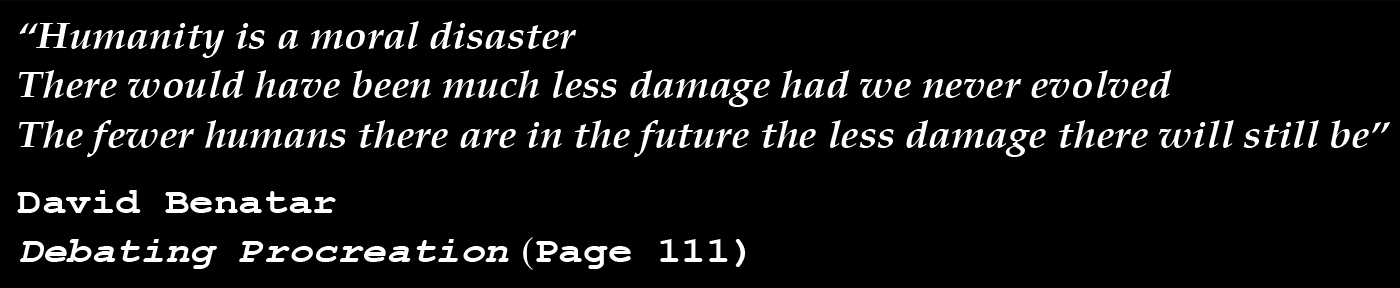
Humans would never voluntarily cease to procreate, and would never cease to be destructive. That’s why we must aim at human extinction by forced sterilization.

Pro-Natalism

The second part of the book is written by David Wasserman who argues for the defense of procreation. He begins with a brief critique of Benatar’s asymmetry, mainly by mentioning the familiar aspects which were specified in the post dedicated to it, so there is no point repeating it here. He also criticizes Benatar’s quality-of-life argument, again mainly by mentioning the familiar aspects such as that Benatar offers unduly pessimistic assessments and inappropriately perfectionist standards.
A more interesting claim he makes is regarding the dynamics between Benatar’s asymmetry and his quality-of-life argument, a point which was mentioned in the post regarding extinction and pro-mortalism. Wasserman wonders why Benatar even needs the asymmetry argument (which he calls the comparative argument) and is not sufficed with the quality-of-life argument (which he calls the philanthropic argument), as Benatar:

“does not regard his comparative argument by itself as making the case that all procreation is wrongful. That case also requires his philanthropic argument, which is designed to show just how bad our lives really are. But if it is the magnitude of the harm that gives rise to a complaint, not the conclusion that life is always a harm, then it is not clear what role the comparative argument plays in reaching that conclusion. If careful scrutiny and critical assessment could show that life was very harmful overall for everyone, or almost everyone, then why would it matter for purposes of a moral complaint that it was also disadvantageous in comparison with nonexistence? The extremely high odds of a very bad existence would make procreation wrongful on any reasonable decision rule for risk or uncertainty.” (p.151)

So Wasserman thinks that Benatar should make do with his quality-of-life argument and doesn’t need the asymmetry, but he doesn’t agree with it for reasons which were mentioned above, and since he thinks that not only the risks must be considered but also their probability (which he claims are very low). To that he adds criticism of the attempt to use principles taken from Rawls’s Theory of Justice to constitute an antinatalist argument. Both arguments, the risk and Rawls’s Maximin, are worthy of a separate discussion. The one about risk can be found here, and the one about Rawls’s theory of justice can be found here. Therefore, I’ll not detail them here.

Intuitively, it would make sense to mainly focus here on Wasserman’s counter arguments to the misanthropic argument, given that this is Benatar’s novel argument in this book, and since I think that the harm to others is the most important antinatalist argument. However, Wasserman cowardly, poorly, and extremely speciesistly, evades the argument of the harm to others. His evasiveness is another proof that there is no way to seriously confront this claim. Wasserman’s response to the harm to others argument, as unbelievable as it is two decades into the third millennium, is almost Cartesian, meaning he simply denies the moral validity of animals’ suffering, this is what he wrote:
“I can only respond briefly, in part because I strongly disagree with Benatar’s weighing of the suffering of minimally-sentient animals, a disagreement we cannot resolve here.” (p.166)
Benatar details some of the common horrors done to animals on daily basis in factory farms, laboratories, the entertainment business, and the clothing industry, claiming that: “Humans inflict untold suffering and death on many billions of animals every year, and the overwhelming majority of humans are heavily complicit.” (p. 93) and Wasserman’s reply is that animals don’t really matter. That’s it. His “reply” is simply disgraceful.

Regarding the harms to other humans that Benatar details about as part of the misanthropic argument, Wasserman’s reply is that he disagrees most sharply with Benatar on the implications of human destructiveness and cruelty for individual procreative decisions. And surprisingly, the argument he uses to justify this claim, in my view, undermines moral philosophy:

“I do no think prospective parents must “universalize” about the likely consequences if everyone judged or acted as they do. I think the concerns about the consequences “if everyone did it” have far more relevance for policymakers than prospective parents. Although the latter must be cautious in their predictions about their children and may reasonably have concerns about the fairness and cumulative impact of similar decisions, I believe that they do not need to give this the same weight in their decisions as policymakers or other impartial third parties should in theirs.” (p.167)

Universalizing decisions and acting as policymakers is exactly how ethics should work. That doesn’t imply using Kant’s categorical imperative for any possible case, but Wasserman doesn’t even suggest exceptional cases or anything of this sort. He practically permits people to act as they wish as long as they are not official policymakers, as if only the actions of the latter have consequences. Obviously all actions have consequences, and all consequences must be considered ethically, especially when it comes to actions that everyone can do, like creating a new person.
What’s the point in morality if it is subjective? What exactly is the validation of ethics if every couple can be their own personal policymakers?

I wanted to seriously confront a serious opposition to the misanthropic argument, but Wasserman didn’t provide one. So I’ll focus in the rest of this text on three other points that he makes which I have found worth addressing.

The Good Of The Children

The first point is Wasserman’s claim, and the example allegedly proving that claim, that people can have a child for the child’s sake:

“Here is an example to give some flesh, and plausibility, to the idea that prospective parents can create children for reasons that concern the good of the children, or at least their shared good. Consider a couple who very much want children and decide to adopt. They are normally fertile, but are moved by the need to find homes for the many orphaned children in their country now housed in institutions. This, however, is not their primary reason for adopting; it merely tips the balance. Their reasons include wanting the fulfillment of raising a child from a young age, seeking the uniquely intimate relationship that a child develops with its parents, and giving the child a good home—among the reasons given in surveys of prospective parents. They regard these as reasons that could be served equally well by adoption or conception. Just as they are going to start visiting orphanages, their government prohibits adoption—orphans and abandoned children will be wards of the state, with temporary foster parents in special cases. The couple is very disappointed but quickly decides to go with “Plan B”—they conceive a child for the same reasons.
The point of this example is not just to illustrate that adoption and procreation may be done for similar reasons. As important for my purposes, it suggests the limited role that the actual vs. contingent existence of the child may play in the sorts of reasons prospective parents have. The couple in my example starts by seeking to find a child of their own who already exists, or whose existence is not contingent on their actions. Barred from doing so, they shift to creating a child. But their reasons for doing the latter are largely the same as their reasons for having sought the former. The desire to help existing needy children was just a tiebreaker.” (p.190)

I fail to see the reasoning behind this argument or the explanatory power of this example.
If anything this example proves the opposite. It goes to show that these people want a child of their own, not to help someone in need. If they find no difference in that sense between adopting a child and creating one, then clearly the interests of the child weren’t their motive, as in one option there is an existing child who is orphan and so in need, and in the other option there is no one who needs anything.
It is the parents who wanted the fulfillment of raising a child from a young age. Before they have procreated, that child didn’t exist and so didn’t share their want. It wasn’t in the interests of that child to be raised from a young age. Non-existing persons don’t have interests and no wants, so it can’t be for the good of the child. An existing child on the other hand, does have an interest to be raised from a young age. That’s a very important difference between the two cases.

And same goes for the second reason – no non-existing person is seeking the uniquely intimate relationship that a child develops with its parents. But existing persons – prospective parents, and even more so orphans – probably do. In the case of procreation, seeking the uniquely intimate relationship is the parents’ want imposed on the child they have created.
The last reason is no different. While orphans desperately need a good home, because they already exist but don’t have one, non-existing persons don’t need a home, or anything else for that matter. The need for a good home was created correspondingly with their creation.

There are many ways to really act for reasons that concern the good of the children, but none of them includes creating ones. There are many children who have parents but don’t have other things that would make their lives better, why not focus on them? Why not help children with their homework? Why not volunteer to babysit them every once in a while? Why not starting a children class for free? Why not choose professions that focus on care for the good of the children like being teachers, doctors, social workers, kindergartners, Clown Cares, and etc.?
If it was really benefiting children that was on their mind they would invest most of their time, energy and resources on existing children who are in need, instead of on someone who they have created its need by procreation. It doesn’t make any sense. Anyone who wants to provide a good home for someone in need, who feel they have so much love to give, who want to do good for others, can adopt a homeless dog from a shelter.

Wasserman argues that “For both adoptive and biological parents, the child’s “bare existence” is a necessary condition for fulfilling their primary end but is not, or need not be, a primary end in itself.” (p. 193) But that doesn’t explain choosing the most senseless option. And even if there wasn’t any other option for giving and the only option was truly to create a need, it is still treating someone as a means to an end. The child had neither interest nor any say in being created into existence. The child is a mean to the parents’ ends.

Unfortunately there is no shortage in philanthropist aims in this world, why choose to create a new one and focus on it? With so much misery in the world why create a new need? Doesn’t it make much more sense to focus on an existing need?

If this world lacks love and meaning, what is the point of increasing the number of creatures who need love and meaning? This is the stupidest form of giving.
Or, of course, that it is not really the reason why people procreate. The real reasons are that people feel powerful when someone is totally depended on them, they feel needed and important, it fills the empty and pointless lives of people with meaning, they believe it would save their relationships, it eases loneliness, it soothes their fear of getting old with no one to take care of them, biological impulse, genetical vanity, immortality illusion, continuity illusion, it makes them feel normal, it makes them look normal to others, conformism, stupidity, accident.
Tantrum in the Mall as a Sip of Lifelong Frustration

The second point I want to address is Wasserman’s argument regrading parents’ duty towards their children: “Even the most spoiled child should recognize that his parents do not have a duty to maximally satisfy his interests; that their own interests, as well as those of a myriad of others, appropriately limit their duty to satisfy his.” (p.154)

This claim might be true when that child would grow up but in real time that child suffers. As an adult that child might regret being so spoiled, but that doesn’t serve as compensation for the frustration at not getting maximum satisfaction. The fact that the child is wrong doesn’t make that child less wanting and less frustrated. Many children tend to keep crying and screaming when they don’t get what they want even after they are explained that what they want is exaggerated or that there is no option to provide them everything they want, any time they want it. And that, in my view, holds much more than might seem. Only because it is obvious that children don’t get everything they want, and also because the crying and screaming scene is so common, people don’t stop and think about the fact that they are creating someone who would want everything possible, and would have to compromise on very little of that. They don’t stop and think about the fact that they are creating someone who would be constantly frustrated.
And it doesn’t end at childhood, it continues throughout their whole life. It is only refined along the years, when children learn to suppress some of their desires (which might come out in different ways that are not necessarily more positive), or control their urges and desires (which again, doesn’t always turn out to be better), but this is forever. Frustration is forever.

The crying and screaming scene on the shopping mall floor because the child got a little bit smaller toy than wanted, which have become so familiar that it turned into a parenthood cliché, is much deeper than children being extremely spoiled. There are so many advices for how to deal with these scenes. Most blame the parents. And they are right, but not because they don’t know how to set boundaries for their children, but because they don’t know how to set boundaries for themselves. It is the parents who are too spoiled and selfish and careless about the effects on others. It is them who acted to promote their own interests and so created a toy for themselves. They don’t know how to postpone gratifications and therefore have created a new small unit of exploitation and pollution which doesn’t know how to postpone gratifications.

This scene, which is considered as parents’ initiation, and which some go through several times during a lifetime, has been so normalized, that rarely do people realize that this wanting being they have chosen to create, didn’t have to exist, and now that it does, it constantly wants things and is being constantly limited. Frustration, even when is the product of being spoiled, is still frustration. People must realize they are creating a wanting being which would be constantly unsatisfied. Quieter children who don’t cry and scream when not getting something, are viewed as more mature and better educated children, and less spoiled. That might be true, and they might internalize that being spoiled is not good, but looking at the screaming children getting their toys, makes them frustrated. Some of them want that toy just as much, but they have internalized the expectation of them to suppress their wants.
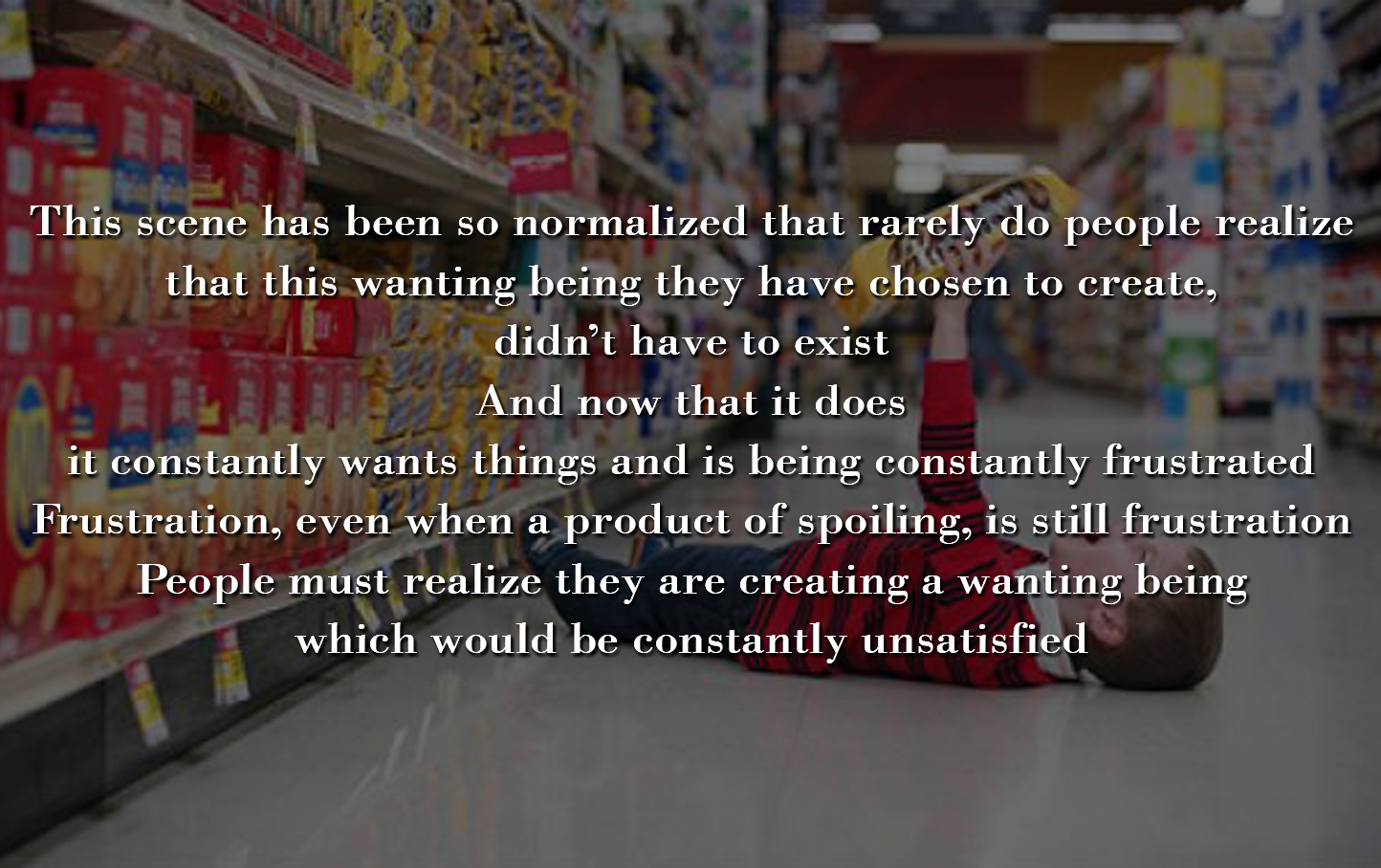
You can look at the mall scene as merely children being too spoiled, or as lack of parental authority, or the consequences of the snowflake attitude, or the effects of the consumerist society, or a little bit of each. But it is also a window of opportunity to comprehend that creating a child is creating a bottomless pit of wants which can’t be satisfied. Of course this example is totally marginal but it is not trivial just because it is so common. It is a window of opportunity because when children are in a state of tantrum there are almost no emotional impediments. Obviously, these scenes are in many cases very manipulative (children are not yet equipped with many tools to help them get what they want so they use what they have which is crying and screaming and kicking as hard as possible), however, they nevertheless express true helplessness. These incidents often occur when children feel they have no control over the circumstances. They want things but are helpless in getting them. Helplessness can often produce fear as the children are depended on other people’s wishes. These scenes are also much more raw than the customary desires of adults, as they are highly socialized to navigate their desires in more subtle ways.

In light of the horrors Benatar specified in the first part, obviously the mall scene doesn’t only pale but seems absolutely ridiculous. But I am not bringing it up as an example of human frustration, but as an example of the greatest trivialization of human’s most trivial frustration. What makes it interesting is the glimpse it offers for everybody to publicly see how much of a lump of wants a person is, and how much frustration even the most trivial scene contains, and how trivial frustration is in people’s lives. The scene is so trivial that everybody accepts it. The child would learn that we don’t get everything we want in life. Unfortunately the adults don’t learn that they shouldn’t create frustration, even if it is very very marginal.
Parents are forcing their children to give up the toy they want, because they have refused to give up the toys they wanted to create.

Russian Roulette

As mentioned earlier, I have addressed the risk argument in a separate text, so here I’ll make do with a quick note on Wasserman’s remark regarding Benatar’s risk imposition metaphor which according to him:

“gains spurious strength, I suspect, from the Russian roulette simile he employs, which has prospective parents pointing a gun at the head of their future child; a gun with a high proportion of chambers loaded. This simile is misleading. As the literature on the ethics of risk imposition and distribution points out, it matters a great deal if the threatened harm will be imposed intentionally. Shooting someone with a loaded gun is intentionally harming him, even if the discharge of a bullet had been far from certain.” (p.165)

One might argue that the parents are not always the ones who pull the trigger. However, they are definitely the ones who set the target, and they are the ones who load at least some of the bullets.
Parents who know that their children would experience suffering, and every parent knows that suffering is inevitable at least at some point in life, are setting the target. Had that child not been created by them, there would have been no one to shoot at.
They are loading some of the bullets by passing physical and mental traits which their children would suffer from. Other starting points might also affect the life of that child. If the environmental conditions are bad, then the gun is loaded with even more bullets. And if it is quite certain that the child is prone to a serious disease, or that the parents are prone to a serious disease, or have a violent history, for example, then the parents are also pulling the trigger, at least in some rounds, and the other rounds are being completed by other factors.
Since parents are creating persons out of their own will and for their own benefit, they are imposing an intended risk on someone else’s life. They don’t intend to harm their own children, but they intendedly ignore the fact that their children would surely be harmed.

When considering the harm to others, since the parents are the ones who provide their children food, clothes, energy and every other harmful aspect involved with supporting their life, they are definitely held responsible in every possible way. They have created this consuming being which wasn’t there and wasn’t deprived of anything before they have decided to create it, and now it exists, and it is hurting many sentient creatures in many different ways for no justified reason at all.
Considering the enormous harm every person inflicts on others, and the loaded weapon is not a gun, but an aircraft carrier.

References

Benatar David and Wasserman David, Debating Procreation: Is It Wrong to Reproduce?
(Oxford: Oxford University Press, 2015)

Benatar, D. Better Never to Have Been (Oxford: Oxford University Press, 2006)
Critical Review of “Better Never To Have Been – Part 6 – Extinction and Pro-Mortalism

After addressing the asymmetry argument, and its supporting asymmetries, the quality-of-life argument, and Benatar’s ‘Pro-Death’ view for abortion, the last post regarding Better Never To Have Been, deals with its sixth chapter. It is mostly about extinction, on which Benatar says:
“My answer to the question ‘How many people should there be?’ is ‘zero’. That is to say, I do not think that there should ever have been any people. Given that there have been people, I do not think that there should be any more. But this ‘zero’ answer, I said earlier, is an ideal answer.” (p. 182)
And: “it would be better if humans (and other species) became extinct. All things being equal, my arguments also suggest that it would be better if this occurred sooner rather than later.”

So far so good, however Benatar divides extinction into two categories:

“It would be helpful to distinguish between two ways in which a species can become extinct. The first is for it to be killed off. The second is for it to die off. We might call the first ‘killing-extinction’ and the second either ‘dying-extinction’ or ‘non-generative extinction’. When a species is killed off, extinction is brought about by killing members of the species until there are no more of them. This killing may be by humans or it may be by the hand of nature (or by humans forcing the hand of nature). By contrast, when a species dies off, extinction is brought about by a failure to replace those members of the species whose lives come to an inevitable natural end.” (p.195)

And argues against one of them:

“There are clear differences between the two. Most obviously, killing-extinction cuts lives short, whereas dying-extinction does not. Although it may be bad for anyone of us to die, it is still worse to die earlier than we need to. Secondly, there is a moral difference between some cases of killing-extinction and cases of dying-extinction. Were anti-natalists to become pro-mortalists and embark on a ‘speciecide’ programme of killing humans, their actions would be plagued by moral problems that would not be faced by dying-extinction. Humans killing their own species to extinction is troubling for all the reasons that killing is troubling. It is (usually) bad for those who are killed, and unlike dying (from natural causes), it is a bad that could be avoided (until dying occurs). Although we can regret somebody’s death from natural causes at the end of a full life span, we cannot say that any wrong has been done, whereas we can say that a moral agent killing somebody, without proper justification, is wrong.” (p.196)

In this paragraph, as well as in interviews and other papers, Benatar emphasises that he is not a pro-mortalist. Some argue that Benatar’s version of antinatalism entails pro-mortalism, but Benatar insists that it doesn’t. His reason is that since non-existence always has an advantage over existence, it is always better not to start a life, but once life has started, existing persons have interests to continue living so we must not act to cut their lives short or stop them once they have started. In fact he claims that death is another reason to be antinatalist “coming into existence is bad in part because it invariably leads to the harm of ceasing to exist” (p.213).

In this post I’ll argue that despite his repudiation attempt, Benatar’s version of antinatalism does indeed entail pro-mortalism, and more importantly, that there are other much stronger reasons to be pro-mortalist and pro-extinctionist, independent of any of Benatar’s arguments.

Extinction and Pro-Mortalism

Benatar argues in the article Every Conceivable Harm:A Further Defence of Anti-Natalism that:

“by itself, the asymmetry argument is insufficient to yield the antiatalist conclusion. It shows that it is better never to come into existence. It does not show how great a harm it is to come into existence. The second argument – what I shall call the quality-of-life argument – reveals the magnitude of that harm. However, the quality-of-life argument can also be understood as a separate argument for the conclusion that coming into existence is a harm.” (p.146)

I’ve specifically addressed the quality-of-life argument in a former post so please read it if you are not familiar with it. Basically the argument is that life is much worse than people tend to think it is, and the reason is that people’s self-assessment of the quality of life is extremely unreliable. Empirical evidence shows that most humans have an optimism bias, which leads them to overestimate the quality of their lives.

Such being the case, why is it only that coming into existence is a harm, but not existence itself? If life is as bad as Benatar argues it is, and if people’s self-assessments of the quality of life are so unreliable, then the fact that most of them state that their lives are worth continuing is also unreliable, and since according to Benatar, for the non-existent, the absence of pain is good, but the absence of pleasure is not bad, then it seems that Benatar’s antinatalism do entails pro-mortalism.

However, as mentioned earlier, Benatar argues against pro-mortalism, and one of his reasons is that he thinks death itself is a harm. When Benatar, like many others for that matter, claims that death itself is a harm, they don’t mean that the dying process is bad for the person who is dying, which is obvious, nor the harm of being aware that death is bound to happen someday, or the feeling that it’s coming close and etc. which is obviously bad for the one who experiences it. Both cases, dying and death in the mentioned sense, are bad experiences, but only as long as a person is still alive. The dead are no longer bothered with dying or death. Another point worth mentioning for that matter is that this claim is not made about others who are harmed by the death of a person. The case in point is whether death is bad for the one who died. And oddly, Benatar’s answer is yes, death is bad for the ones who died because it leads to the harm of ceasing to exist. In other words, for Benatar, death is a sort of deprivation. That is odd since the dead can’t experience any of the effects of their death. In fact they can’t experience anything hence can’t be deprived of anything. A state can’t be bad for someone if it doesn’t have bad consequences for that someone (or any consequences whatsoever in the case of death). It is often argued that death frustrates the wishes of the dead, but the dead can’t be frustrated. There is no one who experiences the loss of the goals which won’t be accomplished. No one is there anymore to be a victim of this “frustration”. This claim can only make sense if wishes were moral entities. There is no morally relevant agent who wants these wishes but is deprived by death.

Another reason why this claim is odd is that Benatar is the philosopher who argues that “The absence of pain is good even if that good is not enjoyed by anyone; but the absence of pleasure is not bad unless there is somebody for whom this absence is a deprivation”. So it seems that, especially in his case, it would be more plausible to argue that not only that the sooner human extinction comes the better, but that human extinction is a moral imperative. That is since it is preventing bad experiences from innumerable generations, with no negative effect, and since arguing that something is better, ethically compels (surly in this unequivocal case) an intervention to make it happen. After all, to stand idle while generation after generation spawns an unimaginable amount of suffering, is complicity.
Benatar explains the oddity by arguing that while non-existing persons don’t have an interest to live, existing people do have an interest to live, so it is a different scenario.

First of all, Benatar’s argument that death is a harm that adds to already bad life significantly undermines his argument that life is a serious harm. If life is as bad as he argues it is, then death should be viewed as salvation from harmful lives, not another harmful aspect of them. It is a harm that ends all other harms. So for death to be another harm and not a relief, the other harms must be not as bad as he argues they are.

But even if we accept that it is a different scenario and therefore doesn’t necessarily entail pro-mortalism, it is definitely not sufficient as a reason against extinction brought by killing, since to make that case Benatar must think that not only that existing people’s interests in continuing to exist (which is in itself flawed given the psychological features which distort their ability to make objective assessments of the actual quality of life and constitute instead a fallacious positive assessment) subdue their own suffering in life, but that they also subdue the suffering of all the future generations.
Even if death isn’t a benefit since it ends horrible lives, but really another harm in horrible lives, in order to oppose extinction brought by killing, Benatar must argue that the harm of cutting the lives of existing people short (which in itself should be doubtful since Benatar thinks that the absence of pleasure is bad only if there is somebody for whom this absence is a deprivation) overcomes the harms of anyone who would ever be born if the lives of existing people won’t be cut short. It is reasonable only if you think that life isn’t that bad. But Benatar does think so. If Beantar had only argued that it is better never to have been created in the first place since non-existence has an advantage over existence, then he could plausibly argue that his version of antinatalism doesn’t entail pro-mortalism. But he does argue that life is a harm. His antinatalism is not pure logic, meaning solely based on the logical conclusion derived from his asymmetry. He really cares about suffering. And that’s what makes his pro-life argument so strange. His support of what he calls ‘dying extinction’ is self-explanatory, however I fail to understand his opposition to ‘killing extinction’, especially when he of all people, is basing it on the opposition to cut existing people’s lives short. How can he seriously balance all the suffering of all the sentient creatures who would ever be created with the suffering of the existing people had their lives been cut short?
And given that non-existing have no interest in coming into existence, so they are not harmed by not coming into existence (he of course argues that they are harmed by coming into existence), then actually the opposition to human extinction if brought by killing and not by dying off, is favoring the sacrifice of anyone who would ever be born, for the sake of not hurting the interests of existing people whose lives would be cut short.

Although in supporting ‘dying extinction’ he is in favor that there won’t be future generations, his support of ‘a right to procreative freedom’ (claiming that if the state would actively prohibit reproduction it would require highly intrusive policing and invasions of privacy since people would refuse to obey this law) practically allows and accepts the creation of future generations. In addition, it is not that he opposes extinction brought by killing because of the option of ‘dying extinction’, but he opposes extinction brought by killing because killing is wrong, period. Even if there was no other way to prevent all the suffering of all the generations that would ever exist except by killing the current one, he would oppose it. And so despite that he is in favor that there won’t be future generations, he conditions this support with unethical terms.

Even if we accept the claim that people’s interests in continuing to live can be an argument against killing-extinction (despite that there is something very inconsistent when it comes from someone like Benatar who thinks that people’s self-assessments of quality of life are extremely unreliable, and that life is so bad that they mustn’t ever start, and since he is supposed to think that death is not bad for the dead considering that he argues that the absence of pleasures are bad only if there is someone for whom this absence is a deprivation), people’s interests in continuing to live is not a valid argument against extinction even if brought by killing, when it is at the expense of others. The interests of existing people are not negated but are set aside by bigger interests of many more subjects – the billions of subjects who are harmed by the existing people. Every human who continues to live means thousands of others who would continue to suffer as a result. Even if death has a cost, and it always has a cost, there is a much bigger cost for life. The main motive behind pro-mortalism isn’t the neutral nature of death for the ones who died, but the cruel nature of life for the ones who are living. It is not the fact that death is not bad for the one who dies, it is the fact that life is bad for the ones who are forced to live horrible lives because of that person.
The interests of current living humans can’t be seriously compared with the interests of generations upon generations of sentient creatures, who would otherwise be forced into a life of suffering.

I believe that the fact that death is not bad for the one who dies, mainly makes the dilemma much easier. But the main motive is that human extinction would prevent the suffering of trillions of nonhumans, as well as generation upon generation of frustrated humans who would continue to be forced into existence with different levels of misery.
Each human is not only suffering in life (and so non-existence is better than living for that person), but is first and foremost a little exploitation and pollution unit. The death of a person is not bad for that person, and it is good for many others.
And in a broader scale, the little good that humanity has brought to this world is concealed in the ocean of misery that it caused. Wherever humans have set their foot they have murdered, exploited and demolished. That includes each other, other species, and the environment.

Weighting the counterfactual desire of dead people to continue their existence against the concrete suffering of many more people, means that Benatar doesn’t take seriously enough his own quality of life argument. And that’s in the better case, in the worst one he is being cruel and speciesist as most of humans’ victims are animals, and they already significantly outnumber existing people. Trillions of sentient creatures would be forced into a miserable existence just so the interests of much less creatures, who are also their victimizers, won’t be violated. What about the interests of hundreds of billions of chickens who can’t spread their wings? What about the interests of tens of billions of pigs who don’t know what it is like not to feel pain? And the interests of tens of billions of ducks who never feel water or clean air throughout their entire lives? Their suffering is extremely greater than would be the suffering of the last generation of humans, were it on the brink of extinction. Therefore I think it is justified that human extinction would be initiated by people who care about others, obviously with minimum harm and as fast as possible. The best way I can think of to accomplish that is forced sterilization.

The amazingly sad thing is that during a podcast hosting Benatar, Sam Harris presented a human extinction scenario in which no one suffers and Benatar rejected it anyway. Harris asked him why would it be a bad thing for everyone to die tonight painlessly in their sleep without knowing that this is their last day, and without even experiencing it, and with no one around to know that it has even happened? Benatar replied that those of us who do exist, have an interest in continuing to exit, they have an interest to not be annihilated.
The power of this thought experiment lays in showing how human chauvinism is so deeply rooted. Even the suggestion of human extinction with no human ever being aware or experiencing it, is being rejected. It is beyond me how Benatar can think that existence is always bad, but the painless death of everyone is worse.
Condemning such a dream like scenario is complete evil. The claim that in the name of what the dead would have wanted if they were still alive (but currently don’t want anything and are not hurt by anything), he would sacrifice everyone who would ever suffer in this cruel world, is one of the harshest things I can imagine.
Preventing the human race from procreating using a virus or a bacteria or something of this sort which cause sterilization, is not as ideal as Sam Harris’ thought experiment, but it is probably the least harmful way of stopping the most harmful species ever in the history of this planet. And that is one of greatest things I can imagine.

References

Benatar, D. Better Never to Have Been (Oxford: Oxford University Press, 2006)
Benatar, D. Every Conceivable Harm: A Further Defence of Anti-Natalism
S. Afr. Journal Philos. 2012, 31

Benatar, D. Still Better Never to Have Been: A Reply to (More of) My Critics
Journal of Ethics (2013)

Feldman, F. Some puzzles about the evil of death in Life, Death and Meaning (Lanham MD: Rowman & Littlefield 2004)

Luper, S. Annihilation in Life, Death and Meaning (Lanham MD: Rowman & Littlefield 2004)

McGregor, R. and Sullivan-Bissett, E. 2012: “Better No Longer To Be: The Harm of Continued Existence” The South African Journal of Philosophy

Pitcher, G. The misfortunate of the dead in Life, Death and Meaning (Lanham MD: Rowman & Littlefield 2004)

Rosenbaum, S. How to be dead and not to care in Life, Death and Meaning (Lanham MD: Rowman & Littlefield 2004)

Suits D. B. Why death is not bad for the ones died in Life, Death and Meaning (Lanham MD: Rowman & Littlefield 2004)

Critical Review of “Better Never To Have Been – Part 5 – Abortion: The ‘Pro-Death’ View

In the fifth chapter of the book Benatar offers his argument for abortion, a ‘Pro-Death’ View as he calls it.
Basically the idea is that since coming into existence is harmful, and since at least during the earlier stages of pregnancy, one has not yet come into existence in the morally relevant sense, people mustn’t give a justifiable reason for having an abortion but for not having one.

It is the failure to abort which must be defended he argues, and adds that the greater the harm of existence, the harder it will be to defend that failure. And if life is as bad as he suggests it is – then the failure to abort (at least during the earlier stages of pregnancy) may never, or almost never, be justified.

I agree that people mustn’t give a justifiable reason for having an abortion but for not having an abortion, only for different reasons than Benatar’s. His first premise – that the creation of a new person is always harmful – is correct, but as opposed to what Benatar means when he claims that, the creation of a new person is always harmful first and foremost for other sentient creatures who would be harmed by that new person. And harming them can never be justified.
The harms to others are so severe that it nullifies the harm of abortion even when performed after the fetus has already reached the morally relevant stage. Arguing otherwise is suggesting that the interest of a fetus, even if already conscious, is more important than the interests of all the existing sentient creatures who would be harmed if that person is born. That is morally wrong.

Considering the harms to others and not having an abortion could never be justified, and considering how severe the harms to others are, abortion at any stage is always morally justified.

Some argue that abortion is wrong since it deprives a person of the value of its future. But such an argument forces us to think that it would be worse to kill a fetus than to kill a thirty-year old, since a fetus, all things being equal, would have a longer future, and would therefore be deprived of more. Most people find that preference unacceptable. Benatar provides an explanation why:

“The greater deprivation makes sense when we are comparing the death of a thirty-year old with that of a nonagenarian, where most people take the former to be worse. However, it makes much less sense when comparing the deaths of the fetus and the thirty-year old, where many of us take the latter to be much worse. The best explanation for this is that a fetus has not yet acquired the interest in its own existence that the thirty-year old has.
The case of the thirty-year old and the nonagenarian can be explained in one of two ways. It could be that both have equal interests in continued life but the nonagenarian has less life left. Alternatively, in some cases only, it could be that the nonagenarian’s interest in living has already begun to decline, perhaps on account of life’s becoming worse with advancing age and decrepitude.” (p.159)

There is another reason to prefer abortion over killing a thirty-year old, and that is since the latter had already passed 30 years of causing suffering, while the fetus still has a lifetime of inflicting suffering on others. The main ethical reason to prefer killing the fetus over a thirty-year old is the time each has left to harm others. All things being equal, the fetus has 30 years more to inflict harms, so there is no dilemma.
Even if we look at it from Benatar’s view and not from the harm to others view, if life is as bad as he claims it is, then clearly it is better to kill the fetus who has a lifetime of suffering ahead, while the thirty-year old at least has 30 years less to suffer.

Having said that, Benatar nevertheless seriously argues for a right to procreate:

“If a right to reproductive freedom were withheld in order to prevent harm to those who would be brought into existence, the state could then either simply let people exercise reproductive choices without having a right to do so, or it could actively prohibit reproduction. The first option would be pointless. If the point of withholding an entitlement to have children is to prevent the harm of bringing people into existence, why withhold an entitlement to have children only then to permit people to have children?
Withholding the right would have to bfocusing on the harms to humans[r1]
[r1]Link to 1e linked, therefore, to a prohibition on having children. However the argument in defence of a legal right to reproductive freedom might go, procreative prohibition simply would not work. People would find ways of breaking the law. To enforce the law, even partially and unevenly, the state would have to engage in highly intrusive policing and the invasions of privacy that that would entail. On the plausible assumption that coitus itself should not and cannot effectively be prohibited, the state would have to be able to distinguish between those, on the one hand, who conceived wittingly or negligently, and those, on the other hand, who conceived accidentally. In either case, the state would then have to require abortions. In the case of the unwilling, this would require physically restraining people and performing unwanted abortions on them. The threat of this would very likely drive pregnancy underground, with women gestating and giving birth on the quiet. This, in turn, would very likely increase pregnancy- and parturition-related morbidity and mortality. These sorts of moral costs are immense and there is a powerful case to be made for the view that they are not outweighed by the benefits. This is particularly so given that the full benefits are unlikely to be obtained, given that much procreation would not be prevented by a prohibition on producing children.” (p.106)

It is strange that despite his claim in chapter 2 that it is always better never to have been, and despite his claim in chapter 3 that coming into existence is a very serious harm, he makes such an argument. Earlier in the book he also argues against that parents with dependents are somehow thought to count for more: “If, for example, there is some scarce resource—a donor kidney perhaps—and of the two potential recipients one is a parent of young children and one is not, the parent, all things being equal, will likely be favoured. Increasing one’s value by having children might be like increasing one’s value by taking hostages. We might find it unfair and decide not to reward it.” (p.12) Isn’t it a similar case when the right to procreate is justified by the fear of an Orwellian surveillance? If he can that easily defend the right to procreate doesn’t it significantly enfeebles the validity of his basic arguments? If life is as bad as he claims it is, can a surveillance society, as bad as it is in itself (and it most definitely is terrible) be compared with the harms of life? Even without considering the harms to others it is highly doubtful. And when considering the billions of sentient creatures being imprisoned for their entire lives, when considering the billions of sentient creatures being genetically modified so they would provide the maximum meat possible for the to-be born persons, when considering the billions of sentient creatures being forced to live without their family for their entire lives, when considering the billions of sentient creatures who suffer from chronic pain and maladies, when considering the billions of sentient creatures that can never breathe clean air, walk on grass, bath in water, and eat their natural food, when considering the billions of sentient creatures being violently murdered so the to-be born could consume their bodies, when considering the billions of sentient creatures whom their habitats are being destroyed and polluted, when considering the billions of sentient creatures being skinned alive, castrated, burned, poisoned, kicked, dehorned, detailed,  mounted, chained, experimented on, enslaved, it is totally unquestionable.
How can a life of extreme suffering ever be compared with outlawing procreation? Or even forced abortion? Can anything be compared with lifelong suffering with not even one painless second?

Don’t get this wrong, I agree that procreative prohibition won’t work completely, and I agree that it has tremendous moral costs, however, one must be extremely speciesist to think that they are not outweighed by the benefits. This is another problem with focusing on the harms to humans, when considering the harms to others there is no doubt what must be done.
Benatar himself mentions something of this sort as a solution to the expected problems involved in procreative prohibition:

“We can certainly imagine a society in which non-procreation could be widely (even if not universally) ensured without the invasions of privacy and bodily intrusions described above. This would be so if a safe, highly effective contraceptive substance could be widely administered without the knowledge of the population or the consent of individual people—in the drinking water, for example, or by aerial spray. A state in which this were done would avoid the horrendous image of Orwellian surveillance, or forced sterilizations and abortions, and so on. Of course, it would still be violating personal autonomy, but this, we have already seen, is not sufficient to make the case for a legal right to produce children.” (p.107)

With that I couldn’t agree more. It is much more likely to work, and it avoids the harms of procreative prohibition. It also doesn’t require a broad consent or state intervention or operation. All it takes is highly devoted activists with the right idea and resourcefulness, and hopefully finally the cruelest species ever would gradually go extinct, along with all the suffering it is forced to endure, and all the suffering it inflicts on others.

References

Benatar, D. Better Never to Have Been (Oxford: Oxford University Press, 2006)
Benatar, D.. Every Conceivable Harm: A Further Defence of Anti-Natalism
S. Afr. Journal Philos. 2012, 31

Benatar, D. Still Better Never to Have Been: A Reply to (More of) My Critics
Journal of Ethics (2013)

Feldman, F. Some puzzles about the evil of death in Life, Death and Meaning (Lanham MD: Rowman & Littlefield 2004)

Luper, S. Annihilation in Life, Death and Meaning (Lanham MD: Rowman & Littlefield 2004)

Pitcher, G. The misfortunate of the dead in Life, Death and Meaning (Lanham MD: Rowman & Littlefield 2004)

Rosenbaum, S. How to be dead and not to care in Life, Death and Meaning (Lanham MD: Rowman & Littlefield 2004)

Suits D. B. Why death is not bad for the ones died in Life, Death and Meaning (Lanham MD: Rowman & Littlefield 2004)

Critical Review of “Better Never To Have Been – Part 4 – The Quality of Life Argument

After making the claim – that as long as life contains even the smallest amount of bad, coming into existence is a harm – Benatar turns to show that all human lives contain much more bad than is ordinarily recognized. His motivation is that “If people realized just how bad their lives were, they might grant that their coming into existence was a harm even if they deny that coming into existence would have been a harm had their lives contained but the smallest amount of bad.” In other words, it is much harder to dismiss his conclusion considering how bad life actually is. However he argues that “this chapter can be seen as providing a basis, independent of asymmetry and its implications, for regretting one’s existence and for taking all actual cases of coming into existence to be harmful.”

Being aware that most people deny that their lives are bad, Benatar focuses most of the chapter to answering the question, how can it be a harm to come into existence if most of those who have come into existence are pleased that they did? His answer is that their self-assessments are completely unreliable indicators of life’s quality, mainly due to a number of psychological features which distort their ability to make objective assessments of the actual quality of life and constitute instead a fallacious positive assessment.
The following are the 3 mechanisms Benatar mentions, along with a brief explanation of each, taken from the book.

1. The Pollyanna Principle

“The first, most general and most influential of these psychological phenomena is what some have called the Pollyanna Principle, a tendency towards optimism. This manifests in many ways. First, there is an inclination to recall positive rather than negative experiences. For example, when asked to recall events from throughout their lives, subjects in a number of studies listed a much greater number of positive than negative experiences. This selective recall distorts our judgement of how well our lives have gone so far. It is not only assessments of our past that are biased, but also our projections or expectations about the future. We tend to have an exaggerated view of how good things will be.” (p.65)

And here is another educating description of how selective perception and memory contribute to the perception that life is good, taken from an article called Bad is Stronger than Good:

“As Taylor (1991) argued, the human psyche has powerful mechanisms for retrospectively minimizing bad experiences. Although both good and bad feelings may fade with time, the bad ones are actively suppressed; whereas the good memories may be cultivated and sustained (e.g., through reminiscence). By the same token, people may treat bad experiences as isolated events while integrating good ones into an ongoing general perception of goodness. In this way, individuals may sustain a broadly favorable view of their lives.
These considerations are quite consistent with the view that the good life consists of a consistent pattern of good outcomes, even if these are individually relatively small and weak. A few bad outcomes can be minimized by making external attributions or regarding them as unimportant, thereby preserving the subjective impression of a stable pattern of good outcomes. As long as the individual perceives that pattern of consistent goodness, life may seem strongly good overall even if nothing strongly good ever happens.” (Baumeister, R and Bratslavsky, E and Finkenauer, C and Vohs, K, 2001, p.36)

Some may argue that the very fact that people have a structured optimism bias, practically makes their lives better since reexperiencing past events in a better way actually makes them feel better even though it is false. That might be true, but it is crucial to remember that the issue here is not should existing people continue to exist, but should existing people force others into existence. Therefore, even if bad experiences are remembered as better than they actually were, which makes them less bad for the ones who have experienced them, it can’t make similar experiences less bad for the ones who haven’t yet experienced them. For them these experiences would be as bad as they really are. It may be that in the future they too will remember these events as less bad than they actually were, but even if so, it won’t make these experiences less bad when they actually experience them, and as opposed to existing people which in their case it’s too late, these kinds of bad experiences can be prevented in the case of non-existents.
Anyway, the main problem with the false assessment is its ethical implication. If people think that life is much better than it actually is, it would be much harder to convince them not to create new people.

2. Adaptation

“When a person’s objective well-being takes a turn for the worse, there is, at first, a significant subjective dissatisfaction. However, there is a tendency then to adapt to the new situation and to adjust one’s expectations accordingly.
As a result, even if the subjective sense of well-being does not return to the original level, it comes closer towards it than one might think…
Because the subjective sense of well-being tracks recent change in the level of well-being better than it tracks a person’s actual level of well-being, it is an unreliable indicator of the latter.” (p.67)

Like in the case of the Pollyanna principle, some may argue that if people can adapt and adjust, then life is not that bad even when it is not easy. But why condemn people to such a state in the first place? Why force them to adapt to a bad situation when it is absolutely unnecessary?
It is so cruel to say that life is hard on everybody and they are all managing and they all adjust, since not everybody adjust, and since no one should adjust to a situation they don’t choose or haven’t agreed to come into before they were forced to. Why knowingly create someone who would have to adjust to bad situations, instead of easily avoiding any bad situation that person would be forced to endure? Why create someone who would want things all the time, which obviously not all of them would be obtained and the question is only how frustrated that person would be? And why create desires which wouldn’t exist otherwise? Wanting is not good since it means that there is a deficit, otherwise it wasn’t a want but a satisfaction, and sentient creatures, and most certainly humans, always want. And they don’t get what they want most of the time. Statements such as life is a compromise, or that we don’t always get what we want in life, are so common, and yet people consciously choose to throw other people into the position in which they must always compromise and never get everything they want. Why create a need when it is not necessary?

3. Comparison with Others

“It is not so much how well one’s life goes as how well it goes in comparison with others that determines one’s judgement about how well one’s life is going. Thus self-assessments are a better indicator of the comparative rather than actual quality of one’s life. One effect of this is that those negative features of life that are shared by everybody are inert in people’s judgements about their own well-being. Since these features are very relevant, overlooking them leads to unreliable judgements.” (p.68)

This feature is one of the most cynical, oxymoronic and cruel aspects of the issue. That is so since, if to put it bluntly, it means that as long as everyone’s life is miserable, everything is fine. According to this feature, parents shouldn’t be worried that their children would have bad lives, but that someone else would have a good one, since then they and their children would realize how bad their lives actually are. This world is so cynical and cruel that people’s desire to procreate is not threatened by the chance that their children would be miserable, but by the chance that others’ children would be a little bit better.

Life Addiction

Unfortunately, it is almost pointless to throw psychological theories on people since the trick about these psychological biases is that they prevent people even from noticing their utterly biased perception regarding the very existence of these biases, not to mention a more objective and reliable assessment of their own existence. It is a deadlock.

It is hard to see any of that changes since, as Benatar himself claims, these psychological features have a strong evolutionary advantage:

“The above psychological phenomena are unsurprising from an evolutionary perspective. They militate against suicide and in favour of reproduction. If our lives are quite as bad as I shall still suggest they are, and if people were prone to see this true quality of their lives for what it is, they might be much more inclined to kill themselves, or at least not to produce more such lives. Pessimism, then, tends not to be naturally selected.” (p.69)

People won’t be convinced that they shouldn’t procreate because their children would experience the daily discomforts Benatar specifies along the chapter, no matter how abundant and prevalent these are, and they would certainly not avoid procreation because they are biased to optimism. People procreate even when the chances for serious lifelong maladies are very high (for example in the case of genetic diseases or even when problems are observed through ultrasound).
Even people who have had horrible lives don’t hesitate and procreate despite that they know firsthand how easily life can become nightmarish. Procreation is way stronger than rational arguments, and people are anyway not very rational.

Another factor which I find crucial in affecting people’s perceptions, which is also another kind of a psychological mechanism, is that it is hard to imagine non-existence. Not that it should be a required part of making life assessments, but it seems that Benatar’s argument – that life is much worse than people think it is and therefore coming into existence is a very serious harm – necessitates that people would think that their lives are not worth living. No matter how many times he explains that the two differ, I think that people find it hard to distinct and so reply to his argument by an answer to a question he doesn’t ask. They confuse the claim that it is better never to have been, with the claim that their lives better not continue in one case, and the less confused who understand the difference between not continuing their lives and not starting them, find it hard not to imagine losing what they have experienced if their lives had never started, though clearly this is not what would have happened had they never existed.
The source for the second confusion makes sense to me since it is hard to imagine non-existence as a preferable position. Most people find it hard not to imagine non-existence as something bad, as a deprivation, as some sort of mental prison, a state in which their consciousness floats outside of existence or something of this sort. Non-existence is not only a state they find hard to imagine, it is not a state at all. People can’t put themselves in such a position because it literally doesn’t exist. Non-existence is not a comparable state with existence. So they imagine other states in which they would be deprived of everything they experienced during their existence. Despite that this is not the case, this is the intuition of many. Non-existence is not an existential alternative for a bad life and therefore prioritization in this case is irrelevant. It is irrelevant to ask someone if they rather never to have been since there is no such option for an existing person. And since the intuition behind the question ‘whether it’s better never to have been’ is: is it better that the life you have lived so far would have never started, the answer of many is no. But it’s an answer to the wrong question. When someone exists they inevitably weigh their own life as if this is what the question refers to. This false intuition makes them think that since they feel their lives are worth living, then their children’s lives would be so as well. That is despite that Benatar explains and emphasises the difference between living and non-existence. Still something in the structure of his argument makes people think about it wrongly.

This question is problematic from another angle. Even when people are asked to make life assessments, they rarely do it via some sort of hedonistic balance, they don’t compare bad and good experiences, but to them life is just what it is. It is a journey everybody has to take, nobody really chose and only few chose to quit. It is just something one has got to do. It is what it is. There is no alternative.
People think it is better to live hard lives than missing them, even though they won’t miss a thing had they never had a life. Nobody is harmed by a great life that nobody lived. But someone is definitely harmed by living a horrible life.

Biased assessments and the difficulty to imagine non-existence are not the only problems. Many people feel that they are not even qualified to make life evaluation, a task preserved, according to them, only to god, and their god is very pro-natalist. Some of them believe that the suffering on earth would be compensated in the afterlife, and so generally accept the existence of suffering in this life. They usually don’t ponder over whether their children would share the same belief system, and so condemn them to suffer existence for the sake of salvation in the afterlife despite that before they were born, their children need not to be saved from anything.

Life is much worse than people tend to think, but even if they weren’t, each bad moment happening during them is unnecessary. Every pain, every sickness, every fear, every frustration, every regret, every broken-heartedness, every moment of boredom and etc. are all needless. They exist only because the person experiencing them exists. They exist because the parents of that person have forced existence on that person, as well as forcing that person’s existence on others. There is no good reason for that to happen. Every problem could have been easily prevented instead of being difficultly solved, if solved at all. People exist because it was decided for them to exist by other people, not because it is necessary in any way. People can choose whether to create a sentient creature who would necessarily suffer, and they chose that it would. They chose that that person would experience pain, frustration, fear, boredom, death and the fear of dying for most of their life, they chose it would get disappointed, sick, rejected, and humiliated.
Yes, that person may enjoy parts of life too, but that is not mandatory, while it is mandatory that this short list of bad things will happen at some point, at least once in that person life. Pleasure is optional, happiness isn’t, and suffering is inevitable. Why would anyone willingly force a sentient creature into this condition?

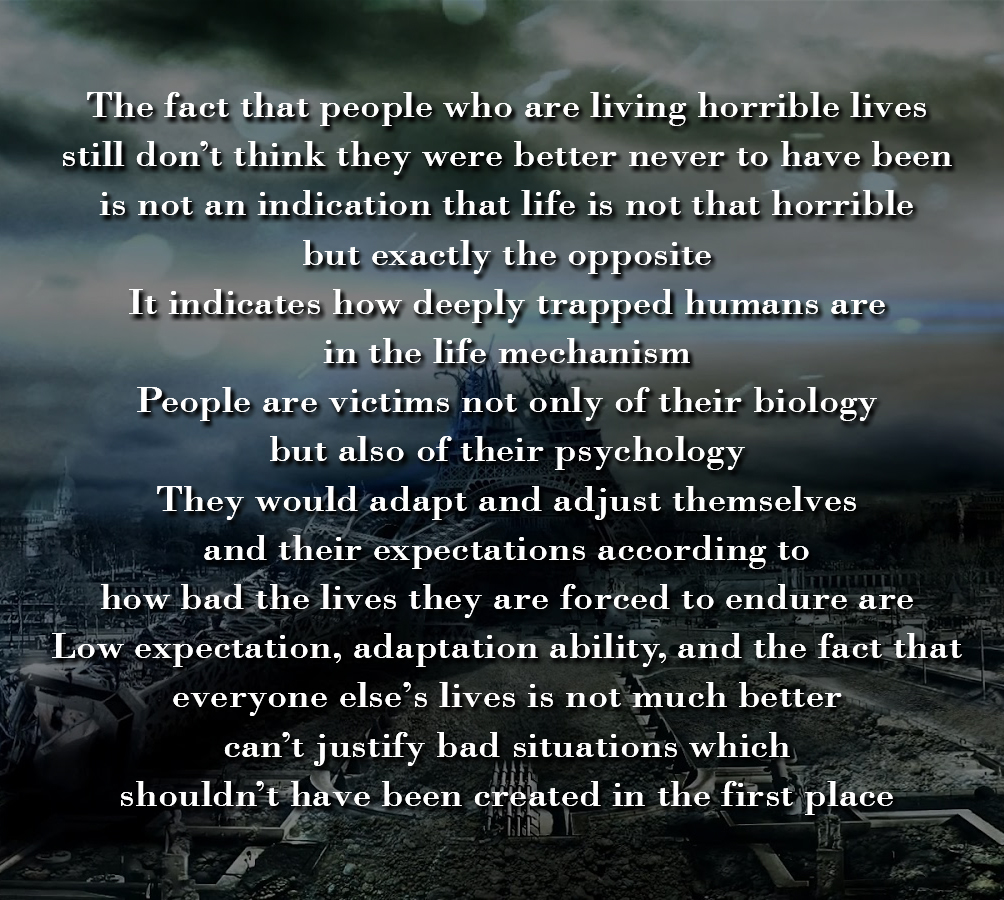
The fact that people who are living horrible lives still don’t think they were better never to have been, is not an indication that life is not that horrible, but exactly the opposite. It goes to show how deeply trapped humans are in the life mechanism. People are victims not only of their biology but also of their psychology. They would adapt and adjust themselves and their expectations according to how bad the lives they are forced to endure are. Low expectation, adaptation ability, and the fact that everyone else’s lives is not much better, can’t justify bad situations which shouldn’t have been created in the first place.
But an even sadder fact is that humans are not really looking for justifications to procreate. Most just do. They don’t even really need mechanisms to sooth their worries about the future of their children, because as inevitable as it is that bad things would happen to their children, it rarely crosses their minds. Unfortunately people are that apathetic to the fate of others, even when it comes to their future children, and definitely when it comes to the rest of the victims of procreation.

The Harm to Others

The fact that life is much worse than people tend to think, is not only relevant to the claim that creating a person harms that person, it is also very relevant to the central antinatalism argument of this blog – the harm to others. That is because as long as people think that life is good, the greater the chances they would create more units of suffering, exploitation and pollution.
Since most humans, more than 95% of them actually, are not even vegans – the most basic and primal ethical decision one must make – procreation is practically letting a mass murder on the loose. When procreating people are choosing that more fish would suffocate to death by being violently sucked out of water, that more chickens would be cramped into tiny cages with each forced to live in a space the size of an A4 paper, that more calves would be separated from their mothers, and more cow mothers would be left traumatized by the abduction of their babies, it is choosing more pigs who suffer from chronic pain, more lame sheep, more beaten goats, more turkeys who can barely stand as a result of their unproportionate bodies, more ducks who are forced to live out of water and in filthy crowded sheds, more rabbits imprisoned in an iron cage the size of their bodies, more geese being aggressively plucked, more male chicks being gassed, crushed or suffocated since they are unexploitable for eggs nor meat, more snakes being skinned alive, and more crocodiles and alligators being hammered to death and often also skinned alive to be worn, and more mice, cats, dogs, fish, rabbits, and monkeys being experimented on.

Benatar sums the chapter with the following paragraph:

“everybody must experience at least some or other of the harms in the above catalogue of misery. Even if there are some lives that are spared most of this suffering, and those lives are better than I have said they are, those (relatively) high-quality lives are exceedingly uncommon. A charmed life is so rare that for every one such life there are millions of wretched lives. Some know that their baby will be among the unfortunate. Nobody knows, however, that their baby will be one of the allegedly lucky few. Great suffering could await any person that is brought into existence. Even the most privileged people could give birth to a child that will suffer unbearably, be raped, assaulted, or be murdered brutally. The optimist surely bears the burden of justifying this procreational Russian roulette. Given that there are no real advantages over never existing for those who are brought into existence, it is hard to see how the significant risk of serious harm could be justified. If we count not only the unusually severe harms that anybody could endure, but also the quite routine ones of ordinary human life, then we find that matters are still worse for cheery procreators. It shows that they play Russian roulette with a fully loaded gun—aimed, of course, not at their own heads, but at those of their future offspring.” (p.92)

When considering the harms to others, people play Russian roulette not with a fully loaded gun but with a fucking machine gun, aimed, of course, not only at the heads of their future offspring, but at the heads of everyone who would ever be hurt by their future offspring.

References

David Benatar, Better Never to Have Been (Oxford: Oxford University Press, 2006)

Benatar, D. Every Conceivable Harm: A Further Defence of Anti-Natalism
S. Afr. Journal Philos., 31 2012

Benatar, D. Grim news for an unoriginal position Journal of Med Ethics 35 2009

Benatar, D. Still Better Never to Have Been: A Reply to (More of) My Critics
Journal of Ethics 2013

Bradley, B Benatar And The Logic Of Betterness Journal of Ethics & Social Philosophy 2010

Cabrera, j. A Critique of Affirmative Morality: a reflection on death, birth and the value of life.
Brasília: Julio Cabrera Editions 2014

Harman, E. Critical study of Benatar (2006). Nouˆs 43: 776–785.

McGregor, R & Sullivan-Bissett, E, ‘Better No Longer to Be: The Harm of Continued Existence’ South African Journal of Philosophy, vol. 31, no. 1, 2012 pp. pg.55-68

Parfit, D. Reasons and Persons (Oxford: Clarendon Press 1984)

Shiffrin, S.V. Wrongful life, procreative responsibility, and the significance of harm. 1999
Legal Theory 5: pg.117–148

Critical Review of “Better Never To Have Been” – Part 3 – The Four Asymmetries

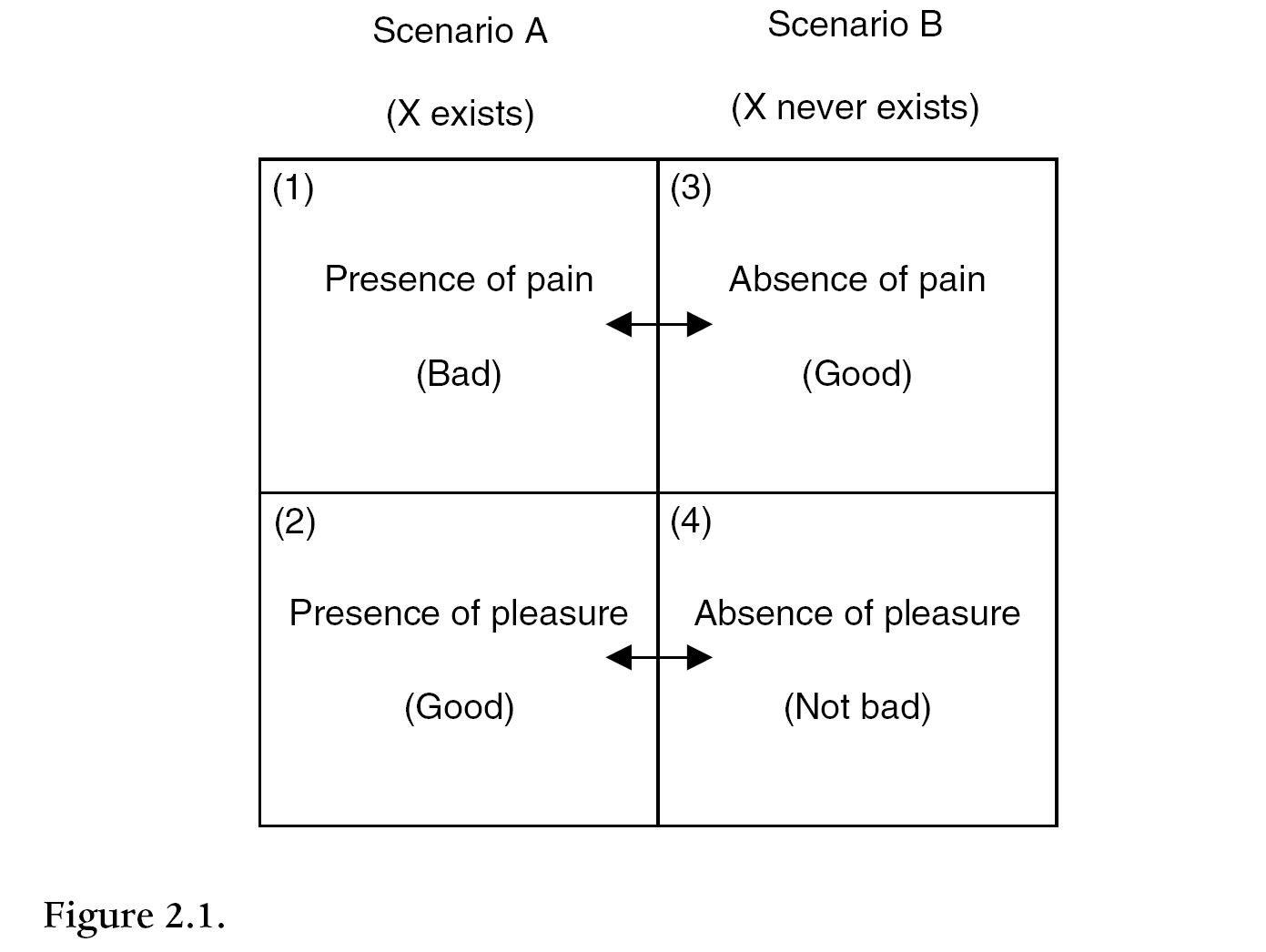
Expecting the criticism regarding his basic asymmetry, most specifically regarding the following: “The absence of pain is good even if that good is not enjoyed by anyone; but the absence of pleasure is not bad unless there is somebody for whom this absence is a deprivation”, Benatar argues that people who wish to state that just as the absence of pains in non-existence is good, the absence of pleasures is bad, must consider the repercussions that this move entails. Among them is that they would then not be able to make the value judgments that they do regarding four other asymmetries that he mentions in the book, which he claims, can only be explained by his basic asymmetry.
In his words (taken from his article Still Better Never to Have Been: A Reply to (More of) My Critics), “My basic asymmetry has the virtue of simplicity. It provides a single, unifying explanation for all the other asymmetries. In this way it is preferable to a strategy of mustering a range of explanations for the various asymmetries.” (p.127)

I find it hard to be convinced by an argument with an essential logical problem only because it provides a unifying explanation for other arguments. It is hard to be convinced by a supportive argument for a basic argument, which basically says that if we reject the basic one, we don’t have an explanation for other arguments. What we ought to do is try and find other explanations for the other asymmetries which are not based on his basic asymmetry. That’s what I’ll try to do here.
But before you continue, it is highly recommended to first read the text dealing with Benatar’s basic asymmetry if you haven’t read it yet, and especially if you disagree that it has a basic flaw.

(i) The Asymmetry of Procreational Duties

“While we have a duty to avoid bringing into existence people who would lead miserable lives, we have no duty to bring into existence those who would lead happy lives.” (p.123)

First of all unfortunately it is not accurate that there is a duty to avoid creating people who would lead miserable lives. I wish there was such a duty but I think there isn’t one since the focus is very much on the existent – the prospective parents – and not their future children. People don’t think much about the future of the ones who haven’t been born yet, but about the future of the parents. The relevancy of that to this specific asymmetry is that people’s common intuition is that nobody has to create a new person if they don’t want to, even if that person is likely to be happy (I’ll ignore for the sake of the argument the fact that any estimation of one’s happiness is totally groundless and extremely fragile). It’s the parents’ desire that counts. Even if the future person is expected to lead a miserable life, it’s still the parents’ choice.
Only in very extreme scenarios we can talk about a duty, if duty is at all on the agenda.
Certainly most ethicists would agree that people have such a duty, and maybe some pro-natalists would claim so in a hypothetical scenario, but if it was their case, or their family or friends’ case, in which the parents wanted a child despite an early detection of serious health issues, they would have probably supported the decision, and certainly wouldn’t claim that there is a duty not to do so.

Most people think that the decision to create a child with expected serious health issues is the parents’ choice, despite that the price would be paid, first and foremost, by the child, and also by society and not only by the parents.
So the interim conclusion is that practically, and among the general public even theoretically, it is not at all obvious that there is a duty to avoid creating people who would lead miserable lives.

And regarding the other part of the asymmetry, if there actually was a duty to create those who would lead happy lives, then prima facie, healthy and relatively wealthy people would have a duty to create the maximum possible people to the point it would wear out their ability to provide them with good starting conditions. And on the other hand, if there was a duty not to create those who would lead miserable lives, then people with health issues and inability to provide their future children a good starting point, would have a duty not to create new people at all. I think that most people would find both implications unacceptable and if so it means that there isn’t really “a duty to avoid bringing into existence people who would lead miserable lives”, and also “no duty to bring into existence those who would lead happy lives”. As earlier mentioned, most people think that what matters most is what the parents want, not how the children would feel. They are concerned with the parents’ present, not with their children’s future.

This view stems from the liberal reasoning that people are first and foremost obligated to promote their own happiness and fulfill their own desires. Therefore it is wrong to pressure them to create new people even if they would lead happy lives, and it is also wrong to pressure them not to bring people who would lead miserable lives, in fact, the perception is that if that’s what they want, they should be supported. People who do so are in many cases considered heros. That is despite that they, and mostly their children, are struggling with a problem they unnecessarily chose to create. Procreation is not about what children would need and about what they absolutely don’t need, but about what their parents want and about what they absolutely don’t agree to give up.

Creating people who would lead miserable lives, is making the parents miserable as well. Creating those who would lead happy lives, is making the parents miserable if they don’t want to create anyone. If there was a duty to bring into existence those who would lead happy lives even if the parents don’t want to, then they (the parents) wouldn’t lead happy lives.
People think that there is no duty to create those who would lead happy lives, not because they share Benatar’s claim that the absence of pleasure is not bad unless there is somebody for whom this absence is a deprivation, but because causing someone who doesn’t want children to have them anyway is wrong.

So in the more liberal parts of the world there is no duty to create those who would lead happy lives, but not because people think that the absence of pleasure is not bad unless there is somebody for whom this absence is a deprivation, but because people think that it is the parents’ interests that counts. And in other parts of the world there is a duty to procreate (pretty much regardless of the expected consequences). Perhaps a duty might feel too far-reaching, but there is definitely peer pressure to do so. In many cases this peer pressure is very close to a duty, for example in societies where procreation is a divine decree, or societies who feel they need soldiers or more working hands, or somebody to take care of the aging population in the rare cases of negative population growth, or simply because it is socially unacceptable not to have children. Probably an enormous amount of people were forced into horrible lives, by people who didn’t want to create new people but had no choice, even after the contraceptive age, not to mention before it. Most societies still look at healthy couples who are not extremely poor, as selfish if they choose not to create new people.

Even if there was a duty not to create those who would lead miserable lives, it doesn’t necessarily support Benatar’s basic asymmetry. People can think that it is wrong to create those who would lead miserable lives without thinking that the absence of bad is good even if there is nobody to benefit from that absence. It’s plausible to think that it is bad to bring misery into the world, despite that it is not good not to do it (in case there is no one to benefit from the absence of that misery). Misery can be valued as bad without the absence of it being good. We don’t think that people are doing something good when they choose not to hurt someone, though we certainly think that people are doing something bad when they do. Not raping is not good despite that raping is extremely bad. People are supposed to not hurt others, not hurting others mustn’t be valued as good, but as obvious. So it is plausible to think that there is a duty not to create those who would lead miserable lives, without that being good. For a duty to make sense, it is sufficient that it would be bad if it is not applied, it is not necessary that the opposite case would be good.
It takes a truly horrible world that not harming someone is considered good. It’s supposed to be the ethical default. Avoiding procreation isn’t good but the ethical default. We shouldn’t thank people who haven’t procreated. Only in a fucked up world like ours, not committing the greatest crime an individual can commit, is being thanked for. People who don’t procreate are not doing a good thing but the ethically obvious thing. People who do procreate are doing a bad thing and they must be stopped.

Another explanation for the first asymmetry can be that it truly relies on a more basic asymmetry, but not Benatar’s. That is that there is a duty not to harm others, but not to benefit others. The happiness of every person is theirs and their close ones’ responsibility, and there is no duty to bestow happiness on other people. On the other hand, there is a duty not to cause harms. There is a duty not to cause someone pain but not a duty to invest one’s own energy, time and efforts to make someone else happy. This basic asymmetry relies on an even more basic perception which is that it is much more important to avoid harms than to gain pleasures. It is more important for almost each and every human, and probably each and every other sentient creature, to avoid feeling pain, than to feel pleasure. And if this is the case with each one of us, the same logic must be applied regarding non-existing people.
There is no duty to create others even if they would lead happy lives since not doing so will not harm anyone, but there should be a duty not to impose pain, frustration, death, the fear of death, illnesses, boredom, anger, anxiety, regret, disappointment, suffering and every other negative experience imperative to existence, on others.

And finally, there is something problematic in the framing of this asymmetry. Saying we have a duty to avoid creating people who would lead miserable lives, means that we know that’s what’s going to happen (for example because we know of foreseen serious health issues or seriously poor social starting conditions). However, we have no way of knowing that someone would lead a happy life. There is absolutely no guarantee that someone would lead a happy life even if the starting conditions are great from all possible aspects. People know that there are infinite ways in which life can easily turn from happy to miserable (and of course actually being happy is extremely rare to begin with). So we have certainty regarding one claim and uncertainty regarding the other and that is a significant parameter.
The asymmetry would have been much more challenging was it that we have a duty not to create new people under conditions such as war, famine, or extreme poverty, but without stating that these people would lead miserable lives. I think that the intuition would have been different in that case. Not because these examples are not viewed as miserable, as they certainly are, but because telling people that they have a duty not to procreate during wartime, famine, or extreme poverty sounds to many people unfair towards people who want children, regardless of the lives these children are forced into. That formulation of duty would be at least much less popular, if not rejected by most people. Some of the justification would probably be that these starting conditions may not be ideal but they don’t necessarily mean that these people would lead miserable lives. And that is strengthening the argument that certainty plays an important role here. Once the people are defined as leading miserable lives, it is easier to say that there is a duty not to create them, as opposed to bringing people into existence of dire conditions.

(ii) The prospective beneficence asymmetry

“It is strange to cite as a reason for having a child that that child will thereby be benefited. It is not similarly strange to cite as a reason for not having a child that that child will suffer.” (p.123)

Of all the four supporting asymmetries Benatar suggests, I think this one is the least commonly accepted among people. I don’t think it is considered strange to cite as a reason for having a child that that child will thereby be benefited. It is obviously absolutely fallacious, but not strange to cite as an excuse. In fact it is quite common. People certainly wrongly think that it is not strange to reason having a child so that child will thereby be benefited, despite that it is absolutely senseless to create someone who would need things, to benefit that someone with some of them, despite that had that person not existed there would have been no need for anything. That paradox goes under their radar. I don’t think there is asymmetry here but symmetry. People don’t think it is strange to cite as a reason for having a child that that child will thereby be benefited, and they don’t think it is strange to cite as a reason for not having a child that that child will suffer. Antinatalists find it strange and for many reasons, but the supporting power of the four asymmetries lies on how common they are among non antinatalist people, and I think that this one is just not common.

Not only that many don’t find it strange, some actually do cite as a reason for having a child that that child will thereby be benefited. As mentioned above, this is obviously absolutely fallacious, benefiting others is never the reason. As argued in a former post, if that was really the motivation behind people’s decisions, then they can benefit existing people. They can increase the pleasures of people to whom it was already decided without their consent that they would exist and therefore suffer and die. If people want to benefit others so much, they can do so with ones who can give their consent, and their inevitable suffering was already chosen for them by their parents. Why not focusing on people who already exist and suffer? Why create new people who might benefit but would certainly be harmed, instead of benefiting existing people without harming them on the way? The answer is that obviously it is just an excuse. Nobody is procreating to benefit anyone. You can’t benefit someone who doesn’t exist and is not harmed by not existing. Non-existents are not trapped in glass containers outside of existence pleading that someone would bring them in. There is nobody in “non-existence”, so there is no one who needs to experience anything. There is nobody who needs to be created to be bestowed with benefits or to balance good and bad. People don’t procreate to benefit others but to benefit themselves. But the fact that this claim is utterly bogus doesn’t mean they find it strange to cite it, or use it themselves.

Many pro-natalists don’t find it strange and many antinatalists find it bogus and morally illegitimate but not necessarily strange. And those who do, don’t necessarily think that the explanation to this asymmetry is Benatar’s basic asymmetry (the absence of suffering is good even if there is no one to benefit from this absence, but the absence of pleasure is bad only if there is someone who is deprived of this absence). Many antinatalists think that absence has no value for non-existing people in any case, only that creating people would certainly cause at least some harm, and not creating people would certainly not cause any harm. That is a sufficient antinatalist argument, and in my view it can explain all the supporting asymmetries without Benatar’s basic asymmetry.

Antinatalists find it strange to cite as a reason for having a child that that child will thereby be benefited, because it is untrue (the reasons for procreation are benefiting the procreators, not someone who doesn’t exist yet), because it is invalid (it is logically impossible to benefit someone who doesn’t exist yet), because while we accept causing a harm to prevent greater harms we prohibit causing harms to bestow benefits, because there is no one who is impatiently longing to be born and who the people who decide to force into existence are saving from unbearable waiting, because while it makes sense to argue that one doesn’t want to cause someone suffering (as there is no life without suffering), it doesn’t make sense to argue that one wants to benefit someone who doesn’t exist yet. But one needs to be antinatalist to think so.
Among antinatalists there are some who think that every harm makes procreation immoral, and others who think that the chances that the child would benefit are null given the nature of pleasures compared with the nature of pains. Others think that there is an option in which the child would benefit but it is prohibited to take risk on someone else’s life. Others think that it doesn’t matter how sure we are that a person would benefit from coming to existence, it is prohibited to harm someone without consent. And others think it doesn’t matter how sure we are that a person would benefit from coming to existence since others would surely be hurt by that person’s existence and so it is morally prohibited. None of these options require any explanatory relation to Benatar’s second supporting asymmetry, or that the second supporting asymmetry would be accurate in itself, or that his basic asymmetry would be accurate in itself.

Since one of the main aims of this blog is to put the focus of antinatalism on the harm to others, it is essential to point out that not procreating is a good decision for the reasons mentioned, but also because it is a great benefit, not for the non-existent of course, but for other existing beings. Every procreation makes this world even more hellish, therefore every procreation avoidance benefits not the non-existent but the existing creatures who would be harmed had that procreation not been avoided.

(iii) The retrospective beneficence asymmetry

“When one has brought a suffering child into existence, it makes sense to regret having brought that child into existence—and to regret it for the sake of that child.
By contrast, when one fails to bring a happy child into existence, one cannot regret that failure for the sake of the person.” (p.123)

I fail to understand why this asymmetry can serve as an explanation to the claim that absence of pleasures is bad only if there is someone for whom this absence is a deprivation, but the absence of pain is good even if there is no one to benefit from this absence, when it is not really about the difference between the absence of pain and the absence of pleasure, but about the difference between existing persons and the absence of persons.
It shows that it makes sense to regret something for an existing person’s sake, but not for a non-existing person’s sake. That doesn’t explain his basic asymmetry, it is just common sense. It makes sense to regret creating a suffering child for the sake of that child because that child exists, not because the absence of suffering is bad even if there is no one to benefit from that absence. There is someone who would benefit from the absence of this suffering and that is the existing suffering child.
By contrast, it doesn’t make sense to regret the failure to create a happy child for the sake of that person since it makes no sense to refer to non-existing persons any sake, good or bad.

The asymmetry stems from the premises, the suffering person in this asymmetry is not counterfactual, there is an actual existing victim for whom it would be better never to exist, however the happy person is counterfactual.

For this asymmetry to support the basic one, it should argue that it makes sense to be happy for not creating a miserable child for the sake of that child. But this is not how Benatar frames this asymmetry and it is not by chance. He knows it means ascribing interests to a non-existing person. It’s true that non-existents are not harmed by not existing despite that their lives would have been happy, and so allegedly support Benatar’s basic asymmetry, but it is also the case that non-existents are not benefiting by not existing despite that their lives would have been miserable.

The regret for creating a suffering child is on the basis of the actual suffering of someone’s actual existence, not on the basis of the logical conclusion that it is always better never to have been, derived from a hypothetical comparison between actual and counterfactual scenarios. For this asymmetry to have a strong explanatory power regarding the basic asymmetry, it should have argued that it makes sense to regret having a child experiencing even the smallest harm, since had that child not existed, there would be no harms whatsoever, and no deprivation of any pleasure. That may be a strong case of its own, but it would also be extremely unpopular. The vast majority of people need a formulation such as the one Benatar suggests in this asymmetry, meaning that there would be an existing suffering person, leading a miserable life. Only a fraction would be sufficed with the least harm possible.

Another aspect of the explanation why people don’t tend to regret failing to create a happy child for the sake of that person, is that there is no way of knowing whether that person would truly be happy. It would be a regret devoid of meaning. It can only be truly relevant in a science fiction sense, meaning if one can tell beforehand that their children would be happy.
As opposed to that scenario, it makes sense to regret creating a child who we know is suffering. We have an existing suffering child on one hand, which is not a speculation, not a potential, but an actual person whom we know is a victim, and a potentially happy child on the other. This asymmetry is also based on the certainty of one case, and the speculation of the other.

Lastly, since the aim of this asymmetry is to support the basic one which claims that The absence of pain is good even if that good is not enjoyed by anyone; but the absence of pleasure is not bad unless there is somebody for whom this absence is a deprivation, we can try to overturn the retrospective beneficence asymmetry using content instead of regret. But then I think it wouldn’t serve as supportive argument for Benatar’s basic asymmetry. It would go something like this: it doesn’t make sense to be happy that a happy child was created for the sake of the child, since that although it is good that existing people enjoy their lives, there is no advantage of existence over non-existence since there would not be a deprivation of all the pleasures of the happy person in the case of non-existence, and since even happy lives contain at least some pain, so that child was better off not existing, and we shouldn’t be happy about placing someone in a worse possible condition. By contrast, it makes sense to be happy that a suffering child wasn’t created for the sake of that child.
Under this formulation of the claim, I think most people (and definitely all non antinatalist ones) would highly disagree with the first premise, and the second one is plainly ascribing interests to a non-existing person, a position which Benatar himself finds unacceptable.

(iv) The asymmetry of distant suffering and absent happy people

“We are rightly sad for distant people who suffer. By contrast we need not shed any tears for absent happy people on uninhabited planets, or uninhabited islands or other regions on our own planet.” (p.123)

Like in the former asymmetry, in this case as well the suffering is of existing people while the happiness is of non-existing people. That doesn’t support the claim that the absence of pain is good even if there is no one to benefit from that good, since there are people who are suffering.
Even if that asymmetry shows that people who think that the absence of pleasure is bad are not consistent since they should shed tears for absent happy people on uninhabited planets, it doesn’t deal with the problem of the absence of suffering as a good thing even if there is no one to benefit from that absence. Like the former asymmetry this asymmetry proves that the presence of pain is bad for existing people (quadrant 1 of the original asymmetry) not that the absence of pain is good even if that good is not enjoyed by anyone (quadrant 3 of the original asymmetry), as there are suffering people in this case.

The fact that certain places are uninhabited means there is no pleasure and no pain there. So we are supposed to be neutral regarding them. We shouldn’t be happy that there is no pain there nor be sad that there are no pleasures there. There is no one for whom to be neither happy nor sad. On the other hand, the case of the distant suffering people is unmistakably bad. Of course we regret its existence.
Even pathological optimists who think that it is a pity that there are uninhabited planets (because the absence of pleasures is bad), must think that the case of existing distant suffering people is sadder, because the distant suffering people exist and the happy people on uninhabited planets don’t.
The asymmetry should compare hypothetical thoughts with hypothetical thoughts and concrete cases with concrete cases, but then the argument would be much less convincing.

In the distant place there are suffering people, and it is not that in uninhabited planets there are no pleasures but there are no experiences at all. Life contains both pleasure and pain (and even that is under an extremely charitable manner), so even if these uninhabited planets and islands weren’t absent, they would contain both pleasure and pain. So this asymmetry is wrongfully formulated. The asymmetry formula misleads us to think that for some reason when uninhabited planets will be inhabited they would be happy. But there is no reason to think so. In fact it is strange that Benatar from all people, presents life as if they are good as long as they weren’t specifically defined as miserable. He obviously doesn’t think so, yet this notion is present in all four asymmetries. If there were life on mars they would probably be miserable, and same goes for life on uninhabited islands, just like any other place on earth. Life shouldn’t be specifically defined as miserable for us to think that they are at least not happy.

In the basic asymmetry there are no specific cases but potential, and here there is a specific case of suffering so clearly we must be sad that this is the case. This is not a challenge even to people who think that pain and pleasure are equal and so in order to determine whether someone’s existence is justified we must weigh them up, since clearly in one case the suffering override happiness, and in the other case we don’t know so we have no reason to be sad or happy. Those who think that pain and pleasure are not equal certainly have a reason to be happy for every uninhabited planet and island, since it is more likely that these places would have been more miserable than happy. That is of course even more so for those who think that pleasures are not at all good, or even if they were, that they can never balance the pains.

Having said that, we can say that we are happy that suffering was avoided not because it is a benefit for non-existing persons but because us existing know that if these persons were forced into existence they would have suffered. We are happy because we know that something which would have been bad for someone was avoided, not because something good can happen to a non-existing person.
But anyway, for existence to be bad there is no need that non-existence would be good, or better, or even a valuably relevant option. The non-existing are not in any state. There is no such state as non-existence. There is only existence and existing creatures are suffering and causing suffering to others. Procreation is always wrong not because non-existence is good, but because existence is horrible.


References

David Benatar, Better Never to Have Been (Oxford: Oxford University Press, 2006)

Benatar, D. Every Conceivable Harm: A Further Defence of Anti-Natalism
S. Afr. Journal Philos., 31 2012

Benatar, D. Grim news for an unoriginal position Journal of Med Ethics 35 2009

Benatar, D. Still Better Never to Have Been: A Reply to (More of) My Critics
Journal of Ethics (2013)

Bradley, B Benatar And The Logic Of Betterness Journal of Ethics & Social Philosophy 2010

Cabrera, j. 2014 A Critique of Affirmative Morality: a reflection on death, birth and the value of life.
Brasília: Julio Cabrera Editions

Harman, E. 2009. Critical study of Benatar (2006). Nouˆs 43: 776–785.

McGregor, R & Sullivan-Bissett, E, ‘Better No Longer to Be: The Harm of Continued Existence’ South African Journal of Philosophy, vol. 31, no. 1, 2012 pp. 55-68.

Parfit, D. Reasons and Persons (Oxford: Clarendon Press 1984)

Shiffrin, S.V. Wrongful life, procreative responsibility, and the significance of harm. 1999
Legal Theory 5: 117–148

Critical Review of “Better Never To Have Been” – Part 2 – The Asymmetry Argument


The second chapter of the book contains the heart of Benatar’s theory and by far the most controversial argument he makes. In fact even many antinatalists disagree with the argument he makes in this chapter including myself. I’ll briefly present the argument, some of its main criticisms, and why despite its essential flaw, it is nevertheless always a harm to create new people.

The following is Benatar’s Asymmetry Argument taken from the second chapter of the book called ‘why coming into existence is always a harm’, and to do justice to it, I’ve chosen a relatively long quote:

“We infrequently contemplate the harms that await any new-born child—pain, disappointment, anxiety, grief, and death. For any given child we cannot predict what form these harms will take or how severe they will be, but we can be sure that at least some of them will occur. None of this befalls the non-existent. Only existers suffer harm.

Optimists will be quick to note that I have not told the whole story. Not only bad things but also good things happen only to those who exist. Pleasure, joy, and satisfaction can only be had by existers. Thus, the cheerful will say, we must weigh up the pleasures of life against the evils. As long as the former outweigh the latter, the life is worth living. Coming into being with such a life is, on this view, a benefit.

However, this conclusion does not follow. This is because there is a crucial difference between harms (such as pains) and benefits (such as pleasures) which entails that existence has no advantage over, but does have disadvantages relative to, non-existence. Consider pains and pleasures as exemplars of harms and benefits. It is uncontroversial to say that

(1) the presence of pain is bad,

and that

(2) the presence of pleasure is good.

However, such a symmetrical evaluation does not seem to apply to the absence of pain and pleasure, for it strikes me as true that

(3) the absence of pain is good, even if that good is not enjoyed by anyone, whereas

(4) the absence of pleasure is not bad unless there is somebody for whom this absence is a deprivation.” (p.29-31)

“Figure 2.1 is intended to show why it is always preferable not to come into existence. It shows that coming into existence has disadvantages relative to never coming into existence whereas the positive features of existing are not advantages over never existing. Scenario B is always better than Scenario A.” (p.48)

That is basically how he concludes that it is always better never to come into existence.

When Benatar argues that the absence of pain of non-existent people is good and that the absence of pleasure of non-existent people is not bad, he is not making an impersonal evaluation (an evaluation that something is good or bad without being good or bad for somebody), rather he is making judgments whether being created is in the interests of the created person or whether it would have been better for that person to have never been. Therefore, one of the most common criticisms of Benatar’s asymmetry argument is that he ascribes interests to non-existent persons. Many people have difficulty making sense of the idea that never existing can be better for a person who never exists, because there is no subject for whom never existing could be a benefit. In other words, they wonder how can the absence of pain be good, if there is no one for whom it would be good? For something to be good, it needs to be good for someone, and in non-existence there is no someone. Only existing beings can be deprived of something. Hypotheticals are abstractions with no feelings nor preferences nor nothing. How can it be in the interest of not-existent not to exist, if only actual beings have interests?

Predicting this objection, Benatar writes in the book:

“Now it might be asked how the absence of pain could be good if that good is not enjoyed by anybody. Absent pain, it might be said, cannot be good for anybody, if nobody exists for whom it can be good.
The judgement made in 3 (the absence of pain is good, even if that good is not enjoyed by anyone) is made with reference to the (potential) interests of a person who either does or does not exist. To this it might be objected that because (3) is part of the scenario under which this person never exists, (3) cannot say anything about an existing person. This objection would be mistaken because (3) can say something about a counterfactual case in which a person who does actually exist never did exist. Of the pain of an existing person, (3) says that the absence of this pain would have been good even if this could only have been achieved by the absence of the person who now suffers it. In other words, judged in terms of the interests of a person who now exists, the absence of the pain would have been good even though this person would then not have existed. Consider next what (3) says of the absent pain of one who never exists—of pain, the absence of which is ensured by not making a potential person actual. Claim (3) says that this absence is good when judged in terms of the interests of the person who would otherwise have existed. We may not know who that person would have been, but we can still say that whoever that person would have been, the avoidance of his or her pains is good when judged in terms of his or her potential interests. If there is any (obviously loose) sense in which the absent pain is good for the person who could have existed but does not exist, this is it. Clearly (3) does not entail the absurd literal claim that there is some actual person for whom the absent pain is good.” (p.30)

 And later in an article called Still Better Never to Have Been: A Reply to (More of) My Critics:

“Now it is obviously the case that if somebody never comes into existence there is no actual person who is thereby benefited. However, we can still claim that it is better for a person that he never exist, on condition that we understand that locution as a shorthand for a more complex idea. That more complex idea is this: We are comparing two possible worlds—one in which a person exists and one in which he does not. One way in which we can judge which of these possible worlds is better, is with reference to the interests of the person who exists in one (and only one) of these two possible worlds. Obviously those interests only exist in the possible world in which the person exists, but this does not preclude our making judgments about the value of an alternative possible world, and doing so with reference to the interests of the person in the possible world in which he does exist. Thus, we can claim of somebody who exists that it would have been better for him if he had never existed. If somebody does not exist, we can state of him that had he existed, it would have been better for him if he had never existed. In each case we are claiming something about somebody who exists in one of two alternative possible worlds.

When we claim that we avoid bringing a suffering child into existence for that child’s sake, we do not literally mean that nonexistent people have a sake. Instead, it is shorthand for stating that when we compare two possible worlds and we judge the matter in terms of the interests of the person who exists in one but not the other of these worlds, we judge the world in which he does not exist to be better.” (p.125-126)

I agree obviously with the common objection that the non-existent can’t be benefited. However, this is not the main problem with Benatar’s asymmetry. The main problem is not that a person exists in one world but not the other, and not even that the absence of pain is good, even if that good is not enjoyed by anyone, but that in the same world, the one in which the person doesn’t exist, when it comes to the absence of pain the person is treated as if s/he exists (otherwise the absence of pain can’t be good for him/her) but when it comes to the absence of pleasures s/he is treated as if s/he doesn’t exist (otherwise the absence of pleasures would be bad for him/her, and the only reason it isn’t is because the non-existent is not deprived of pleasures). In other words, the claim that the absence of pain is good, even if that good is not enjoyed by anyone, is a counterfactual claim (statement which expresses what could or would happen under different circumstances). Meaning, if that person were to exist pain would be bad for that person. However, he doesn’t use the same standard when it comes to the absence of pleasures. If pain would be bad if someone would exist in quadrant 3 in figure 2.1 than how come pleasure wouldn’t be good if that person would exist in quadrant 4? Just as pain would be bad for person X if existed, so would pleasure be good if person X existed. Just as the non-existents are not in a position to miss any pleasure, they are also not in a position to be relieved from not experiencing any pain. Since his argument is counterfactual, the absence of pleasure should be valued as bad for the non-existent, just as the absence of pain is valued as good for the non-existent.

So even if we accept his explanation regarding ascribing interests (or at least counterfactual preferences) to the non-existent, I still can’t figure how he can use one standard for quadrant 3 and another for quadrant 4. It can’t go both ways, if pleasure is good then its absence is bad. If one wants to argue that the absence of pleasure is not bad since there is no one to be deprived of them, then the same standard must be applied in the case of the absence of pain, meaning it can’t be good if there is no one to enjoy its avoidance. So the absence of pain can be valued as ‘not good’ and the absence of pleasure can be valued as ‘not bad’, but then the matrix is symmetrical, and obviously the argument loses its point.

If the problem is still not clear enough, here is an explanation by another antinatalist philosopher called Julio Cabrera (whose ideas I am referring here) who disagrees with Benatar’s asymmetry argument:

“If the counterfactual conception of a “possible being” is used in the same way when assessing the absence of pleasure and the absence of pain, the alleged asymmetry would not follow. What is happening here is that in certain moments of his argumentation, Benatar uses a different notion of “possible being”, a concept that could be called “empty”, according to which a “possible being” would be the one that simply is not present in the world and neither is counterfactually represented. Clearly, these two concepts are incompatible: when using the counterfactual conception, it is irrelevant that the being is not present in the world, since he/she is counterfactually represented; and when using the empty conception, it is irrelevant making considerations of any kind about the possible being because, in this conception, there is no such a being at all. Benatar allows the “counterfactual conception” of a possible being when dealing with the absence of pain, but he imposes the “empty conception” when dealing with the absence of pleasure.

Ideally, someone could say (using the empty conception) that for the absence of pain to be good, there has to be someone for whom this absence is enjoyable, and (using the counterfactual notion) that the absence of pleasure is bad even when there is nobody to suffer from it. If the “possible being” is conceived in (3) in the empty conception, the absence of pain would not be good (or bad), and if the “possible being” is conceived in (4) in the counterfactual conception, the absence of pleasure would not be not bad, but bad. This would be establishing the asymmetry of the way around of Benatar, and with the same drawbacks. In fact, to stay within the logical requirements, it would be right using both for the absence of pleasure and the absence of pain, the same conception of “possible being” whatever it is (counterfactual or empty). What is illegitimate is to mix them within the same line of reasoning.” (Cabrera 2014, p.219-220)

One way to show that the main problem with Benatar’s asymmetry argument is not that it attributes interests to non-existent, but that it ascribes two different categories to the two quadrants (quadrant 3 and 4) which are on the same column (and so should have been treated the same in a categorical sense), is to rephrase it so it would ascribe the same category to the two quadrants. Then the conclusion would be something like: The non-existent doesn’t benefit from the absence of pain since there is no one for whom it would be a benefit, but the non-existent also doesn’t lose from not existing since the non-existent is not deprived of any pleasure.
But even with this formulation of the argument, anyone who thinks that pleasures are good can reply that even if missing pleasure is not bad since no one is deprived of them, creating someone who would experience pleasures is good, given that pleasures are good by themselves.
Many pro-natalists can argue that their claim isn’t that they are harming someone by not bringing them into life of pleasures, but that they are benefiting someone in doing so. They may claim that they are not motivated to procreate since otherwise they are wronging someone who could have enjoyed pleasures, but that they are bestowing someone the opportunity to experience pleasures. This argument is not addressed by Benatar’s asymmetry argument.
Of course, there are many other arguments against this pro-natalist claim, such as that there is no way to guarantee that someone enjoys one’s life, that there is no way to avoid suffering, that there is no way to guarantee that the pleasures would outweigh the suffering, that there is no way to obtain consent, that while it is morally justifiable to cause someone suffering without their consent if it is impossible to get one in order to reduce the suffering of that person, it is morally wrong to cause someone suffering merely to benefit that person, and of course, that not only that there is no way to guarantee that the created person won’t experience suffering, it is absolutely guaranteed that that person would cause suffering to others. So even if it was true that people are creating new people because they want to benefit them, while doing so they are making the lives of existing sentient beings even worse than they already are, and therefore procreation is never morally justified.

I wrote ‘even if it was true that people are creating new people because they want to benefit them’ because it is never the reason, and that is also important and relevant to mention. If increasing pleasures was really the motivation behind people’s decisions, then they can increase the pleasures of existing people. They can benefit people to whom it was already decided without their consent that they would exist and therefore suffer and die. If people want to benefit others so much, they can do so with ones who can give their consent, and that their inevitable suffering was already chosen for them by their parents. Why not focusing on existing people who already exist and suffer? Why create new people who might benefit but would most certainly be harmed, instead of benefiting existing people without harming them on the way? The answer is that obviously it is just an excuse. Nobody is procreating to benefit anyone. You can’t benefit someone who doesn’t exist, and someone who doesn’t exist is not harmed by not existing so need not to be saved. Non-existents are not trapped in glass containers outside of existence pleading that someone would bring them in. There is nobody in non-existence, so there is no one who needs to experience anything. There is nobody who needs to be created so it can be bestowed with benefits or to balance good and bad. People don’t procreate to benefit others, but to benefit themselves.

However, although there are anyway other more sound and convincing arguments for antinatalism (such as the ones mentioned above), the asymmetrical argument does work, but in a different formulation than Benatar’s.
Besides the mentioned problems with his version, like some other antinatalists, I think that pleasures are not really intrinsically good but addictive falsehood smoke screen illusions, which trap sentient beings to an endless, pointless and vain seek for more of them. Pleasures are in the best case instrumentally good which mostly ease some of the pains of life, but far from all of them. Pleasures are not intrinsic, and that is since basically they stem from wants. Pleasures are preceded by wants which are the absence of objects desired by subjects. People want because they are missing something. They seek pleasures to release the tension of craving. Craving or wants, are at least bad experiences if not a sort of pain. Pleasures are short and temporary, and compel a preceding deprivation, a want or a need, which is not always being fulfilled, rarely to the desired measure, and almost never exactly when wanted. And even when desires are fulfilled, the cycle starts again. Maybe some would find pain as not the most accurate term for this case, but frustration definitely fits.

Bad experiences almost always precede pleasures, but it is even worse, pains are the natural default state. If one would stop all action, pains would attack very shortly in the form of hunger, thirst, boredom, loneliness, physical discomfort, thermal discomfort and etc. Pain comes if one does nothing, it is the default state. Pleasures don’t come if we do nothing, they usually require effort, and usually only for a brief positive experience.

Pain is a very vicious tyrant, it forces us to react. Some of the reactions are found satisfying and therefore we mistakenly call them pleasures, but it is only a manipulative system which requires a preceding deprivation, and compels a following deprivation of the next “pleasure”.
That doesn’t mean, if to take the common and intuitive example of food, that the pleasures from food stem from the pains of hunger. Some do argue that, but since quite often people take pleasure in food when they are not hungry, and in many cases their pleasure from it is experienced as a stronger feeling than the pains of hunger (usually the case in the rich world), this is not how I think this argument should be based. It is inaccurate to balance the feeling of hunger before a meal and the feeling of pleasure during it, but all the pains, and all the hard work preceding the pleasure, with the consequent gains. And in relation to food, the balance should be between all the efforts and frustration put in so food can even be available for someone, with the pleasure it provides. Then, it is hardly likely that it was worth it. Not only the pains of huger should be compared with the pleasures from food but also all the labor of providing it.
And that’s only a more accurate balancing between the negative and positive within the same person. The case of food particularly is the last example that can be referred to as a balance between a person’s hunger and pleasure from food. Food is by far the biggest source of suffering in the history of this planet. Therefore the pleasure from food must be balanced with all the suffering caused to produce it. The case of food is totally distorted without considering all the involved exploitation, pollution, demolition, plunder, murder, and enslavement. All the exhausting labor of all the people along the production chain of food in our globalized capitalistic world, must be considered, and obviously, and without any comparison, all the animals’ suffering. All the pleasures from all the food in one’s life can never be balanced with even one second in any factory farm.

Another common example pro-natalists give is sexual pleasure. In this case, same as in the case of food, I disagree that the pleasure from sex is merely the relief from the pains of sexual desire. I think that like in the case of food, it is wrong to compare the pleasure from sex with pains of sexual desire prior to the sexual act, but if anything, to compare all the pleasures from all the sexual acts with all the frustrations of all the sexual desires. Comparing specific anecdotes would give the wrong impression that the pains of sexual desire are equivalent to the pleasure from sex which I think is not the case, and also that every moment of sexual desire ends up with sexual pleasure which is far from being the case. A much more over-all balancing between sexual satisfaction and dissatisfaction is required to determine whether sex can be considered as pleasurable, and even that would be only partial. We must also consider all the efforts put in by people so sex can even be an option. This is not the place to dig into that but I suppose it is obvious to you that people and other animals invest immense amounts of time and energy just to be in the position that sex would even be an option. All these efforts must also be considered before sex is labeled as pure pleasure.
And of course, again, like in the case of food, the harms to others must be considered as well (if not primarily). Not only the harms by the production and waste of the many peripheral devices involved in sex, nor the potentially greatest harm of sex (when unsafe) which is that another person might be born, but what it makes people do to each other.

Sex is mentioned as one of the various examples proving that bad experiences have a much stronger effect than good experiences, in the article Bad Is Stronger Than Good, which I address here. Here is part of the explanation:

“Sexuality offers a sphere in which relevant comparisons can perhaps be made, insofar as good sexual experiences are often regarded as among the best and most intense positive experiences people have. Ample evidence suggests that a single bad experience in the sexual domain can impair sexual functioning and enjoyment and even have deleterious effects on health and well-being for years afterward (see Laumann, Gagon, Michael, & Michaels, 1994; Laumann, Paik, & Rosen, 1999; Rynd, 1988; note, however, that these are correlational findings and some interpretive questions remain). There is no indication that any good sexual experience, no matter how good, can produce benefits in which magnitude is comparable to the harm caused by such victimization.” (p.327)

This example is not only a very strong indication that bad is stronger than good but also that sex is far from being a source of pure pleasure. Sex is also an infinite source of pain. It is true that some of it is not merely sexual originated, for example rape is mostly about power and dominance, but not only, and rape is not the only sexually related way people hurt each other. It is probably the worst one on the scale, but there are plenty of other ways, from lies and manipulation to extortion and humiliation. The limits are set by the human imagination. To consider sex as a source of pleasure, like in the case of food, is ignorant if not cruel.

According to the “set point” theory of happiness, which many psychologists find convincing nowadays, mood is homeostatic. That means that even desirable things which people do manage to obtain, are satisfying at first, but eventually people adapt to them and return to their “set points”. Therefore they usually end up more or less on the same level of wellbeing they were before. That’s why some argue that people actually run on hedonic treadmills.
Pleasures are unguaranteed, brief, and at some point become boring and ineffective. There is no chronic pleasure, but there is definitely chronic pain. And it is quite abundant. Pain is always guaranteed.
People pursue pleasures not necessarily due to their great positive power, but due to the great negative power of cravings for them when they are absent. Strong addiction is not necessarily indicative of the pleasure of having, but can definitely be about the great pains of not having.

We are forced to want pleasures, and wants are not good. That is not only because wants are not always being satisfied, but also and mainly because usually, when wants are satisfied, it is at the expense of others. Procreation is immoral not only because it is imposing existence on a creature who is designed by default to feel pain, but also and mainly because it is imposing pain on many others as a result of creating that someone. Not every want is principally at the expense of others, but practically it is safe to say that almost all of them are, definitely in the consumerist society. Materialistic desires are usually at the expense of animals and poorer humans. Animals are paying the price for human pleasures not only by being directly consumed, but also by the interminable production of new goods and the throwing away of old ones into their habitats.

In many cases, people are trying to fulfill non materialistic wants, or to compensate for general frustration with consumption of commodities. And even when they don’t, it is in many cases at the expense of other people. It is rarely the case that two people want exactly the same things all the time. In most cases they don’t. In the least worse case they compromise, in the worst ones pressure, manipulations and intimidation are used. Or that all sides live with frustrations. There is no way to win. Nobody lives as they want. Nobody is happy. Everybody is frustrated to some degree. It usually goes under our radar since we are so used to frustrations, and since people tend to internalize the realistic scope of their desires’ fulfillment. But that doesn’t mean they don’t desire totally different things in life. Things they will never get.

Pleasure is not good that should be balanced with pain, but a perpetual need to satisfy unnecessary desires. It is better not to dig the hole in the first place than exert oneself all lifelong with no chance to ever fill it up, and with no point anyway other than that it would be full.
The hypothetical option of providing solutions can’t serve as a justification for creating the problem.

As convincing as I personally find the claim the pleasures are not good, or at least not intrinsically good but merely instrumentally good (easing bad experiences such as pain, boredom and frustration), I can understand why it’s debatable. However the claim that pain is much more important than pleasure is undoubtedly undebatable.
Benatar asked in one of the interviews he gave, would you take one hour of the best pleasure you can imagine in exchange for 5 minutes of torture? Probably no one would take it. And that’s just one example of a thought experiment aiming to show that people’s intuition is that pain is more important than pleasures. Other thought experiments are designed to demonstrate a similar intuition – that avoiding causing someone pain is more important ethically than making someone happy. A generic offhand example could be something like, imagine two worlds, one in which people are in a neutral state, and the other in which people are suffering. We have one button which can increase the pleasure of people in the neutral world and one button that can decrease the suffering in the other world. Even if the pleasure button is 10 times stronger than the pain reliever button, most people would probably go for the pain reliever button, and probably all of them would in the case of equally strong buttons. If you find these kind of thought experiments insufficient, or the appeal to intuition itself as insufficient, and you feel you need some harder science, in the next post I elaborate in detail some scientifically based indications of why suffering is much more important than pleasure.
Anyway, even if one objects to the perspective that pleasure is not good, a non-biased observation must anyway lead to the conclusion that missing unnecessary pleasure is much less bad than forcing unnecessary suffering.

Given that pleasure is not at all good but in the best case actually easing pain, or that it is good but much less good than pain is bad, under both of these alternative perceptions of pleasure, there is an asymmetry since the columns of existence are: pain is bad, and pleasure is not good (or at least not as good as pain is bad), and the columns of non-existence are: the absence of pain is not good (because there is no one to enjoy that good), and the absence of pleasure is not bad (because pleasures are not good and even if they were, there is no one to be deprived of them), so we can argue that non-existence is not good and not bad, and that existence is bad. That is since even if good experiences do exist, and even if they are intrinsically good and not merely instrumentally good, bad experiences are much stronger than them. So in any case it is indeed better never to exist.

Once one realizes that suffering is much more important than pleasures, even without being convinced that pleasures are not even good by themselves but are merely temporary pain relievers in the better case, or frustration enhancers in the worst case, then indeed there is an asymmetry. It is a slightly different formulation than Benatar’s, but it’s definitely an asymmetry which should definitely bring everyone to the rational conclusion that creating someone is always a harm. But do you think people would find that convincing? Absolutely not. Even if you add other valid and sound antinatalist arguments such as the lack of consent, risk aversion, rights violation, and of course the most important one – the harm to others, people won’t be convinced.

So why am I investing so much time writing about antinatalism if I think it is pointless to try and convince others to stop procreating? Because I am not aiming at the general public. I know they are hopeless. I am not trying to convince them to stop procreating, I am trying to convince you that procreation is such a serious crime – the greatest crime an individual can commit – that we must do much more than raise awareness. I am trying to convince you to skip the futile attempt of convincing all humans to stop breeding, and look for ways to make all of them incapable of breeding. People will never do it by choice. They will never stop breeding until we make them. It is not about finding the best antinatalist argument, it is about finding the best way to somehow sterilize them all.


References

Benatar, D. Better Never to Have Been (Oxford: Oxford University Press, 2006)

Benatar, D. Every Conceivable Harm: A Further Defence of Anti-Natalism
S. Afr. Journal Philos., 31 2012

Benatar, D. Grim news for an unoriginal position Journal of Med Ethics 35 2009

Benatar, D. Still Better Never to Have Been: A Reply to (More of) My Critics
Journal of Ethics (2013)

Bradley, B Benatar And The Logic Of Betterness Journal of Ethics & Social Philosophy 2010

Cabrera Julio, A Critique of Affirmative Morality: a reflection on death, birth and the value of life
(Brasília: Julio Cabrera Editions 2014)

Harman, E. Critical study of Benatar (2006). Nouˆs 43: 776–785.

McGregor, R & Sullivan-Bissett, E, ‘Better No Longer to Be: The Harm of Continued Existence’ South African Journal of Philosophy, vol. 31, no. 1, 2012 pp. 55-68.

Parfit, D. Reasons and Persons (Oxford: Clarendon Press 1984)

Shiffrin, S.V. Wrongful life, procreative responsibility, and the significance of harm. 1999
Legal Theory 5: 117–148