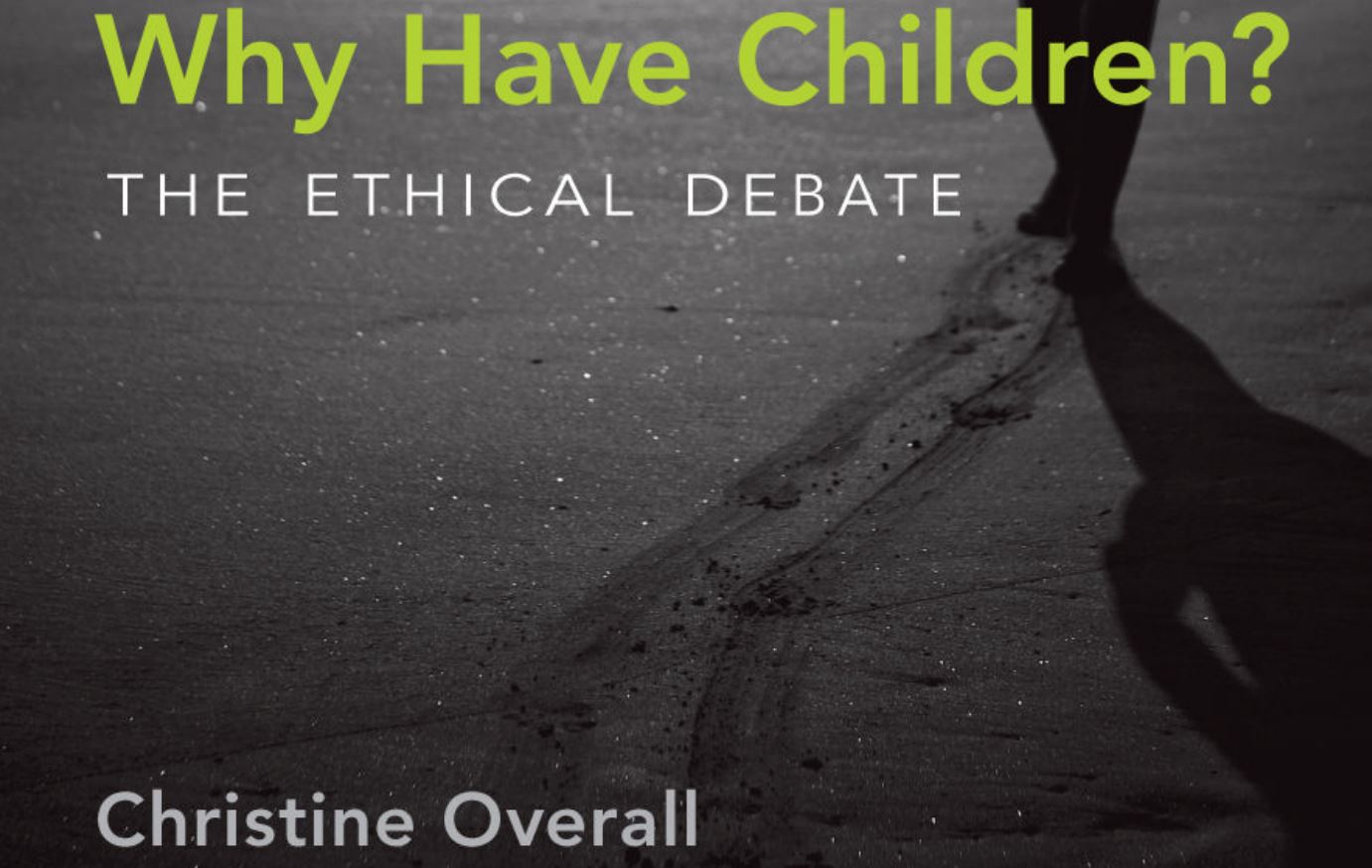
In chapter six of the book Why Have Children? The Ethical Debate, the author, Christine Overall, offers four criticisms of David Benatar’s Better Never to Have Been. Three of which show, according to her, why Benatar’s arguments are fatally flawed and that he therefore does not succeed in establishing a strong argument against all procreation, and one criticism demonstrates the potentially dangerous consequences of accepting his theory.
In this post I’ll try to show why all of her criticisms are fatally flawed and that she therefore does not succeed in establishing a strong argument against antinatalism. The motivation is not because I agree with all of Benatar’s arguments for antinatalism (I don’t and I’ve addressed several of them here, here, here, here, here and here), but because I disagree with her objections.
Criticism 1
In her first criticism, Overall accepts, for the sake of argument, Benatar’s assumption that it is legitimate to ascribe value to the absence of good or bad, even without any sentient being to experience the absence. What she doesn’t accept is Benatar’s asymmetrical claim – the absence of bad things, such as pain, is good even if there is nobody to enjoy that good, whereas the absence of good things, such as pleasure, is bad only if there is somebody who is deprived of these good things. She thinks that the absence of good things is also at least sometimes bad, even if there is nobody who is deprived of those good things.
This criticism shouldn’t be mistaken as identical to the one I have elaborated about in the post regarding Benatar’s asymmetrical claim. Overall doesn’t criticize Benatar for using a double standard, one for pain and another for pleasures when it comes to non-existence. Her criticism is regarding the claim that the absence of pleasure is not bad if there is no one who is deprived of it. So on the face of it, if Benatar had used the same standard for pain, she would still have a disagreement with him. Her problem is not Benatar’s double standard but his standard for pleasure in non-existence.
And she suggests refuting his claim that the absence of pleasure is not bad unless there is someone to whom it is a deprivation by the following thought experiment:
“Imagine a nation of ten million people. Five million of them suffer from chronic illness and experience great and unremitting pain. The other five million are free of chronic illness and are able to experience happiness and fulfillment. One of God’s angels appeals to God and says, “Surely the suffering of five million of these people is too great. Can you not do something about it?” God agrees. “I will roll back time,” says God, “and fix these five million people so that they do not suffer from chronic illness and pain.” Time is rolled back, the unfortunate five million are re-created, but this time without their original vulnerability to chronic illness and pain. Like the originally happy 50 percent, they, too, are now capable of happiness and fulfillment, and the angel is pleased.
But after the angel appeals to God, God might alternatively say, “I see that these five million people are suffering. I will roll back time and change things so that this entire nation of individuals, all ten million of them, will not exist. That way, the suffering of five million does not exist.” Time is rolled back, the nation of people no longer exists, and so a fortiori there is no chronic illness or pain and no suffering whatsoever.
I suggest that in this second scenario the angel would be justified in being appalled by God’s actions. The nonexistence of the good of the happy and fulfilled five million is far too high a price to pay for the absence of bad of the suffering five million. What the thought experiment shows is that, contrary to Benatar’s claim, the absence of good can be bad, not “not bad.” The angel is correct to regret God’s failure to re-create the five million happy people; mere indifference on the angel’s part would be inappropriate.
I think another important point can be made if we imagine that God responds to the angel’s horror by trying another approach. Once again, then, God rolls back time, but this time he re-creates the nation with only the original happy five million in existence. The suffering five million do not exist. But once again the angel is, I predict, disappointed, for the angel believes correctly that with respect to most lives nonexistence is usually too high a price to pay for the avoidance of pain.” (p.98)
I fail to see how this thought experiment refutes the claim that the absence of pleasure is not bad if there is no one for whom this absence is a deprivation. How can the angle’s disappointment somehow prove that the absence of pleasures of the 5 million people had they never existed under one of the scenarios, deprives them of anything?
Her angle’s disappointment is a reflection of her preference, not a proof of her claims. It doesn’t explain why a world in which there is suffering as well as pleasures is better than a world in which there is no suffering and no pleasures, but simply repeat her preference. How does it prove anything? To refute Benatar, Overall needs to prove that the absence of pleasure is bad even if there is no one who is deprived of that absence. Inventing an angel that is disappointed of god doesn’t provide any evidence for this claim. It is just her opinion hidden behind an invented angel, in a ridiculous hope that it can somehow strengthen her claim.
All this thought experiment shows is that she (represented by the angel she invented) thinks that it is preferable that people would suffer but also enjoy themselves, but we knew that before the thought experiment which doesn’t add anything to the claim but a sensational scenery.
Furthermore, I don’t think there is any justification for the angel’s appalled reactions. If anything s/he can feel that it is a shame that god didn’t choose to bestow happiness despite that he could have, but there is nothing appalling in a scenario where no one experience anything bad. No reason to be appalled by not choosing an allegedly good option (according to the angel) over an option in which no one is harmed by anything.
The angel shouldn’t be disappointed since there is no price to pay for the avoidance of pain, let alone a price too high. The whole point of Benatar’s claim is that there is no harm in non-existence, so simply arguing that there is a harm – evidently the angle is disappointed – is not a refute of his claims. It is just saying the opposite with no serious counterarguments but that the angel she invented begs to differ.
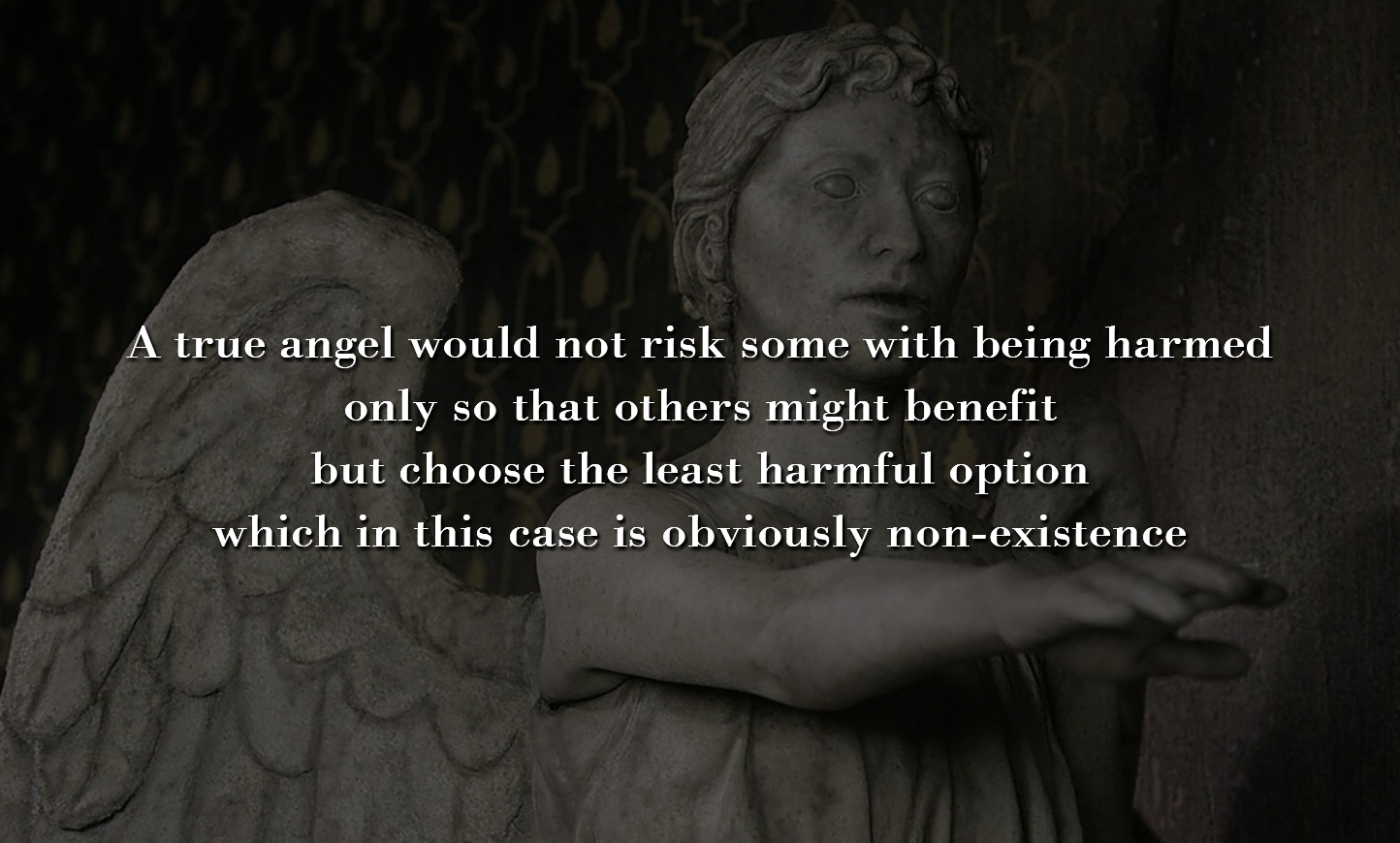
It is the angel of her creation which is appalled and disappointed, others’ angles may react differently. A true angel would not risk some with being harmed only so that others might benefit, but choose the least harmful option which in this case is obviously non-existence.
In my view her angel is actually a demon since s/he prefers that 5 million people would suffer, all the more so great and unremitting pain, over that they would never be forced to ever experience anything negative and won’t ever be deprived of experiencing anything positive. To be disappointed with a scenario in which no one suffers any pain and any deprivation of anything good, and to prefer over it a scenario in which half of the population is suffering, is cruel.

Later in Criticism 1, Overall suggests that we must as opposed to Benatar’s claims deal with potential harms by preventing them, not by preventing the existence of people who might or do suffer them. And she gives several examples to prove her point. One of them is that “It would be bad if the person who holds job X experiences sexual harassment or racial bias.” But the way to deal with it, according to her, is to ensure (as far as possible) that sexual harassment and racial bias do not occur to the person who eventually wins job X. “We don’t deal with the situation by refusing to fill the position or by abolishing the job altogether. That is, we do not decide to prevent the potential suffering by not bringing “the person who holds job X” into existence.” (p.101)
First of all, refusing to fill the position or abolishing the job altogether are not options compatible with non-existence, since if this job exists it implies that it is necessary or at least desired by at least some people, so not filling it or abolishing it altogether would harm them in some way. But no one has to exist, and no one is harmed by not existing. Before anyone exist, they don’t want anything, including not to exist, and so are not harmed by not existing. That is a very crucial point in Benatar’s claims which Overall chooses to ignore whenever it suits her.
In addition, the example she gives is quite manipulative because the injustice of sexual harassment or racial bias directs our intuitions to fight it instead of allegedly give up and let injustices win. This is far from being the point, and more importantly far from being a generic representative of the harms of life which not all of them are social injustices. This example doesn’t work in the case of non-detected inborn diseases which are not a result of social injustice. Even if we assume that sexual harassment and racial biases can be totally eradicated, some harms of life can never be. Sexual harassment and racial bias are unfairness examples that should be fought against, chronic pain, disappointments, aging and death are unfairness examples that it is impossible to fight against, and impossible to avoid.
Another example she displays is:
“It would be bad if students who take Philosophy 204 go through the pain of failing the course. So we never offer Philosophy 204 to students. Since pain and suffering are possible in any role or position we might take on, by parity of reasoning Benatar’s theory means that we should never create any new roles or positions or at least never fill them. Any theory with implications that broad is surely mistaken.” (p.101)
Again, like in the case of job X, never offering Philosophy 204 to students is not compatible with non-existence, since as opposed to non-existence which can’t deprive anything from anyone who doesn’t exist, preventing something from existing people who do want that something, does deprive them and so harms them.
Another false move Overall is making is presenting Benatar’s theory as if it is about avoiding risks. However, despite that he does mention and support risk aversion, this is not his main claim. His main argument is not that the risk of harm in forcing someone into existence is too big, but that harming is a fact. He doesn’t try to avoid a risk of harm which is too big, but to prevent any harm. That claim might be debatable even among antintalists (as opposed to the risk claim which I think is non-debatable), but at least it is truly his claim, and so the one Overall should have addressed.
But perhaps more importantly for that matter, generally speaking, the claim that “any theory with implications that broad is surely mistaken” is quite disappointing. A theory cannot be judged by whether its implications are too broad for people. When most of humanity were extremely racist and pro-slavery, egalitarian theories weren’t less right than they are today, despite that they were viewed as extremely broad and so, according to Overall, surly mistaken. Same goes for feminist views or animal rights views. The moral status of animals can’t be derived from whether people find the vegan diet as a too broad implication. Animals moral consideration must be derived from their own traits, not from peoples’ willingness to accept the implications of the theory. Suggesting otherwise is a reversal of the logical order of things. Moral theories must dictate the behavior not the other way around.
Another illustration of the supposed absurdity in Benatar’s claims Overall mentions, is of one of her undergraduate students who suggests the following analogy:
“Before you is a person with a bag full of jellybeans. The jellybeans come in two flavours: cherry-red, which you love; and black licorice, which you hate. . . . You are unaware of the proportion and size of the jellybeans because the bag is opaque. The person gives you the following choice: you may reach for a handful of jellybeans or not. If you choose to reach for the jellybeans, you must eat them. Would you be better or worse off having chosen to take a handful?
Each jellybean represents an experience, either harmful or beneficial, and that taking the handful represents coming into existence. Every handful will have at least one black jellybean in it, which represents one’s death, and most likely many more, representing all the various instances of suffering that we experience in a lifetime. From Benatar’s point of view, we should never take a handful because we will always be forced to eat at least one black one, which is bad, but if we refuse to take a handful at all, we will avoid the black ones altogether. Benatar’s advice to a putative jellybean eater would be, “Do not reach for the jellybeans.”” (p.101)
First of all, this thought experiment is a bad analogy to pre-existence scenario since it forces us to think as existing persons who allegedly choose whether to experience life or not, despite that it is actually impossible. The source for this confusion is derived from how hard it is to imagine non-existence as a preferable position. Most people find it hard not to imagine non-existence as something bad, as a deprivation, as some sort of mental prison, a state in which their consciousness floats outside of existence or something of this sort. Non-existence is not only a state they find hard to imagine, it is not a state at all. People can’t put themselves in such a position because it literally doesn’t exist. Non-existence is not a comparable state with existence. So they imagine other states in which they would be deprived of everything they experienced during their existence. Despite that this is not the case, this is the intuition of many. Non-existence is not an existential alternative for a bad life therefore prioritization in this case is irrelevant. It is irrelevant to ask someone if they rather exist or not since there is no option of non-existence for that someone.
The analogy is false since when someone chooses not to take a handful s/he feels that s/he might be missing something. But non-existing people don’t feel anything.
If anything, this analogy is only relevant in cases of people having suicidal thoughts, weighing the benefits and harms of existence in order to make a decision.
However, if I’ll accept the analogy for the sake of the argument, Benatar would probably argue that non-existence is preferable since there is no way to avoid the black jellybean taking a handful, and there would be no deprivation of the cherry-red jellybean when not taking a handful. His claim is not statistical and so statistical analogies don’t refute his claims. Even if the ratio between black and cherry-red jellybeans was highly in favor of the cherry-red, this is not relevant in Benatar’s view since in non-existence one doesn’t miss the cherry-red and is not forced to eat the black. So non-existence is always an advantage over existence in which one may have plenty of cherry-red jellybeans or only a few, but certainly some black ones.
Having said that, besides being false I think there is something very manipulative and degrading in this analogy. Suffering in life is not like eating a detested jellybean. For many it is a living nightmare. If we are asked to imagine not jellybeans but favorite food, favorite music, beautiful sunset, an orgasm, career satisfaction and etc. instead of the cherry-red jellybeans, and clinical depression, loneliness, broken hurt, car accident, death of loved ones, cerebral palsy and etc. instead of the black jellybeans would it still seem as a highly risk-averse outlook on the side of Benatar? It is much easier to claim that it makes more sense to take a handful of a bag full of jellybeans risking that some would be disgusting, but it seems a whole different scenario to take a handful of a bag where you can draw brain cancer or rape.

Another very important issue is missing from this analogy, and that is the price paid for each jellybean. Behind each jellybean there are many creatures who suffered for the creation of that jellybean. So for other creatures every jellybean, particularly the cherry-red, are actually pitch black.
Criticism 2
In her first criticism Overall assumed, along with Benatar, that the absence of bad things and the absence of good things can have value, whether positive or negative, even in the absence of anyone experiencing the absence. But that was for the sake of the argument. Like many others, she thinks that Benatar’s claim that the absence of pain is good, even if that good is not enjoyed by anyone, is false since he ascribes interests to non-existent persons. I’ve thoroughly addressed this issue in the post regarding Benatar’s asymmetry argument so I’ll make do with a shorter response to Overall’s claim.
Many people have difficulty making sense of the idea that never existing can be better for a person who never exists, because there is no subject for whom never existing could be a benefit. In other words, they wonder how can the absence of pain be good, if there is no one for whom it would be good? For something to be good, it needs to be good for someone, and in non-existence there is no someone.
I obviously agree with the common objection that the non-existent can’t be benefited. However, Benatar doesn’t necessarily attribute interests to non-existent persons, at least not in a literal sense. Here is an explanation in his own words taken from Better Never to Have Been:
“Now it might be asked how the absence of pain could be good if that good is not enjoyed by anybody. Absent pain, it might be said, cannot be good for anybody, if nobody exists for whom it can be good.
The judgement made in 3 (the absence of pain is good, even if that good is not enjoyed by anyone) is made with reference to the (potential) interests of a person who either does or does not exist. To this it might be objected that because (3) is part of the scenario under which this person never exists, (3) cannot say anything about an existing person. This objection would be mistaken because (3) can say something about a counterfactual case in which a person who does actually exist never did exist. Of the pain of an existing person, (3) says that the absence of this pain would have been good even if this could only have been achieved by the absence of the person who now suffers it. In other words, judged in terms of the interests of a person who now exists, the absence of the pain would have been good even though this person would then not have existed. Consider next what (3) says of the absent pain of one who never exists—of pain, the absence of which is ensured by not making a potential person actual. Claim (3) says that this absence is good when judged in terms of the interests of the person who would otherwise have existed. We may not know who that person would have been, but we can still say that whoever that person would have been, the avoidance of his or her pains is good when judged in terms of his or her potential interests. If there is any (obviously loose) sense in which the absent pain is good for the person who could have existed but does not exist, this is it. Clearly (3) does not entail the absurd literal claim that there is some actual person for whom the absent pain is good.” (p.30)
And another one taken from a later article called Still Better Never to Have Been: A Reply to (More of) My Critics:
“Now it is obviously the case that if somebody never comes into existence there is no actual person who is thereby benefited. However, we can still claim that it is better for a person that he never exist, on condition that we understand that locution as a shorthand for a more complex idea. That more complex idea is this: We are comparing two possible worlds—one in which a person exists and one in which he does not. One way in which we can judge which of these possible worlds is better, is with reference to the interests of the person who exists in one (and only one) of these two possible worlds. Obviously those interests only exist in the possible world in which the person exists, but this does not preclude our making judgments about the value of an alternative possible world, and doing so with reference to the interests of the person in the possible world in which he does exist. Thus, we can claim of somebody who exists that it would have been better for him if he had never existed. If somebody does not exist, we can state of him that had he existed, it would have been better for him if he had never existed. In each case we are claiming something about somebody who exists in one of two alternative possible worlds.
When we claim that we avoid bringing a suffering child into existence for that child’s sake, we do not literally mean that nonexistent people have a sake. Instead, it is shorthand for stating that when we compare two possible worlds and we judge the matter in terms of the interests of the person who exists in one but not the other of these worlds, we judge the world in which he does not exist to be better.” (p.125-126)
Nevertheless, there is a crucial problem with Benatar’s asymmetry, but not the one Overall and many others refer to. The main problem is not that the absence of pain is good, even if that good is not enjoyed by anyone, nor that the absence of pleasure is not bad unless there is somebody for whom this absence is a deprivation, but that in the same world, the one in which the person doesn’t exist, when it comes to the absence of pain the person is treated as if s/he exists (otherwise the absence of pain can’t be good for him/her) but when it comes to the absence of pleasures s/he is treated as if s/he doesn’t exist (otherwise the absence of pleasures would be bad for him/her, and the only reason it isn’t is because the non-existent is not deprived of pleasures). In other words, the claim that the absence of pain is good, even if that good is not enjoyed by anyone, is a counterfactual claim (statement which expresses what could or would happen under different circumstances). Meaning, if that person were to exist pain would be bad for that person. However, he doesn’t use the same standard when it comes to the absence of pleasures. If pain would be bad if someone would exist in quadrant 3 of his famous formulation than how come pleasure wouldn’t be good if that person would exist in quadrant 4? Just as pain would be bad for person X if existed, pleasure would be good if person X existed. Just as the non-existents are not in a position to miss any pleasure, they are also not in a position to be relieved of not experiencing any pain. Since his argument is counterfactual, the absence of pleasure should be valued as bad for the non-existent, just as the absence of pain is valued as good for the non-existent.
Had Benatar been consistent regarding counterfactuality, I think there was no problem stating that the absence of pain is good even if that good is not enjoyed by anyone, however, then he obviously couldn’t have claimed that the absence of pleasure is not bad unless there is somebody for whom this absence is a deprivation, but would have to claim that the absence of pleasure is bad even if there is nobody who is deprived of this pleasure. And then of course there is no asymmetry but symmetry and the whole point of his argument would obviously be lost. However my point here wasn’t to prove that Benatar’s asymmetry argument is valid, but that the main problem with it is not that he ascribes interests to non-existing people, but that he ascribes two different categories to the two quadrants (quadrant 3 and 4) which are on the same column (and so should have been treated the same in a categorical sense).
So Benatar’s asymmetry argument is invalid, but not for the reasons Overall presents.
Criticism 3
Overall’s third criticism regards Benatar’s Quality of Life Argument. Like many of his other critics she wonders how can it be a harm to come into existence if most of those who have come into existence are pleased that they did?
Benatar’s answer is that their self-assessments are completely unreliable indicators of life’s quality, mainly due to a number of psychological features which distort their ability to make objective assessments of the actual quality of life and constitute instead a fallacious positive assessment. Benatar mentions three main mechanisms, which are The Pollyanna Principle,
Adaptation, and Comparison with Others. I have referred to and briefly explained each in the post regarding his Quality of Life Argument, so there is no point in doing it again here. To better understand how come most people don’t say it would be better had they not existed, it is recommended to read it first.
Bedsides these three psychological features which distort the ability to make objective assessments of the actual quality of life, another important factor in affecting people’s perceptions is that, as earlier mentioned, it is hard to imagine non-existence. Not that it should be a required part of making life assessments, but it seems that Benatar’s argument, that life is much worse than people think it is and therefore being forced into existence is a very serious harm, necessitates that people would think that their lives are not worth living. Many people tend to confuse the claim that it is better never to have been, with the claim that their lives are better not to continue, despite that these are totally different claims. Moreover, most people find it hard not to imagine losing what they have experienced if their lives had never started, and so they think that it is better that they have been born, though clearly this is not what would have happened had they never existed. Obviously they wouldn’t lose anything because they wouldn’t be in the first place. The fact that it is hard to process that thought, along with The Pollyanna Principle, Adaptation, and Comparison with Others, also cause many people to prefer existence, no matter how hard and painful their lives are, over the falsely perceived unknown and scariness of non-existence.
People think it is better to live hard lives than missing them, even though they won’t miss a thing had they never had a life. Nobody is harmed by a great life that nobody lived. But someone is definitely harmed by living a horrible life.
Overall is aware of Benatar’s explanations, yet is highly critical of his supposedly pretension when evaluating other people’s lives. But Benatar’s main concern and motivation is not the inaccuracy of the assessment of other peoples’ own lives, but rather the inaccuracy of people’s general assessment of life since the main problem with the falsehood of the assessment is its ethical implication – if people think that life is much better than it actually is, it would be much harder to convince them not to force new people into existence. The motivation behind the claim that life is far from being as good as people tend to think it is, is not to outsmart people, or to depress them, but to prove them wrong about the chances that their children would have good lives.
But even if Benatar was truly wrong in claiming that life is much worse than people tend to think, still, each bad moment happening in life is totally unnecessary. Every pain, every sickness, every fear, every frustration, every helplessness, every regret, every broken-heartedness, every moment of boredom and etc., are all needless. They exist only because the person experiencing them exists. They exist because the parents of that person have forced existence on that person, and that person existence on others. There is no good reason for that to happen. Every problem could have been easily prevented instead of being difficultly solved, if solved at all. People exist because they were chosen to exist by other people, not because it is necessary in any way. People can choose whether to create a sentient creature who would necessarily suffer, and they choose that it would. They choose that that person would experience pain, frustration, fear, boredom, death and the fear of dying for most of its life, they choose it would get disappointed, sick, rejected, and humiliated.
Yes, that person may enjoy parts of life too, but that is not mandatory, while it is mandatory that this short list of bad things will happen at some point, at least once in that person life. Pleasure is optional, happiness hardly is, and suffering is inevitable. Why would anyone willingly force a sentient creature into this condition?

The fact that people who are living horrible lives still don’t think they were better never to have been, is not an indication that life is not that horrible, but exactly the opposite. It goes to show how deeply trapped humans are in the life mechanism. People are victims not only of their biology but also of their psychology. They would adapt and adjust themselves and their expectations according to how bad the lives they are forced to endure are. Low expectation, adaptation ability, and the fact that everyone else’s lives is not much better, can’t justify bad situations which shouldn’t have been created in the first place.
But an even sadder fact is that humans are not really looking for justifications to procreate. Most just do. They don’t even really need mechanisms to sooth their worries about the future of their children, because as inevitable as it is that bad things would happen to their children, it rarely crosses their minds. Unfortunately people are that apathetic to the fate of others, even when it comes to their future children, and definitely when it comes to the rest of the victims of procreation.
Criticism 4
Overall’s last criticism is not intended to show that Benatar’s theory is mistaken, but to show the possible negative effects and implications, for women in particular, if Benatar’s theory is accepted and widely adopted. She writes:
“Benatar is surprisingly oblivious to the implications of his theory for women’s rights and well-being. Most of his discussion of procreation is curiously gender neutral. At the same time, his theory implies that women’s reproductive labor produces bad consequences. That is, the idea that it is better in every case never to have been implies that women’s reproductive labor in pregnancy, birth, breastfeeding, and even rearing children contributes to the accumulation of net harm on this planet.
It’s unlikely that downgrading procreation in this way would do much for the status of women, particularly in societies where women’s status is dependent primarily on their role as childbearers. If Benatar’s theory were to gain credence (unlikely though that may be), then one of women’s primary social contributions, recognized even (or especially) in the most misogynist societies, would be seen as a liability. Might this view lead to an increase in the infanticide of girls or to assaults on pregnant women?” (p.115)
That is a very strange claim coming from a feminist such as Overall, since it implies, or at least accepts the anti-feminist view that women are first and foremost reproduction machines, then breast-feeding machines and then mothers. How have women, whose particular interests and perspectives were rightly mentioned all along the book, been reduced to walking uteruses when she wants to criticize Benatar?
Ironically it is Overall who treats women as if procreation is their role in life. She and not Benatar is the one that turns women into mothers and nothing else.
There is no doubt that women carry most of the burden when it comes to children. They carry all the burden of pregnancy, birth, breastfeeding, and most of the burden of child rearing. However, Benatar’s claims in no way focus on these aspects of procreation but on the decision to procreate. Antinatalism, and I think it is safe to say Benatar’s version included, is about the decision to create a new person, about the harm of being forced into existence, not the harm of giving birth or breastfeeding.
Benatar’s claims are against the decision to create a new person so claiming that there is something misogynic about his claims means that it is only women’s decision whether to procreate or not. That is not a very feminist claim since it implies that it is women who always want children. As far as I am concerned the decision to procreate is under the full responsibility of the parents. Whether it is a woman and a man, two women, two men, or one woman or one man. Antinatalism is against the decision to create new persons no matter who makes this horrible decision, not against women because they are the ones who get pregnant. Antinatalism is not about the technical procedure, but about the ethical one.
So Benatar’s claims are rightly gender neutral since the decision to create a new person is usually a decision of the parents, which is usually a woman and a man. The only cases in which procreation is truly not gender neutral, are when only one of the parents pushes for creating a new person. But even in these cases it is not necessarily the woman, and even if it was, the man is by no means exempted from the moral responsibility of making a wrong decision.
When it came to sexual harassment and racial bias in job X she argued that “the way to deal with it is to ensure (as far as possible) that sexual harassment and racial bias do not occur to the person who eventually wins job X. We don’t deal with the situation by refusing to fill the position or by abolishing the job altogether”. How come the same line of thought doesn’t apply in the case of societies where women’s status is dependent primarily on their role as childbearers? Why not ensure that these misogynist societies would stop treating women as if their status is dependent primarily on their role as childbearers? How come she all of a sudden suggests submitting to this suppression, all the more so manipulatively using it to criticize Benatar?
How does it make sense to accept the existence of the most misogynist societies in the world, but not to accept antinatalism’s conclusions? How can she justify submitting to the harsh rules of misogynist societies, and ignoring the sacrifice of millions of people and billions of animals who would be forced to live horrible lives?
If anything, the fact that many women around the world don’t even have a say regarding procreation – they must breed whether they want to or not – is not a reason to accept their procreation coercion, but a reason to accept the coercion of the sterilization of everyone, since then no women could ever again be forced to create new persons, no matter how bad the men in their lives want them to.
Although this is not my main motive, it certainly is another very important benefit of the idea of forced sterilization.
References
Benatar, D. Better Never to Have Been (Oxford: Oxford University Press, 2006)
Benatar, D. Every Conceivable Harm: A Further Defence of Anti-Natalism
S. Afr. Journal Philos., 31 (2012)
Benatar, D. Grim news for an unoriginal position Journal of Med Ethics 35 (2009)
Benatar, D. Still Better Never to Have Been: A Reply to (More of) My Critics
Journal of Ethics (2013)
Bradley, B Benatar And The Logic Of Betterness Journal of Ethics & Social Philosophy (2010)
Cabrera Julio, A Critique of Affirmative Morality: a reflection on death, birth and the value of life
(Brasília: Julio Cabrera Editions 2014)
Harman, E. Critical study of Benatar (2006). Nouˆs 43: 776–785.
Parfit, D. Reasons and Persons (Oxford: Clarendon Press 1984)
Shiffrin, S.V. Wrongful life, procreative responsibility, and the significance of harm. 1999
Legal Theory 5: 117–148
Overall Christine, Why Have Children? : The Ethical Debate (The MIT Press 2012)